Tom Michels began with the sort of ambition that rarely requires a business plan: he wanted to book an appointment without making a telephone call. A haircut seemed a reasonable thing to arrange online. The people holding the scissors, it turned out, had rather more to organise than his diary.
He and his future co-founders were outsiders to the salon trade. Their initial advantage was a familiar irritation; their first useful decision was to acknowledge how little they knew. They went to speak to salon owners. The conversations changed what they were building. An appointment button was an entrance into a business whose daily work extended well beyond getting somebody through the door.
That widening of the question has shaped Michels’s career. He is the Luxembourg-based co-founder and CEO of Salonkee, a company that launched commercially in March 2017. By April 2026, its platform served more than 10,000 European salons. Along the way, the software acquired payments, inventory, marketing and a wholesale shop. The original appointment had developed a considerable entourage.
There is a temptation, with a number like 10,000, to start at the funding announcement and work backwards. Michels’s story becomes more interesting when it begins before anyone had much to announce. There were doors to knock on, owners to persuade and a product whose boundaries were still being negotiated by the people expected to use it.
Student budgets, working software
Michels studied business informatics at Saarland University, completing his master’s studies in the period before Salonkee’s launch. The idea took shape in 2016. The team could still live on the modest budgets they knew from university, and they put that flexibility to work. During the day they visited salons; at night they coded. For almost a year, their principal investment was their own labour.
His recollection of those beginnings is practical: “You don't invest money; you invest time to see if your idea actually works.” It is advice with an awkward requirement attached. Somebody has to leave the laptop, meet a potential customer and hear an answer that may be less encouraging than the one imagined at home.
They kept going as the customers arrived one at a time. Michels later recalled roughly 80 customers around the end of 2018, before the €1 million seed round announced in January 2019. That modest early count is useful context for the larger figures that followed. It took time to establish that salon owners would entrust part of their working day to the software.
The seed investment, led by Expon Capital’s Digital Tech Fund with private investors participating, gave the company room to recruit and expand. Salonkee had also graduated from Luxinnovation’s Fit4Start programme in 2018. What began as a group testing an idea was acquiring the obligations of an employer. A salary bill is an effective cure for treating a company as an interesting evening project.

The calendar had other appointments
A salon diary looks simple until someone explains the work inside it. A straightforward haircut may occupy one continuous block. Another service can involve pauses, different staff members and opportunities to serve someone else in between. Online availability has to reflect those details. Otherwise, the elegant booking screen merely schedules an argument for later.
Michels came to regard the early focus on bookings alone as too narrow. Owners needed a system that could handle the rest of the business too. Adding checkout, stock records, customer communication and reporting expanded the job considerably. It also gave the company more reasons to remain part of a salon’s routine after the novelty of online booking had worn off.
The work included teaching people to use what had been built. Salonkee’s approach involved visiting salons and training teams, rather than assuming that sending a login would settle the matter. A new calendar affects everybody sharing it. The person demonstrating the software has to make sense to someone whose next customer may already be waiting.
That helps explain why Michels keeps returning to conversations with customers. They offer a check on the company’s assumptions. They also make expansion demanding: a feature that sounds straightforward in a development meeting still has to work inside an unfamiliar salon, in another language, during an ordinary busy day.
- 01BookCalendar + availability
- 02RunPayments + stock + clients
- 03RestockWholesale ordering
Five people share the scissors
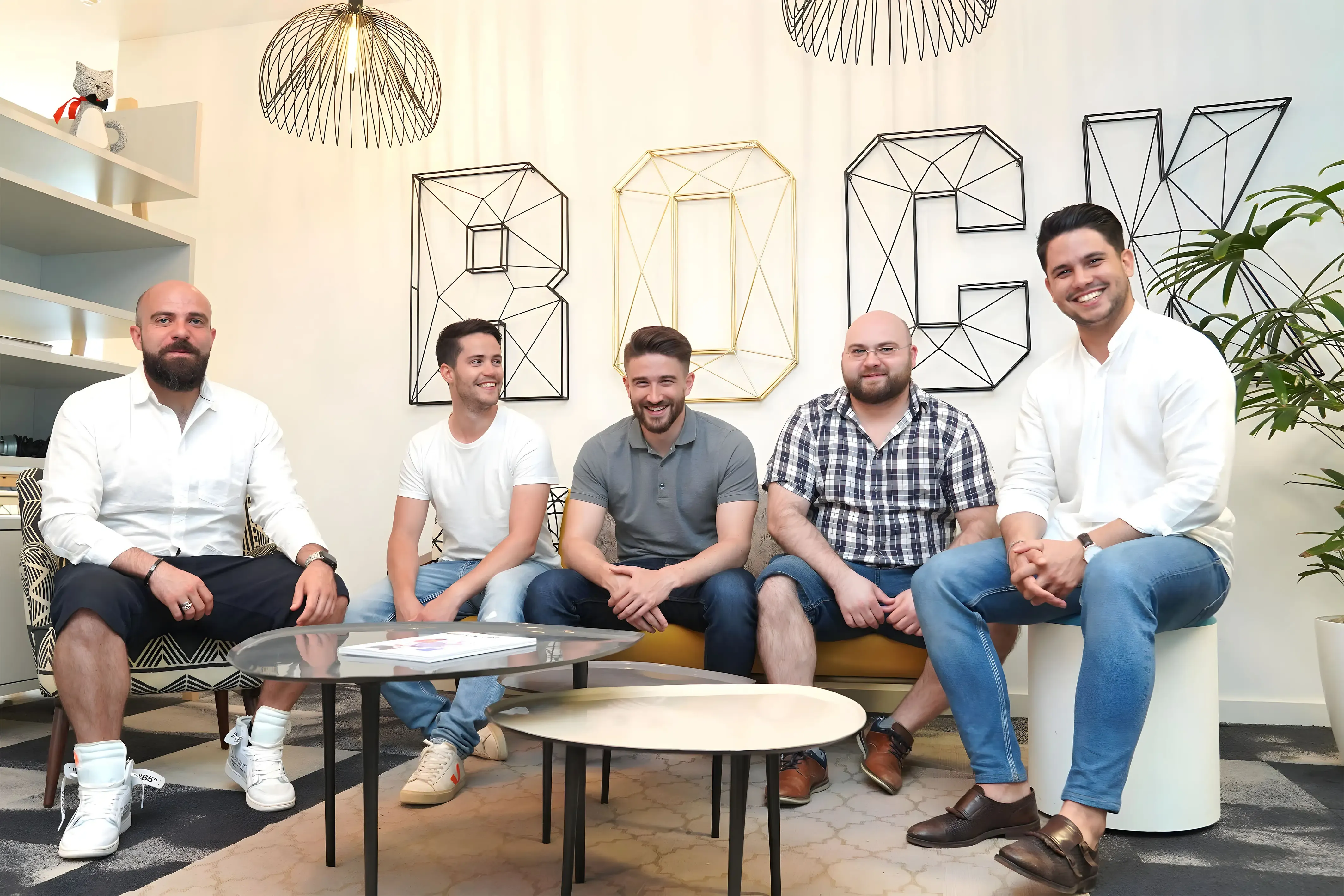
The founding team consists of Michels, André Stehle, Alexandre J. Claro, Samuel Faber and Gilberto Fernandes. Their responsibilities span technology, sales, finance and people as well as Michels’s role as CEO. In his account, their differing expertise made the venture easier to build than it would have been alone. The company’s history has five authors, even when only one is answering the questions.
Public recognition came early enough to catch the business in its smaller years. In November 2020, Michels won Luxembourg’s Creative Young Entrepreneur competition, organised by JCI Luxembourg. He was 29. The award recognised an entrepreneur whose product was already moving beyond its home market, while the more complicated work of building an organisation continued.
His public updates give that work a less ceremonial face. He has celebrated bringing colleagues from different countries together for a company event, and marked the arrival of new sales staff. Recruiting is visible in his version of the story because the product reaches customers through people. A sales team supplies demonstrations, explanations and a route back to the developers.
There is also an endearing piece of company archaeology. When sharing a later Salonkee video, Michels pointed readers back to the 2017 launch film. The budget had been effectively absent, he recalled, and the performers were founders and supportive friends. Before a company can hire a cast, it may have to check which co-founder is free that afternoon.
Capital meets the salon floor
Salonkee raised €6.2 million in a Series A round co-led by Fortino Capital and Newion in 2021. At that stage, it reported more than 1,200 salons and over five million appointments handled. In June 2023 came a €28 million Series B led by PeakSpan Capital, with existing investors participating. Those are financing amounts, separate from the company’s sales or Michels’s personal wealth.
Money made a wider European push possible. It also put more weight on a question Michels had been asking since the early visits: would the product keep the customers it won? He put it bluntly in 2023: “If you have a good retention rate in SaaS you can only grow.” The attention to retention matters because every departure makes the next sales target harder to reach.
The investors’ involvement has included work that rarely earns a launch party. PeakSpan describes helping Salonkee review and renegotiate payment-processing vendor terms. Integrated payments are a product feature; the economics underneath them also depend on contracts. Michels’s job now includes both the visible promise to the salon and the less visible arrangements that help support it.
The change of scale is apparent in his 2024 figures. Salonkee had about 200 employees, and a sales force of 100 was delivering more than 1,500 demonstrations a month. Michels said the company was then adding around 400 customers monthly. Read beside the first 80, the figures show how much the distribution operation had changed. They describe that moment, rather than a permanent monthly rate.
A small country with a useful habit
Luxembourg has remained central to Michels’s plans. He has described growing up in a multilingual setting and the usefulness of German, French, English and Luxembourgish when a business starts crossing borders. A small domestic market also encourages an early question: where do we go next? Abroad enters the plan before it can become a distant ambition.
By June 2024, Salonkee had added Austria to Luxembourg, Belgium, Switzerland, Germany and the Netherlands. Roughly half its employees were then based in the Grand Duchy. Headquarters could concentrate skills while sales colleagues worked in the markets where customers lived. International expansion still required local encounters, even when much of the organisation stayed together.
Michels summarised the attraction in 2026: “From Luxembourg, you can serve multiple countries.” That arrangement allows the company to support several languages from one base while maintaining salespeople on the ground. A map of Europe makes the distances look manageable. A conversation with an owner explains why physical proximity and a shared language still deserve a place in the budget.
His view of hiring is similarly tied to the work ahead. He has argued for investing in technical education and building links between companies, schools and communities. Finding developers for a growing company is an immediate task; helping a country develop more technical talent is a longer one. He has made room for both in his public discussion of growth.
“From Luxembourg, you can serve multiple countries.”
Tom Michels · April 2026
The next order is for shampoo
The latest extension follows the same habit of pursuing the work around the appointment. In the fourth quarter of 2025, Salonkee introduced a business-to-business shop. Salon owners could reorder products, tools and equipment through wholesale partners, with purchasing connected to the platform’s point-of-sale and inventory systems. Software that already knows about stock has an obvious reason to be present when somebody orders more.
By April 2026, the company had passed 10,000 European salons. Michels was looking at the supply shop as another area for growth while continuing to pursue a larger position in Germany. The ambition remains substantial, but the daily questions are recognisable: which products are needed, which customers should return, and how can another task take fewer separate steps?
His advice to younger would-be founders remains connected to the resources he had at the beginning. Starting early can offer time to test an idea before obligations accumulate. His own example involved spending that time with customers and building something they could try. The encouraging part is the permission to begin. The less glamorous part is the work that begins immediately afterwards.
Michels’s story has room for both the €28 million announcement and the founders acting in their own launch video. Each belongs to a different stage of making the same proposition credible. A haircut prompted the question. Salon owners kept expanding the answer. His job is to keep the growing company close enough to those owners that it can still hear what they ask next.
European salons using Salonkee