On March 5, 2008, Tom Freedman stood before a Brookings audience with a small problem of presentation. He had worked in Bill Clinton’s White House. His collaborator, John Bridgeland, had worked in George W. Bush’s. Freedman suggested their appearances together deserved the musical accompaniment of The Odd Couple. It was a good opening for a morning devoted to poverty and economic opportunity: acknowledge the awkward pairing, then get on with the work.
The audience had been watching presidential primary returns the night before. Freedman teased them about their political hangover, then turned to a study of newspaper coverage. He and Bridgeland had examined how poverty figured in the campaign conversation. More attention created an opening, he argued, but attention alone would accomplish little. The next administration needed ideas it could actually use.
That distinction makes a useful entrance to Freedman’s career. Elections reward the ability to make a difference sound urgent. Governing adds the less theatrical problem of persuading several institutions to do something about it. He has spent time on both sides of that divide. The recurring question in his work is practical: once people agree that something matters, what gets them moving?
“the Odd Couple music going in the background”
Tom Freedman · Brookings · March 2008
A career measured in folders
Freedman’s Washington apprenticeship included work as press secretary and then legislative director for Charles E. Schumer, when Schumer served in the House of Representatives. The sequence matters. Explaining a position and developing one are related jobs, but they place different demands on a person. A sentence has to survive the press conference. A policy has to survive what happens afterward.
In Clinton’s administration, Freedman served as special assistant to the president for policy planning and later as a senior adviser. During the 1996 reelection campaign, he was chief of staff for strategy, helping develop the policy and communications plan for Clinton and Al Gore. These were assignments close to the machinery that converts a candidate’s preferences into an argument the country can understand.
The paper trail is considerable. His collection at the Clinton Presidential Library runs to 929 folders, approximately 36,039 pages. Its subjects include education, child care, fair housing, privacy and the wage gap. Articles sit alongside correspondence, drafts, memoranda, speeches and talking points. An adviser’s legacy can look remarkably like a very ambitious filing cabinet.
Before those assignments came Carleton College, where he graduated with honors, and the University of California at Berkeley, where he edited the California Law Review. Carleton identifies him with its class of 1985. That same year he received a traveling Watson Fellowship. The early record combines an editor’s responsibility for an argument with a fellowship built around sustained inquiry abroad.
The promise that needed employers
One of the more concrete undertakings associated with Freedman was the Welfare to Work Partnership, which he co-founded with Eli Segal. The organization eventually included more than 20,000 companies that hired more than one million Americans off public assistance. Those figures describe a collective undertaking involving employers and workers across the country. They should be read at that scale, with the credit distributed accordingly.
The partnership addressed a problem a presidential promise could not settle by itself. Government could change the rules of public assistance; employers still had to offer jobs. A coalition gave business a place in the effort and a practical commitment to make. It put the hiring decision, rather than the expression of sympathy, at the center of participation.
Segal’s later account of the partnership describes the choice to organize it outside government and secure business funding before launch. He recalled wanting an operation capable of lasting. The arrangement depended on companies seeing a reason to invest in people. The design had to work in an employer’s office as well as in a presidential speech.
Freedman’s association with Segal also extended into citizen leadership. He served on the advisory board of the Segal Citizen Leadership Program at Brandeis; the program now lists him among its past board members. It is a quieter entry on a résumé, but one that keeps the relationship visible beyond the lifespan of a particular initiative.
Welfare to Work Partnership · organization-wide figures
An unlikely partner, twice
By October 2003, Freedman was presenting research at the World Food Prize’s Borlaug Dialogue in Iowa. He was introduced as a visiting scholar at Resources for the Future. His research partner was Jim McLaughlin, a Republican pollster. Their assignment concerned voter attitudes toward hunger and the language that might turn public concern into political will.
For a political consultant in Iowa before a presidential election, it was an unusual brief. Instead of selling a candidate, the pair were studying how to build support for a cause. Freedman described voters responding to approaches that helped people become economically independent, including support for farmers growing more food. The lesson concerned the fit between an audience’s values and an actionable proposal.
More than two decades later, the same pairing resurfaced. Freedman Consulting and McLaughlin & Associates conducted a national online survey in March 2025. The firms reported that 96 percent agreed politicians should do more to bring Americans together, while 89 percent wanted more compromise and work across party lines. Freedman and McLaughlin also co-authored a newspaper essay that May about areas of agreement.
A favorable answer about cooperation is easier to obtain than cooperation itself. The findings nevertheless give the partnership a recognizable continuity: test whether agreement exists before treating division as the whole story. The 2025 survey covered 2,000 likely voters, with some questions asked of split samples of 1,000. It recorded attitudes at a particular moment, rather than a guarantee of what any voter would support next.
The mountain has several stages
In 2003, Tom and Karin Freedman co-founded Freedman Consulting. The firm marked its twentieth anniversary in 2023. Its present work includes advising foundations, nonprofit organizations and public-interest causes, with services ranging from strategic planning to policy analysis and coalition support. It has teams based in Washington, New York and California.
That description acquires more texture in a 2014 article Freedman wrote with Sam Gill, “Climbing the Mountain: An Approach to Planning and Evaluating Public-Policy Advocacy.” They proposed treating advocacy as a series of stages, each requiring different planning and assessment. Their warning was straightforward: measure a campaign without understanding its stage of development and you may choose the wrong signs of success.
The mountain is a useful image because it restores distance to the picture. A coalition taking shape and a policy being implemented occupy different terrain. Expecting the same evidence from both can make necessary preparation look like failure, or make activity look like achievement. Their framework asks funders and advocates to be more precise about where they are.
For Freedman, this was a way of making practical experience explicit. The article grew out of work with policy processes and philanthropic institutions including the Rockefeller, Ford, Packard and Hewlett foundations. Consulting knowledge often travels orally, meeting by meeting. Publishing a method allows other people to examine the assumptions, borrow the useful parts and argue with the rest.
What counts as progress
at this stage?
Who gets to understand the technology?
His work also turned toward the supply of technical talent in public institutions. “A Future of Failure?” examined the flow of technologists into government and civil society. The concern was institutional capacity: organizations responsible for public decisions needed people able to understand the systems increasingly shaping those decisions.
It is an employment problem with consequences beyond hiring. An organization that lacks technical knowledge can struggle to specify what it needs, judge what it buys or question what a platform does. In that setting, recruiting expertise becomes part of the work of maintaining public agency. The subject extends Freedman’s interest in matching institutions with the people who can make them effective.
The 2016 report “A Pivotal Moment,” which he co-authored, took the investigation further. Drawing on interviews with 60 experts, the report assembled 26 ideas for developing public-interest technologists. It considered interventions such as paid internships, mentorships, recruitment networks and opportunities to learn across sectors. The ambition was to create more routes into useful work and more reasons to remain there.
The proposals were concrete enough to reveal the friction. Someone can want a public-interest career and still need a paid entry point. An experienced technologist can have formidable skills and need help understanding policy processes. An organization can welcome expertise while lacking the infrastructure to use it. Each difficulty requires its own arrangement; enthusiasm does not automatically supply one.
A firm, a friend, a plate of sushi
Freedman’s later political assignments included the technology, innovation and government reform working group of the 2008 Obama-Biden transition, followed by policy consulting for Obama’s 2012 reelection campaign. His career continued to cross between campaigning and the institutions expected to deliver after an election.
Within the firm, leadership has become more distributed. In October 2024, Freedman Consulting announced that Kyra Jennings would become president. Jennings had joined in 2011 and progressed through project and executive roles. Tom continued as CEO and co-founder, with Karin as CFO and co-founder. For a business that advises organizations on coordination, the allocation of responsibility at home deserves attention too.
There is a more personal detail in its internship program. The Phillip Bevington Policy & Research Internship remembers a childhood friend of Tom’s. The 2026 description asks applicants to discuss decency, kindness, intelligence and commitment, qualities it associates with Bevington. Amid the usual expectations about writing and research, a friendship has become part of how the firm introduces itself to young people.
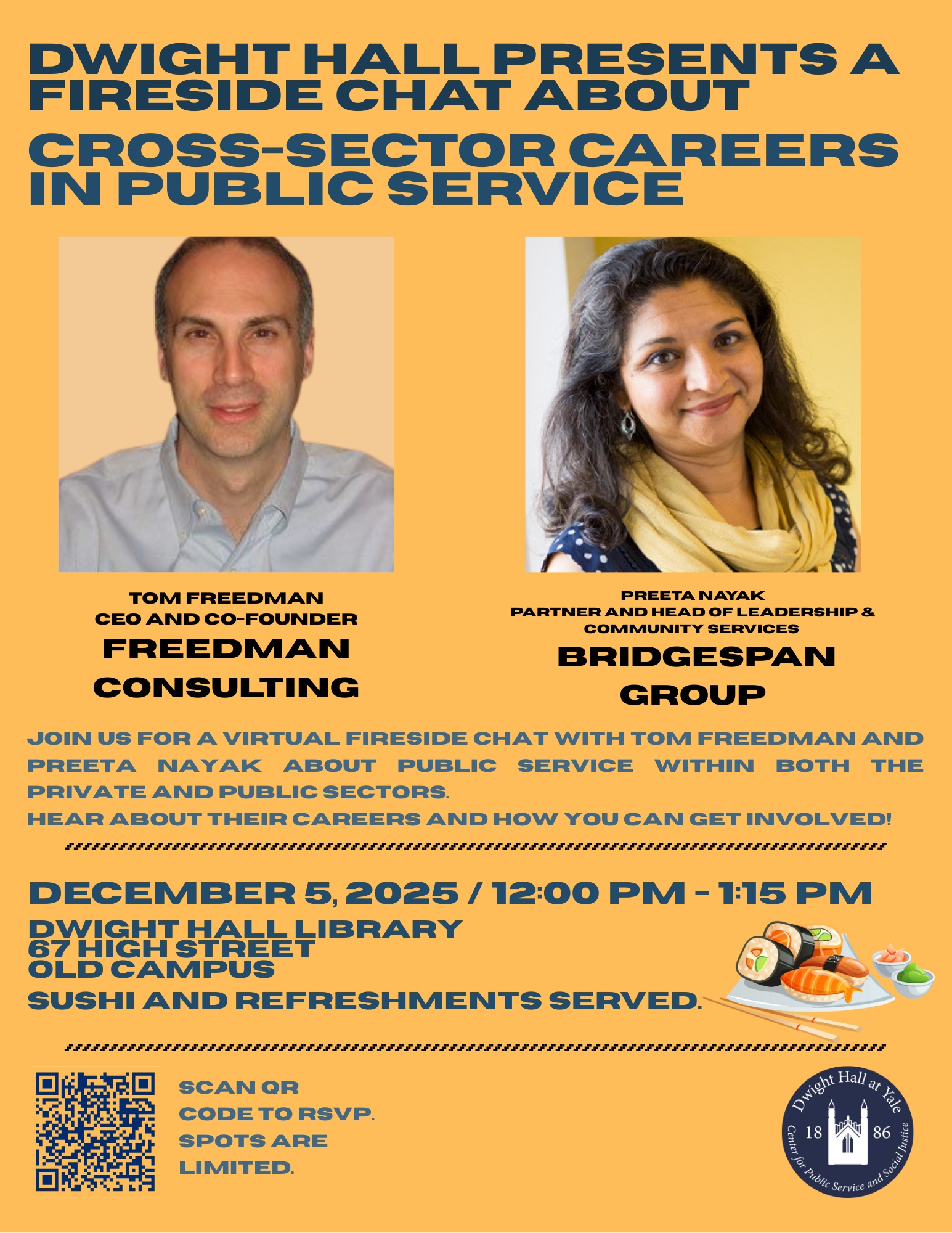
A December 2025 Yale event notice put Freedman beside Preeta Nayak of the Bridgespan Group for a conversation about careers across the public and private sectors. Students could join in person or virtually. The invitation promised sushi and refreshments. Even a discussion about institutional boundaries benefits from a sensible lunch arrangement.
It was a fitting subject for someone whose working life has crossed so many of them. His record offers a sequence of attempts to connect a public objective with a usable organization, an employer, a research partner or a new recruit. The work becomes interesting at the point where another person has to say yes. Freedman’s career has kept returning to that conversation.