A literary agent lives in the future tense. The pages may still be rough, the contract unsigned, the film entirely imaginary. Yet somebody has to see the finished object hiding inside the proposal, then see the other objects hiding inside that one. Todd Shuster has made a career of this compound vision. A book is a book, certainly. In his orbit it may also be a film, a public record, a classroom conversation, or the first working draft of a peace offering.
The breadth of Shuster’s work can look unruly on a single page. He represents former Washington Post executive editor Martin Baron, actress and children’s author Grace Byers, former FBI deputy director Andrew McCabe, presidential speechwriter Cody Keenan, journalists Robert Samuels and Toluse Olorunnipa, and many more. His list moves through current affairs, politics, civil rights, memoir, business, history, literary fiction, mysteries, and thrillers. It is less a shelf than a busy intersection.
The useful clue is that Shuster started with rules. After Yale, where he studied from 1982 to 1986, he earned his law degree at Northeastern University. He then practiced publishing and entertainment law at Palmer & Dodge and Ropes & Gray. Before he was matching manuscripts to editors, he was learning the machinery that lets creative work travel: contracts, ownership, obligations, permissions, and the stubborn little clauses upon which large ambitions depend.
The contract was only the first plot twist
In 1996, Shuster co-founded Zachary Shuster Harmsworth. The firm grew from Boston roots and spent twenty years building a list before joining with Kuhn Projects in 2016. The combined agency took the name Aevitas Creative Management, from a Latin word carrying ideas of lifetime, durability, and the future. It was an apt piece of naming for people who make bets on work that can take years to reach readers and decades to prove its staying power.
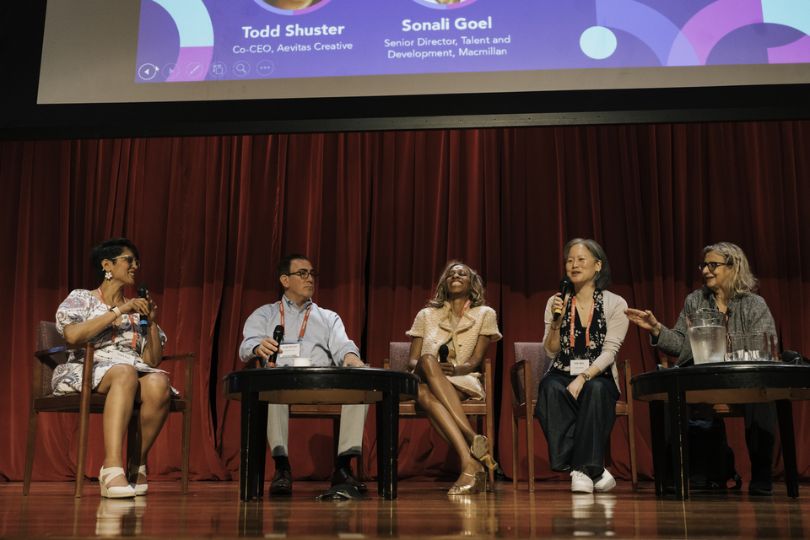
The merger was practical, but its language revealed an institutional idea. The two firms had already shared New York office space and found their lists and operating cultures complementary. Their leaders wanted the new company to preserve the useful habits of both agencies and create more opportunities for younger colleagues. Shuster became one of Aevitas’s managing partners and now serves as co-CEO alongside David Kuhn.
Aevitas has since expanded into a large, multi-city agency with more than fifty agents listed on its site. In 2025, five agents from Erin Murphy Literary Agency joined the firm. Shuster welcomed their authors and illustrators as additions to the Aevitas children’s division. The language was characteristically collective: the people, the clients, and the stronger structure around them.
A good agent spots the life after publication: the next audience, the next form, the next room where an idea can matter.
When the author is a newsroom
Some of Shuster’s revealing clients are institutions. He has represented The Boston Globe in connection with group-reported books including Last Lion, Whitey, and Long Mile Home. He has worked with The Washington Post on The Mueller Report, The Afghanistan Papers, and Trump on Trial. Such projects ask a peculiar editorial question: how does reporting produced by many hands, often under the pressure of daily news, become a coherent book built to outlast the news cycle?
The agent’s role here reaches beyond selling a manuscript. A newsroom has reporting, authority, lawyers, deadlines, and an institutional voice. A publisher needs a book with shape. The arrangement requires someone who understands rights and narrative, along with the diplomacy to move between organizations that possess their own strong cultures. Shuster’s early legal work and later dealmaking meet neatly in that assignment.
His individual author list carries the same attraction to public consequence. Baron wrote Collision of Power about leading The Washington Post through the Trump years and Jeff Bezos’s ownership. McCabe’s The Threat became a number-one New York Times bestseller. Samuels and Olorunnipa’s His Name Is George Floyd was a National Book Award finalist. Keenan’s Grace brought a White House speechwriter’s view to the page. These books differ in temperament, yet each takes private experience or deep reporting and makes it available for public argument.
Stories with passports
Shuster’s books do not always remain between covers. He helped shepherd Wild, starring Reese Witherspoon, and The Pursuit of Happyness, starring Will Smith, to the screen. His producer credits include the 1997 films Six Ways to Sunday and The Inheritance. In 2020, he served as an executive producer on The Midnight Sky, directed by and starring George Clooney. In 2023 came another executive-producer credit, for the documentary South to Black Power.
The portable-story route
or reporting
& representation
or public debate
Shuster’s record runs across the full route. The destination changes; the original story remains the load-bearing beam.
“Adaptation” can sound mechanical, as if a story merely changes containers. The good ones demand something closer to translation. What survives when interior prose becomes performance? What gets compressed, and what must be protected? The agent who has already watched a project travel from an author’s idea to a publisher is well placed to recognize both the opportunity and the danger of another crossing.
This helps explain the unusual coherence of Shuster’s résumé. Lawyer, agent, executive, and producer are different jobs, but they share a concern with passage. A valuable idea begins in one person’s head. Then come collaborators, contracts, edits, audiences, and the occasional red carpet. The route is glamorous only in retrospect. Most days, it is email, judgment, and the careful prevention of avoidable calamity.
Then the agent became the author
In 2023, after decades of representing writers, Shuster published a book of his own. The First Day of Peace, illustrated by Tatiana Gardel and presented by The Peace Studio, is a 32-page fable for children. Mountain people draw water from a river. Valley people rely on a lake. Each refuses the other access, drought sharpens the conflict, and torrential rain finally traps the valley community. A mountain girl sees what has happened and supplies the sentence around which the story turns: “We need to help.”
It is a small sentence with no decorative upholstery. It also offers a compact theory of action. The girl does not wait for the adults to become less proud. She sees an immediate human obligation and names it. The book’s concerns - shared resources, environmental pressure, inherited suspicion, and cooperation - give Shuster’s peacebuilding work a form that a young reader can hold.
Shuster co-founded The Peace Studio, an organization that equips artists, journalists, and other storytellers to use narrative in building connection and transforming conflict. The nonprofit’s programs offer tools and community to people making restorative stories. For someone whose commercial career revolves around the leverage of narrative, the premise feels precise: stories do things in the world, so the people making them should become more deliberate about what those things are.
There is a pleasing role reversal in the picture book. The agent became the writer. The veteran of adult negotiations chose a child as the moral actor. A professional trained in rights wrote about sharing. None of this requires a grand conversion story. It reads instead like an old set of interests moving into a clearer, gentler register.
A longer table for the trade
The latest chapter turns toward people entering publishing. In June 2026, Aevitas and the screenwriting education platform Roadmap Writers announced Roadmap x Aevitas Authors, an online education and professional-development service for new and emerging authors. The planned offering included courses, one-on-one consultations, meetings, contests, and instruction from publishing professionals. For Roadmap, it was a first move into books. For Aevitas, it extended agency expertise beyond the clients already inside the building.
Shuster is also identified as helping lead Aevitas’s development of ethical and legally appropriate policies for artificial intelligence, working with authors, agents, staff, publishers, and industry groups. Here again, his legal beginnings look less like a discarded first career than a tool kept sharp. New technology arrives trailing old questions in unfamiliar clothes: consent, ownership, compensation, attribution, and the value of human judgment.
Publishing and entertainment law in Boston.
A new literary agency, Zachary Shuster Harmsworth.
Two firms combine to form Aevitas.
Film production and a picture-book debut widen the map.
A larger children’s division, author education, and AI policy work.
Publishing loves the myth of the solitary genius, preferably photographed beside an intimidating bookcase. Shuster’s career belongs to the less photogenic truth. Books are cooperative structures. Reporters, editors, lawyers, agents, producers, booksellers, and readers all leave fingerprints, though only a few names reach the jacket. The invisible work becomes visible mainly when it fails.
His record also suggests a generous definition of what a literary career may contain. It can hold a law office and a children’s fable, a newspaper investigation and a feature film, a boutique agency and a multi-city company. The common thread is durable narrative paired with practical architecture. Inspiration gets a meeting. Then somebody has to draw the plans.
A useful Shuster contribution to the book business is his instinct for the second life. The manuscript becomes a book. The book becomes a film. The investigation becomes a record. The organization becomes a school. The professional who has spent years speaking for authors finally writes a line in his own voice, gives it to a child, and lets her say the obvious thing that adults have somehow missed: we need to help.
Follow the work