The useful thing about arriving in a city where you know nobody is that every relationship has to be made on purpose. Tina Engineer-McRae came to Florida from Britain with recruitment experience, an earned confidence and, by her own account, a Rolodex. The contacts inside it did not amount to a Miami network. The promise she made to the local manager did: give her the opportunity and she would help build the business.
There is a bracing lack of mystery in that proposition. No grand theory, no heroic founder mythology, just the oldest business tool in circulation: another person deciding you are worth a meeting. Engineer-McRae had first encountered Miami while on holiday with her sister. She had studied business, finance and languages at the University of Wolverhampton, and the city's Latin and multicultural energy made sense to her. Back at Manpower in Britain, she pursued an intracompany transfer with enough persistence to turn a holiday impression into a career migration.
Miami occasionally struggled with her accent. She could live with that. Born and raised in Manchester to Indian-born parents, she already knew the peculiar freedom and fatigue of being both local and foreign. South Florida offered another version of the same puzzle, only with palm trees and considerably more Spanish. She approached it by learning people one at a time.
“I didn't know a soul in Florida and arrived with just a rolodex, a passion for delivering for clients and a keen awareness that ... I had a lot to prove in this new adventure!”Tina Engineer-McRae, recalling her move to Florida
The first product was attention
Her British recruitment experience traveled better than the Rolodex. The UK market was more mature, and Engineer-McRae brought stronger process, more deliberate documentation and a habit of close client service. She later led the growth and acquisition of a South Florida boutique recruitment company. In 2007, she co-founded the firm that would become M SEARCH.
The firm calls its method the Concierge Approach. The phrase can sound upholstered, as if every search arrives with a brass luggage cart. Its working meaning is plainer: know the client deeply enough to understand the business problem beneath the job description; know the candidate well enough to see beyond a polished history; stay close enough to both sides that surprises become less frequent and trust becomes more so.
The distinction matters because an executive résumé is a very accomplished piece of misdirection. It records titles, scale and victories. It is less gifted at recording how a person behaves when the instructions fail, whether they listen when the room goes quiet, or how they discuss a decision they got wrong. Engineer-McRae has recently written about meeting a senior candidate whose résumé left her unmoved. Twenty minutes of conversation changed her view. The candidate's questions, self-awareness and language about the team supplied what bullet points could not.
Her current test is “stage fit.” A leader who excelled inside a large, well-built machine may not enjoy constructing one while it is moving. A scaling company may need an executive who can address the board at ten, repair a broken process at noon and admit by three that the original plan was nonsense. Another business may need the seasoned maintainer. Prestige cannot settle the argument. Context must.
“They're incredibly impressive. But are they right for your company, right now?”
A name gets shorter; the standard stays
By August 2022, the original firm had reached its fifteenth year. Co-founder Ameer Mughal departed for other ventures, and Engineer-McRae took full management and ownership. The firm had just received certification as a Women's Business Enterprise. The following February, Mughal & McRae became M SEARCH.
A shorter name can conceal a long edit. This one retained a small crown in the logo, a visual pun with responsibilities. It nodded to Engineer-McRae's British citizenship and stood for the “royal standard” she attached to client service. The company changed the sign while keeping the operating promise. It also broadened the work beyond retained search into leadership advisory and scale-up services.
The timing was not especially polite. Executive search had already absorbed the pandemic's violent sequence of freezes, frantic hiring and correction. In a 2025 episode of M SEARCH's Leadership Delivered podcast, Engineer-McRae described the period as a source of new services as well as strain. Her case for the boutique firm is agility: fewer layers between a changing client problem and the people expected to solve it.
She does not treat artificial intelligence as a visiting villain. It will alter recruitment, she argues, but the human part remains stubborn. Software can increase the number of names considered and reduce the clerical drag of a search. It cannot fully answer whether a candidate will be trusted in a difficult room. The future, in her telling, belongs neither to instinct alone nor automation alone. It belongs to better information in the hands of people willing to remain curious.
A network is a verb
Engineer-McRae's professional geography now extends well beyond a firm's client list. She is a founding member of Chief, the executive women's network, and participates in Miami's close-knit member community. She sits on the board of Girls Inc. of Greater Miami, supporting programs meant to help girls develop confidence and leadership. She also takes part in Miami-Dade Beacon Council conversations about the region's international business links.
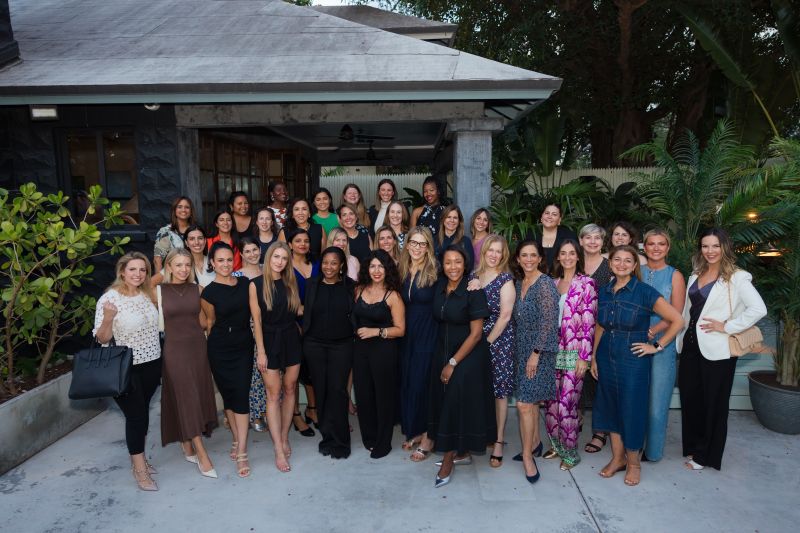
These are related activities, not decorative affiliations. Her business depends on a network that remains alive between assignments. Her civic work depends on adults lending young people time, credibility and introductions before those young people possess much institutional power of their own. Both rest on the same wager: confidence often follows action rather than preceding it.
At her daughter Zia's school career day, Engineer-McRae was struck by the children's readiness to ask questions and say what they thought. She wrote that the encounter made her want to be a better leader, mentor and mother. The observation fits the rest of her public philosophy. Curiosity is not a soft ornament on competence. It is how competence avoids becoming stale.
Family supplies another vocabulary. Her father, Farokh Engineer, played Test cricket for India. In the family story told for M SEARCH's fifteenth anniversary, he was at Lord's when Tina was born, and Queen Elizabeth II conveyed the news after play. The anecdote is almost suspiciously well composed: duty, a famous ground, a royal messenger and a daughter who would later put a crown on her company logo. Life is rarely so considerate to a brand strategist.
“When I started M SEARCH, I believed that relationships would always be at the center of great leadership. 18 years later, that belief has only grown stronger.”Tina Engineer-McRae, on M SEARCH's anniversary
The résumé ends where judgment begins
M SEARCH's durability is not evidence that relationships defeat every market cycle. Plenty of warm handshakes have met cold budgets. It is evidence of something narrower and more useful: a founder can make personal attention repeatable without pretending it is effortless. The work requires remembering the person behind the title, then remembering the company behind the vacancy.
Engineer-McRae's latest writing returns to timing. Companies often know which senior leader they will eventually need, yet postpone the hire until delay has become its own strategy. Six months later, the founder is overloaded, decisions are slower and the gap is suddenly expensive. Her advice is not to hire extravagantly early. It is to recognize the stage ahead before the present stage starts to fray.
That is also a fair description of her own career. She saw a possible life in Miami before she had the network to sustain it. She carried mature practices into a younger market. She founded a firm, took full ownership and edited its identity without discarding its central idea. At each turn, confidence seems to have arrived a few minutes after the decision.
The Rolodex is now a museum piece. The principle inside it is not. A name becomes valuable when somebody has paid attention to the human attached to it. Executive search gives that old truth a large invoice and consequential stakes. Tina Engineer-McRae has spent three decades making a profession of remembering the rest.