Two days is long enough to name a company. Timothée Lacroix and his future co-founders had been turning possibilities over when he finally chose Mistral. It was easy enough to pronounce in English. It did not sound too odd. The fact that “AI” sits inside the word was, he later said, merely “a happy accident.” The trio had spent enough time on it. There were models to train.
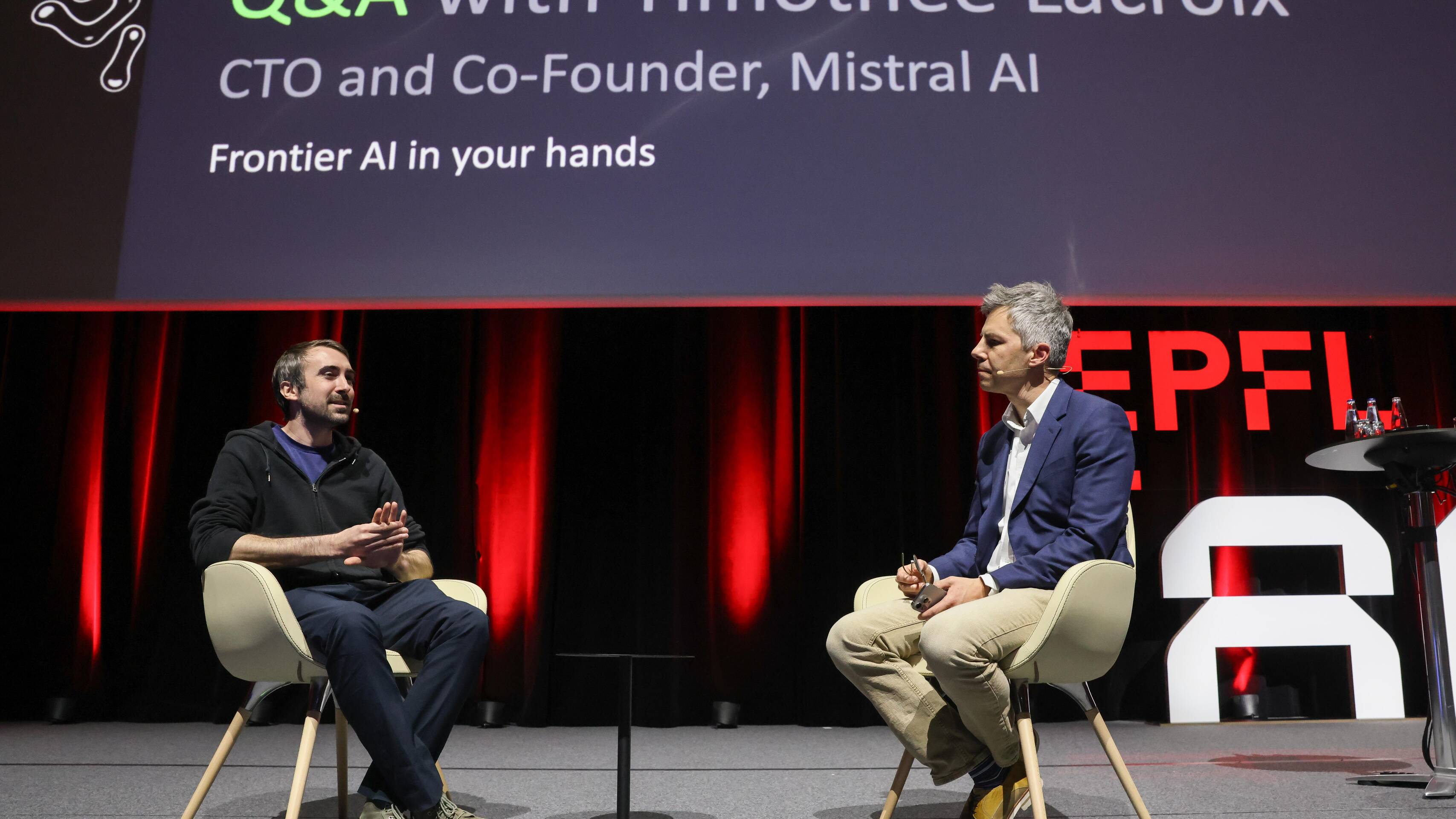
The anecdote is small, but Lacroix is more legible in small details than in grand declarations. He is the least publicly visible of Mistral AI’s three founders, an engineer who says discretion is part of his personality and useful besides: it leaves more time to do his work quietly. His job, however, is anything but small. As chief technology officer, he runs much of the machinery that turns frontier research into software an organization can actually use.
That machinery has expanded with remarkable speed. Product teams serve and deploy the models. Research infrastructure helps scientists run experiments without tripping over a growing organization. Forward-deployed engineers carry the technology into customers’ existing systems and handle the stubborn last mile. Data centers and compute infrastructure have joined the list. The public sees an answer appear in a chat window. Lacroix sees the long stack of choices beneath it.
“I was more interested in the machine that allowed us to be efficient, to move forward.”Timothée Lacroix, translated from French
01 · Before the windFirst, he taught machines to connect facts
Lacroix graduated in computer science from the École Normale Supérieure on rue d’Ulm in 2015 and completed the Mathematics, Vision and Learning master’s at Paris-Saclay. He joined Facebook AI Research that year, initially in New York, and pursued doctoral work with École des Ponts. His subject was tensor decomposition for knowledge-base completion. In ordinary language, he worked on ways for machines to recover missing relationships among things, people, places and moments.
The research sounds remote from a commercial AI assistant, but its habits endure: represent a complicated world efficiently, locate structure in enormous collections of data, and make computation scale. His papers moved through canonical tensor decomposition, temporal knowledge bases and PyTorch-BigGraph, a system designed for graphs with billions of entities. Later came neural theorem proving and, at Meta, the LLaMA paper. This was not a sudden conversion to artificial intelligence when chatbots became fashionable. It was an eight-year apprenticeship in the less photogenic business of making machine learning work.
Two relationships also matured during those years. Lacroix knew Arthur Mensch from their student days. He worked alongside Guillaume Lample at Meta for more than six years. When the three began talking in late 2022, trust and a division of labor already existed. Mensch would become chief executive. Lample leaned toward science. Lacroix gravitated toward the technical system around the science. Founding-team chemistry is often treated as spontaneous combustion. Here it had been rehearsed for years.
02 · The obvious difficult ideaWhy invent a stranger startup?
The three considered what they might build. Then came a clarifying question: why search for an elaborate startup concept when they already knew how to train models? In early 2023, frontier AI was accelerating while access to the best systems was narrowing. The trio believed there was room for a European company built around efficient models, open releases and control for the organizations deploying them. They incorporated Mistral in April.
Its early model release arrived on the internet through torrent links. This was partly distribution and partly declaration. Anyone could download the weights. Lacroix remembers it as a wager whose outcome the team could not predict: real excitement, short nights, then an immediate response. The first releases could perform many simple tasks associated with far larger systems. Mistral had found an audience by handing over the machinery, not merely demonstrating it behind glass.
There was also an unforgiving constraint. Training a large model can occupy weeks and consume expensive compute. Data must be right before the run. Parameters must be chosen before the meter begins spinning. “You cannot be wrong,” Lacroix said of the preparation. The line has none of the industry’s mystical vocabulary. It sounds like an engineer staring at a checklist while a very costly machine waits to be switched on.
The machine around the model
Compute, tools and workflows that let a growing lab run stable experiments quickly.
Vibe, Studio and the serving layer that turn model capability into usable software.
Engineers who adapt systems inside customer environments, where tidy demos meet untidy reality.
03 · Plumbing with consequencesThe model is only the middle
Lacroix’s description of his present job begins where the mythology ends. A research paper is not a production service. A model endpoint is not an organizational transformation. A clever demonstration is certainly not a maintained system. Each gap requires people, software and a tolerance for unglamorous detail.
Consider an aircraft maker changing a bolt specification. Its technical documentation can occupy terabytes, and one change may ripple through manuals, compliance rules and connected components. Lacroix uses this as an example of industrial AI: not a machine composing purple prose, but one finding every implication of “bolt 26,” checking consistency and producing the next documentation inside tools the company already uses. The task is prosaic, exacting and commercially valuable. Wilde would have disliked the bolt but admired the invoice.
This is why Mistral employs forward-deployed engineers. They enter the customer’s environment, learn its business and adapt the system. A proof of concept comes first. If it works, a longer partnership can follow. The approach also feeds reality back into research. Useful models are not defined solely by benchmark scores. They are defined by whether people can control them, fit them to their data and trust them inside existing constraints.
A model can be brilliant in isolation. A product must survive company policy, old software, difficult data and Tuesday morning.The practical test of deployment
That feedback loop helps explain Lacroix’s early position on business models. He argued that commercial logic would become clearer once necessary uses were understood. Open releases let a community explore more possibilities than one company could foresee. Commercial systems could then serve organizations needing customization, reliability and control. Openness and revenue were not opposite poles. They were different instruments for discovering and serving demand.
04 · A career in layersFrom papers to products to power
Graduates from ENS and joins Facebook AI Research.
Publishes on tensor decomposition, graph embeddings and temporal knowledge bases; completes doctoral work.
Co-authors the LLaMA paper and co-founds Mistral AI.
Helps ship Mistral 7B, Mixtral and Pixtral as the company builds its technical organization.
Expands the stack across code, speech, customization and compute infrastructure.
The progression is neat only in hindsight. Knowledge graphs led to large-scale systems. Large-scale systems led to language models. Language models led to a company that needed products, deployment teams and physical infrastructure. Each new layer made the old skill more useful while changing the job around it.
Lacroix now manages many teams and many things, as he puts it with suspicious understatement. He remains drawn to technical and industrial subjects. The more Mistral grows, the less his work resembles solitary research and the more it resembles institutional design: deciding which group owns which problem, where science ends and engineering begins, and how information travels back from a factory or bank to a model team.
There is a pleasant symmetry here. His doctoral work asked how a machine might fill missing links in a body of knowledge. His executive work asks how a company might prevent missing links among research, infrastructure, products and customers. One problem is mathematical, the other human, and both punish gaps.
05 · Quiet, on purposeProtecting the work from the story
Technology companies manufacture narratives almost as energetically as software. Lacroix appears wary of donating too much time to the narrative factory. When a television interviewer called him the most discreet founder and asked whether it was deliberate, he agreed that discretion was largely his nature. It also allowed him to work in peace. This was not false modesty. It was calendar management.
His public humor is similarly dry. Mistral, he noted, is not a terribly original name: military equipment, elevators and logistics firms already use it. The romantic tale of a Mediterranean wind receives a practical appendix about trademark searches and English pronunciation. Then the conversation returns to systems.
The aspiration beneath those systems is clear enough. Build models people find useful. Publish enough openly that researchers and developers can discover uses the lab will miss. Give companies and governments choices about where technology runs and how it is controlled. Compete with larger providers through efficiency and engineering, not incantation.
The AI business likes its metaphors celestial: stars, moons, superintelligence. Lacroix’s language stays closer to earth. Stable training. Faster experiments. Technical documentation. A bolt. A data center. The grand future, in his telling, arrives disguised as plumbing. That may be why it has a chance of working.