In the folklore of artificial intelligence, progress arrives in a truck full of computer chips. Guillaume Lample has spent much of his career asking a less photogenic question: what if the machine already has enough, and the researchers have simply stopped teaching it too soon? The question sounds frugal. In practice, it has carried him from a student project that learned to play Doom to a senior place on the original LLaMA paper, and from Meta's Paris research lab to the company he co-founded, Mistral AI.
His preferred unit of drama is the training run. Months of preparation pass before thousands of processors begin their expensive conversation. A mistake can surface late. A promising trick can vanish when scaled. The final run is the part that attracts the price tag, though Lample likes to point out that the engineering began long before anybody pressed start. Code had to be rebuilt, data cleaned, failures staged in miniature. The finished model is the visible tip of a decidedly unromantic iceberg.
First, remove the dictionary
Long before chatbots became dinner-table company, Lample was studying scarcity. Machine translation normally learns from parallel text: one sentence in English paired with the same sentence in French, German or Urdu. That method works nicely for languages with abundant paired material. Most languages do not enjoy that luxury. At Sorbonne University's LIP6 laboratory, in a doctoral project conducted with Facebook AI Research, he asked whether a system could learn from separate piles of monolingual writing instead.
The results published with Alexis Conneau, Ludovic Denoyer and Marc'Aurelio Ranzato in 2017 showed that it could. Their system mapped sentences into a shared space, reconstructed them and improved through back-translation. A later version exceeded previous results by more than 11 BLEU points on standard English-French and German-English tests, without using a single paired sentence. Lample's thesis made the larger claim with scholarly calm: fully unsupervised translation was possible, and in some low-resource language pairs it could outperform supervised methods starved of examples.
“The performance does not saturate. You can train them longer.”Guillaume Lample, describing the lesson of LLaMA's training
A pattern had appeared. Take away something the field treats as necessary. Replace it with structure, repetition and careful training. See how far the model travels. It would return throughout Lample's work, dressed in different mathematics.
Doom, algebra and a multilingual detour
His route to language was agreeably indirect. At Carnegie Mellon University's Language Technologies Institute, where he earned a master's degree in 2017, Lample worked on Arnold, an agent that navigated the first-person game Doom. The project learned from raw pixels while using game information during training. On his still-public GitHub profile, Arnold sits beside Fader Networks, a system for changing visual attributes by moving virtual sliders, and MUSE, a library for multilingual word embeddings. One researcher, several kinds of world.
After the translation work came XLM, a 2019 project with Conneau that brought pretraining to cross-lingual language models. Then Lample and François Charton trained neural networks to solve symbolic integration and differential equations by treating mathematics rather like a language. Another team applied unsupervised translation to code, converting functions among C++, Java and Python. The subjects changed from natural sentences to algebra and source files. The maneuver remained recognizable: find a representation, learn its hidden grammar, and make supervision less precious.
Arnold learns to act inside Doom, joining vision and reinforcement learning.
Unsupervised systems translate words and sentences without paired bilingual corpora.
XLM pretrains across languages; Lample defends his Sorbonne thesis.
Neural models tackle symbolic mathematics and translation between programming languages.
LLaMA is published; Mistral AI begins.
The small model that kept learning
At Meta, Lample's questions met industrial scale. The original LLaMA family included models with 7, 13, 33 and 65 billion parameters. Its argument had a mischievous elegance: a smaller model trained on much more data could outperform a larger one while being cheaper to run later. The 13-billion-parameter version surpassed GPT-3 on many benchmarks despite being roughly one-tenth its size. Lample, listed in the senior-author position, later explained that even the team had been surprised by how steadily the smaller models improved.
This was less a hymn to smallness than an accounting correction. A model has two lives. Training is the brief, expensive education. Inference is the long career in which it answers questions, translates text or writes code. Spending more during education can produce a compact graduate that costs less every time it works. Lample's instinct for efficiency made the relationship between those two lives hard to ignore.
Three old friends leave the large labs
By late 2022, the publication culture around large models was tightening. Lample and Meta colleague Timothée Lacroix had watched that shift from inside. Arthur Mensch, an École Polytechnique contemporary of Lample's, was at Google DeepMind. The three had known one another for about a decade. When Lample and Mensch crossed paths at the NeurIPS conference in New Orleans, their conversations turned toward building independently in France.
The roles they eventually chose contain a tidy division of anxieties. Mensch became chief executive, responsible for the company outside the machine room. Lacroix became chief technology officer. Lample took chief science officer, keeping one hand on research direction. Mistral AI was formed in spring 2023. In September, it released Mistral 7B, a compact open-weight model delivered to the internet by magnet link. The distribution method had the bracing informality of a mixtape passed across a school desk.
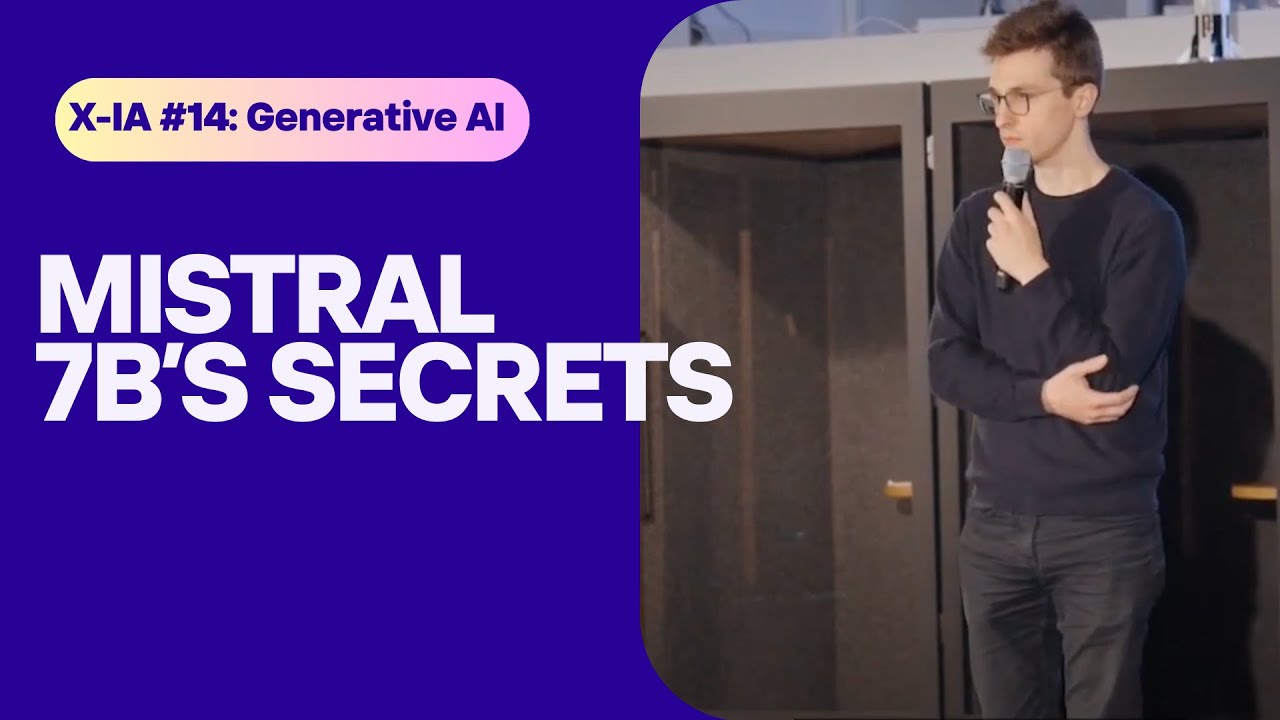
Mistral 7B used techniques including grouped-query attention and sliding-window attention to balance speed, memory and performance. Mixtral followed with a mixture-of-experts architecture that activated only part of the model for each token. The family resemblance to Lample's earlier work was unmistakable. Capability came from arranging computation carefully, not merely accumulating it.
The business hidden inside the research
Open weights can look like an awkward way to build a company. If users can download a model, where does the invoice go? Lample's answer is practical. Models are becoming commodities, he told Le Monde in 2025. Businesses pay for customization: the adaptation, deployment and control required to make a general system useful inside a particular factory, bank or public agency. Openness supplies distribution and scrutiny. Services supply revenue. The two can share a room without pretending to be twins.
There are compromises. Mistral releases some models under open licenses or with downloadable weights, while keeping other systems behind commercial APIs. It sells Le Chat, coding tools, model training and enterprise systems. Its partnerships reach manufacturing, finance, government and defense. Lample has argued that limited compute can be answered partly through optimization and discoveries in training efficiency. “We can always get by,” he said, with methods that waste less.
That philosophy has survived an extraordinary change in scale. In September 2026, Mistral announced a €3 billion funding round. Lample said the money would expand training and inference compute and grow science teams across Paris, Palo Alto, San Francisco, London, Zurich and Warsaw. The researcher who built systems around scarce parallel text now helps decide how a multibillion-euro company should spend abundance. It is the sort of irony an optimizer can enjoy.
A Breton excess, for once
Lample grew up in Brest and studied at Lycée Kerichen before École Polytechnique, Carnegie Mellon and Sorbonne. Former classmates and teachers have described him as loyal, intensely hardworking and fond of chess. His public manner fits the board: patient, numerical, happier discussing the position than narrating the player. He has also admitted to one sentimental inefficiency. In an interview about his Breton roots, he joked that Mistral's training mix included more Breton-language material than strictly necessary.
The joke works because it violates the rest of the record. His career has been an argument against unnecessary weight, unnecessary labels and unnecessary assumptions. Yet efficiency, in Lample's hands, is not austerity. It is what makes room for more languages, more developers and more organizations to participate. A smaller model can travel. An open model can be changed. A European lab can choose its own questions.
Artificial intelligence still adores a truck full of chips. Mistral now owns access to quite a few. The new capital will buy experiments that his earlier teams could only have sketched. It will also make discipline more important: waste multiplied across thousands of processors becomes an expensive institutional habit. Lample's more useful contribution may be the reflex he brought with him: before ordering another truck, check whether the lesson could be taught better.