The Yellow Pages had a practical answer to a difficult question: where should somebody looking for a business begin? Before a search box could finish your sentence, a directory could put a plumber, a restaurant or a moving company within reach. It was a large book with a small ambition: make the next decision easier. For the businesses inside it, that modest service could matter a great deal.
Tim Haslam spent 18 years in that business early in his career. Today he is the New York-based founder and chief executive of We are Talker, a company that combines consumer research with stories designed to earn media coverage. The printed directory and the research-led news story look like distant relatives. In Haslam’s account of his working life, they belong to the same family: each helps determine which business a customer encounters.
His current preoccupation is another change in the entrance. People can ask an AI assistant for a recommendation and receive an answer already assembled. Haslam thinks brands need to understand how they become part of that answer. His interest carries the perspective of someone who has watched an earlier system for finding businesses give way. A directory veteran has reason to notice when the front door moves.
Haslam’s account of his early career
A New York office, with a British accent
By November 2014, Haslam was leading the new American office of 72Point in New York. The business came from the United Kingdom, where 72Point worked with PR agencies on survey-based news. Its research operation, OnePoll, supplied the opinions and findings that could become material for stories. The American expansion already had its own US research panel when it was announced.
The proposition required more than transplanting a company name. A survey needs people willing to answer questions. A story needs an angle that a newsroom might use. A client needs a reason for commissioning both. Haslam’s job at the head of the American operation placed him where those demands met. The underlying business was research; the route to public attention ran through editorial decisions.
John Sewell, then the group chief executive, described a model intended to reach audiences across multiple publishers. That breadth matters to the origin of Haslam’s US company. A finding about everyday life could travel beyond a brand’s own channels and appear in places readers already visited. The attraction was easy to understand: a useful statistic could earn an invitation that a sales pitch might never receive.
Haslam would later describe himself as the founder of the US company, and the business identifies Brooklyn as its launch location. The 2014 beginning is a firm point in his story. It connects his present role to a particular commercial experiment: take the research-and-news approach into the American market, then build the people and relationships needed to keep it working.
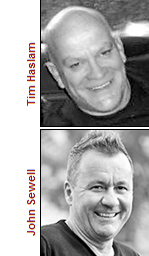
Two faces, one Atlantic crossing. Tim Haslam and group CEO John Sewell in the announcement of 72Point’s New York office. Image: MrWeb.
The number is only the beginning
Inside Talker’s present offering, the sequence begins with a conversation about a client’s goals. Researchers work on questionnaire design and data delivery. Editorial and creative teams turn the findings into news copy, reports, graphics and other materials. Distribution brings the work to digital and broadcast outlets. Spanish-language news copy is also part of the offering. One study can therefore have several lives, each requiring a different craft.
This gives a useful view of the organization Haslam leads. Researchers, journalists, designers and media specialists work on adjacent parts of a project. A questionnaire and a headline may both be short pieces of writing, but they have different obligations. The questionnaire must collect an answer properly. The headline must persuade somebody that the answer is worth reading. Neither gets much help from being merely clever.
For a chief executive, that combination creates a particular kind of responsibility. Haslam leads a business whose output has to satisfy clients while remaining useful to publishers. The commercial purpose is explicit: brands commission the work. The hoped-for editorial interest depends on what the work discovers. There is a practical tension here, and it helps explain his repeated emphasis on research that contributes information.
His public case for the company returns to evidence, attribution and independent attention. A statistic can be supplied by a brand, repeated by an outlet and encountered by a reader who has never visited the brand’s website. That journey is the company’s working territory. Haslam is now examining what becomes of the same journey when a machine gathers the material before a person sees it.
Ten years later, a name that could speak
In April 2024, the American business announced its new identity: We are Talker. OnePoll U.S. became Talker Research. The announcement named Haslam as CEO and founder of the US company and said he would continue leading its editorial, research, creative, account management and operational teams. By that point the business reported teams in New York, California and Texas.
The new name made the company’s purpose easier to say aloud. Haslam described a mission to “Get America talking.” A four-word ambition is a sensible possession for somebody in communications. It also fitted the business’s US focus: an operation born from a British company was giving itself an identity organized around its American clients.
Talker Inc. brings together We are Talker, Talker Research and Talker News. Research, content and publishing sit beneath related names. The rebrand gave that relationship a visible form after a decade of operating in the market. For Haslam, it marked continuity as well as change. He remained at the head of the business he had helped establish, with a new label on work already familiar to his team.
The anniversary also put employees into his account of the company. In 2024, Talker gained Great Place To Work certification. It returned for a second year in 2025 and a third in 2026. Haslam credited the team’s commitment to one another, clients and the work. These are workplace certifications, with their own scope, rather than a verdict on every part of the business. Still, the repeated recognition gives his emphasis on continuity a concrete milestone.
Haslam leads New York
A new US identity
A new strategic focus
Who gets the credit for an answer?
Haslam’s newer argument begins with an awkward possibility for a research client. A company commissions a study. The findings earn coverage. An AI assistant later uses that coverage to answer a question. The publisher may receive the citation while the organization behind the research receives little recognition. The information has travelled successfully; the credit has taken a different route.
In June 2026, he discussed this attribution problem in a Talker article about AI answers. His concern was that a successful burst of media coverage could leave a brand without a lasting position as a source. He wanted campaigns structured so the originating research remained identifiable. It is a recognizable extension of his business: understand how an intermediary presents information, then consider what the client needs to do differently.
The company’s research also offered a reason to pay attention. In an online study of 1,000 American active AI users, conducted in April 2026, 58% said a brand cited as a source in an AI answer appeared more trustworthy than one that was not mentioned. The finding describes responses from that surveyed group. It gives Haslam a consumer perception to work with, rather than proof that every citation produces a sale.
The distinction is central to his position. A mention, a citation, a recommendation and a customer’s eventual choice are different events. Counting the first does not settle the last. Haslam wants clients to examine whether their research is being used and credited, and whether the brand is entering relevant recommendations. A dashboard full of appearances can still leave a business asking a rather old question: did anybody choose us?
“Earned media remains as essential as it’s ever been.”Tim Haslam · June 2026
The recommendation has a memory
In August 2026, Haslam developed this argument in an essay about citations and authority. His proposed direction was “B2AI”: brands would have to consider the information AI systems encounter alongside the information intended for people. He linked the idea to original research, recurring publication and earned coverage. This is his strategic thesis, grounded in the kind of work Talker sells.
He also put forward a useful set of questions about measurement. Does a brand appear in relevant recommendations? Does its own research receive the reference? Does material continue to surface after publication? Those questions move the discussion beyond the day a campaign launches. They ask whether an organization has left behind information that remains useful when the immediate news cycle has passed.
Talker’s case work supplies a bounded example. In a 2026 campaign for CheapCaribbean, the company explored late summer travel and last-minute bookings through a survey of 2,000 Americans. Talker reported that citations to the client’s website increased from 46 to 424 across the prompts it tracked. That is a company-reported campaign result with a defined measurement frame, not a count of every answer on the internet.
The example brings Haslam’s old and new work into the same picture. Consumer questions become research; research becomes coverage; coverage and original material become potential evidence for an answer. Talker Pulse, the company’s ongoing research and content program, is designed to repeat that process. His aspiration is to build a continuing association between a brand and a subject, rather than rely on a single moment of attention.
When research becomes a reference
A headline needs a method behind it
For all the talk of new interfaces, Haslam’s argument depends on something decidedly unglamorous: disclosing how the research was done. In December 2025, Talker Research announced its membership in the American Association for Public Opinion Research’s Transparency Initiative. The initiative encourages routine disclosure of the methods behind publicly released studies. It addresses the workings beneath the headline.
That commitment fits the demands of the business Haslam has built. Publishers need to understand the findings they are being offered. Clients need research they can explain. Readers need a way to assess a claim beyond its confidence of delivery. Methodology is rarely the liveliest guest at the publicity party, but the conversation improves when it is invited.
The directory years give his present work a distinctive perspective. Haslam has spent part of his career inside a system that organized businesses for customers, and another part leading a company that helps businesses contribute information to the public conversation. He now argues that AI recommendations create another place where that information may matter. The prediction is his; the career behind it is tangible.
The thread is a customer trying to make a decision and a business hoping to be considered. The medium has changed from a printed book to news coverage to a conversational answer. Haslam’s response is to keep asking how the selection happens. After years of helping clients attract attention, he is concentrating on the evidence that might make attention last.