There was a bell in HelloFresh’s early office. Every time a customer signed up, someone could ring it. Thomas Griesel’s recollection of this little ceremony comes with a qualification: “it was a very quiet office!” A business built around dinner had acquired a sound effect before it had acquired much of an audience.
That bell makes a useful place to begin with Griesel. The familiar milestones arrive later: the international markets, the production sites, the Frankfurt listing. At the beginning, there were ingredients to pack and people to persuade. In a kitchen, even an ambitious business has to contend with the amount of available counter space.
Griesel helped found HelloFresh in Berlin in 2011. Dominik Richter, his university contemporary, was a co-founder; Jessica Nilsson was part of the founding group too. Griesel and Richter had both graduated from WHU in 2009. Their acquaintance preceded the company, giving the partnership a history before there were customer orders to discuss.
The first kits were packed in the founders’ own kitchens and delivered to friends and family. It is an appealing origin, though the work itself sounds rather less picturesque. Ingredients have to be counted. A recipe has to agree with what goes into the box. Someone has to carry the result to a door. Dinner imposes a certain discipline on a business plan.
Fourteen years later, Griesel would announce that he intended to leave. Between those kitchen deliveries and that decision sits the more interesting part of his career: learning how to make a promise travel, repeat and survive contact with customers who have their own ideas about what to eat.
Dinner, with assembly instructions
HelloFresh offered recipes and the ingredients to cook them. Customers could keep the act of making dinner while handing over some of the shopping and planning. Griesel’s account of the original problem was practical: he and his fellow founder liked cooking, but had little time to shop and wanted inspiration for new dishes.
There is a small pleasure in finding that the executive responsible for this proposition actually used it. Asked in a 2016 interview what he would cook that evening, Griesel named Sicilian spaghetti from a HelloFresh box, using a recipe Jamie Oliver had devised for the company. He described his own cooking as advanced, while stopping short of calling himself a professional.
The detail brings him back to the customer’s side of the counter. A founder can talk about addressable markets all afternoon. Eventually, the instructions must be understandable to someone with a saucepan. The point of the service depends on what happens after the box is opened, when corporate strategy has to share a kitchen with dinner.
Offering more choice made that relationship harder to manage. In May 2016, Griesel opened HelloFresh’s new German production and logistics site in Verden an der Aller. As chief operating officer, he explained the connection between a more personalized box and control over the production process. Customers choosing different recipes meant the business had to handle more combinations.
HelloFresh recruited specialists from automotive production to help with that complexity. The pairing has a pleasing absurdity: the dinner business had something to learn from people accustomed to building cars. Yet both face the practical question of how to assemble different versions of a product without losing track of what belongs where.
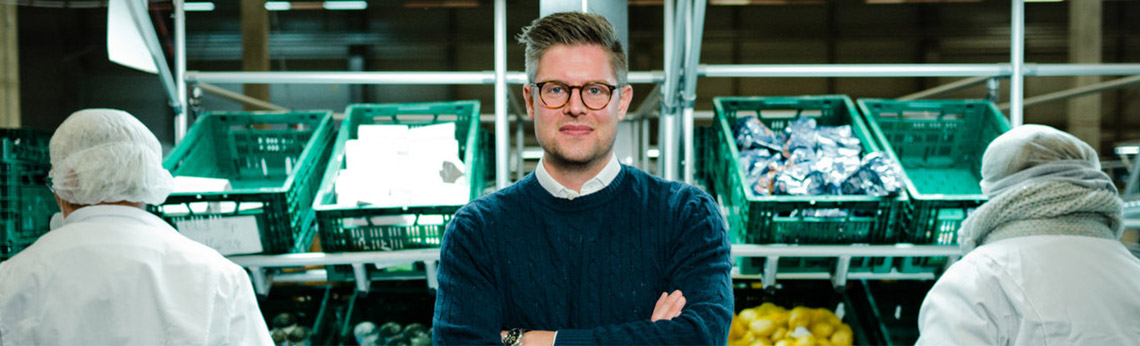
Seen this way, his role was unusually tangible for a founder of an internet business. A choice on a screen had consequences for procurement, assembly and delivery. Adding another option was easy to announce. Getting the right ingredients into the right box gave the announcement its meaning.
Learning to hear the understatement
Before HelloFresh, Griesel had worked at OC&C Strategy Consultants. His education took him from WHU to London Business School, where he completed the Masters in Management in 2010. The move supplied a qualification and an introduction to working with people who brought different assumptions into the same room.
He later recalled a study group representing Greece, Lebanon, India, Malaysia and Germany. His direct German style did not always land as intended. Learning to adjust it, and to recognize understatement in others, became part of the education. An international classroom offered plenty of opportunities to discover that a clear message to its speaker could sound quite different to its listener.
This is a modest admission, and a revealing one. Griesel did not present cultural fluency as something he had always possessed. He described having to learn. The person who would help operate a company across borders first had to notice the borders inside an ordinary conversation.
“do less stuff, properly”
Thomas Griesel’s advice to students
He also remembered the school’s Sundowners drinks fondly. For all the emphasis on management education, there was room in his recollection for the company of classmates after studying. His advice to incoming students was about focus: choose what deserves attention, then give it enough. A crowded programme, like a crowded city, offers more than anyone can use well.
A job that crossed the map
The formal description of Griesel’s work gives shape to the years that followed. HelloFresh’s governance documents assigned him international markets outside the United States, supply chain and operations, alongside business development and new models. The title CEO International eventually became shorthand for a collection of responsibilities that stretched well beyond opening another country office.
Each market required an operating business behind it. Ingredients, production and the final delivery all belonged to the promise made at checkout. The international dimension multiplied the number of places in which that promise had to work. A map makes expansion look clean; an operating responsibility makes it a collection of daily obligations.
- 2009WHU graduation
- 2010London Business School MiM
- 2011HelloFresh founded in Berlin
- 2017Frankfurt stock-market listing
- 2026Departure deadline: 30 April
HelloFresh went public in Frankfurt in November 2017. For a business that had begun with kitchen packing, the change in scale was substantial. A stock-market listing also brought the company into a different kind of scrutiny, with recurring results and expectations attached to the work of attracting customers and fulfilling their orders.
By 2022, Griesel was working closely with Edward Boyes and Nina Wagner’s product-development, strategy and expansion teams. Their agenda covered entering markets, extending brands and finding additional meal occasions. Breakfast and lunch offered further possibilities beyond the dinner around which the original idea had been built.
The financial record adds scale without needing to turn Griesel into a walking valuation. HelloFresh reported approximately €7.66 billion in group revenue for 2024. Its adjusted EBITDA was about €399 million. Those are company figures, representing the work of many people. They help describe the organization he helped build; they do not describe his personal wealth.
HelloFresh Group, 2023 and 2024. Different scales for each measure.
Adjusted EBITDA is an adjusted earnings measure, not net profit. Figures rounded.
The same results describe a business changing its priorities. During the second half of 2024, HelloFresh put greater emphasis on profitability, cash generation and higher-value customers, even at the expense of order volume. Growth had become a question of which customers and orders to pursue, alongside how many.
The market that did not work
Japan belongs in this story. HelloFresh launched there in April 2022, making its first entry into an Asian market. Before the year ended, the company decided to withdraw. A new country on the expansion map had proved much harder to turn into a workable business.
Reporting on Griesel’s internal communications described difficulties retaining customers and a long route to reasonable economics. He accepted responsibility for the lack of sufficiently fast progress. The closure followed an internal announcement in December, ending operations at the close of the year.
There was a human cost to that speed. Employees were reported to have been surprised by the decision and its short timetable. The episode complicates any easy portrait of international growth. A launch has teams behind it, and so does a withdrawal. The consequences extend beyond the arithmetic that prompts the decision.
For Griesel, Japan was a difficult part of the job he had spent years building. It shows the limit of a repeatable model: a business can cross a border more easily than it can ensure customers stay. The decision to stop belongs beside the decision to expand, however uncomfortable the pairing.
The founder leaves the office
On 5 September 2025, Griesel informed HelloFresh’s supervisory-board chairman that he would not continue his management-board mandate beyond 30 April 2026. He wanted to step back and explore interests outside the company. HelloFresh said his board position would initially remain unfilled.
His explanation placed weight on the teams and structures already built. The company, he believed, could continue without his daily presence. For someone whose earliest role had involved packing and delivering, that was a different relationship to the work: accepting that an organization could operate beyond the founder’s own hands.
Richter’s farewell emphasized their working partnership and friendship. The connection had lasted from university through the building of the company. Leaving an executive role therefore also meant changing a long-running daily collaboration. The corporate announcement carried a personal history inside it.
Griesel’s interests outside HelloFresh already had a public record. He participated in Enpal’s €100 million financing round in July 2021, alongside investors including SolarCity co-founder Peter Rive and former Auto1 executive Christopher Muhr. The solar company gave him a place in a business far removed from recipe cards.
In July 2026, he was named among the angel investors backing Willidrop, a startup developing software to coordinate vehicle logistics. Its public launch described a business working on transport tasks still managed through calls, emails and spreadsheets. The connection with his earlier operating world is suggestive, although the investment itself supplies no account of his reasons for making it.
HelloFresh had also said he would remain a committed investor after leaving its management board. That distinction matters to the ending. His executive chapter closed, while a financial connection to the company continued. A founder can leave the office and still have an interest in what happens inside it.
The early bell was meant to celebrate a customer arriving. By the time Griesel left, the business had factories, teams and obligations that no kitchen could accommodate. His career had moved with them, from doing the work himself to helping organize people who could do it repeatedly. Somewhere between those two jobs, a box of ingredients became an international operation.
Read, watch, listen
- LinkedIn profile
- Watch: Griesel’s founder story at London Business School
- Listen: Essen im Abo, Gründerzeit podcast
- The 2021 conversation about data and growth
- The 2016 interview about production and choice
- HelloFresh’s departure announcement
- Willidrop’s July 2026 funding news
- HelloFresh Group website