An account manager at Consero could handle four accounts. Then, according to thinkbridge’s customer story, the same role could handle eight. The company had not discovered a longer working day. It had changed what happened inside the existing one. For anyone who has watched a capable employee spend an afternoon moving numbers between windows, this is a small statistic with a rather large accusation attached.
- thinkbridge builds software around a company’s actual operating rules, including the awkward exceptions.
- Its current offer spans AI discovery, client-owned internal systems, and engineering teams supported by AI agents.
- The buying question is how much work disappears, who owns the result, and who maintains it.
The employee who became an integration
Consero supplies outsourced finance operations. Its problem, as thinkbridge describes it, was a collection of tools for reconciliation, reporting and client communication that left account managers joining everything up. New customers brought more manual coordination. Revenue could grow, but so could the effort required to deliver it. A sixth tool would have joined a party already struggling to converse.
thinkbridge worked with Consero on a platform covering intake, reconciliation, exception review and reporting. Routine tasks were automated; anomalies were routed to people. Shared dashboards replaced some of the manual updates. The published case reports 40% revenue growth without corresponding overhead growth and a 30% improvement in EBITDA, alongside the rise from four accounts per manager to eight. These are reported customer outcomes, rather than a forecast for the next buyer.
The interesting failure came before any grand AI question: the software stack could not carry the service all the way through. People supplied the missing connections. That is the company’s most useful lens. A workaround is evidence. It tells you where the official system has ceased to describe the real business.
The finance team stops reading every line
A separate Consero financial-review case makes the mechanism more concrete. Analysts had been reviewing statements, checking anomalies and preparing executive summaries across client accounts. Much of their attention went to clean data. The work was consistent, but its appetite for human time grew with the client base.
thinkbridge’s account describes a system combining automated financial parsing, anomaly detection trained on historical data, retrieval of relevant documentation and generated reporting narratives. Analysts moved toward reviewing exceptions. The company reports 75% less time spent compiling and interpreting financial data, 90% less manual effort on executive summaries and three times the analyst span of control.
Notice the precision of the claim about summaries. It concerns manual effort on a particular output. It does not mean 90% of the finance department vanished. That distinction matters when a buyer turns a customer story into a budget. The useful thing to copy is the task boundary: identify what can run routinely, what needs inspection, and who receives the exception.
“Outcomes matter most.”thinkbridge’s published core values
A business model written in its own language
thinkbridge occupies the space between a strategy consultancy and a software engineering partner. The customer brings an operation that has outgrown its systems; the firm brings discovery, design, implementation and support. Its preferred mid-market customer has enough complexity to justify custom work, without necessarily having a large internal team to undertake it.
The current offer has three doors. thinkAI starts with a two-to-six-week discovery engagement. It maps operations, assesses readiness and ranks AI opportunities, producing a roadmap that the client can take elsewhere. The published expectation is about four hours of client-team time each week. This is a purchase of diagnosis before implementation.
thinkOne builds the internal operating layer. It can consolidate fragmented workflows or sit alongside an ERP that continues to handle accounting. Its stated method moves from understanding the current business, through sign-off and design, into delivery, data migration and care. The offer describes a four-month build and care extending through month 40. Clients own the code, data model and business logic from the start.
thinkTeam supplies a composed pod of senior engineers and supervised AI agents for customer-facing products, AI features and platform work. Humans carry architecture, review and accountability. Agents handle work such as scaffolding, test generation, documentation and routine operations. The commercial unit is a monthly team, rather than a collection of hourly contractors.
The expertise is therefore broader than writing an application: translating business rules into a data model, moving existing information safely, testing the result and operating it after launch. Large integrators, smaller development firms, internal teams and packaged software are all alternatives. thinkbridge’s positioning rests on combining those responsibilities with client ownership. That is a proposition to examine in the agreement, rather than a distinction proved by a new product name.
The constraint comes before the model
SensorsCall gives this approach a different setting. The senior-care technology company needed monitoring without cameras in the home. It also had to deal with the fact that people do not all keep the same routine. A single rigid threshold could miss a meaningful change or produce an irritating number of alerts.
thinkbridge describes building an IoT backbone and machine-learning system that adapts to a resident’s behavior, alongside sound classification and caregiver-facing explanations. Its published case reports deployment across thousands of homes and a 30% reduction in false alarms. Raw sound, the company says, stays in the home through local preprocessing.
This is a useful corrective to the habit of beginning an AI project by choosing a model. Here the product’s shape follows the constraint: preserve privacy, learn a household’s pattern and make the output understandable to someone responsible for another person. A clever detector with an incomprehensible alert would leave the caregiver doing a new kind of unpaid interpretation.
They once tried to waste less metal
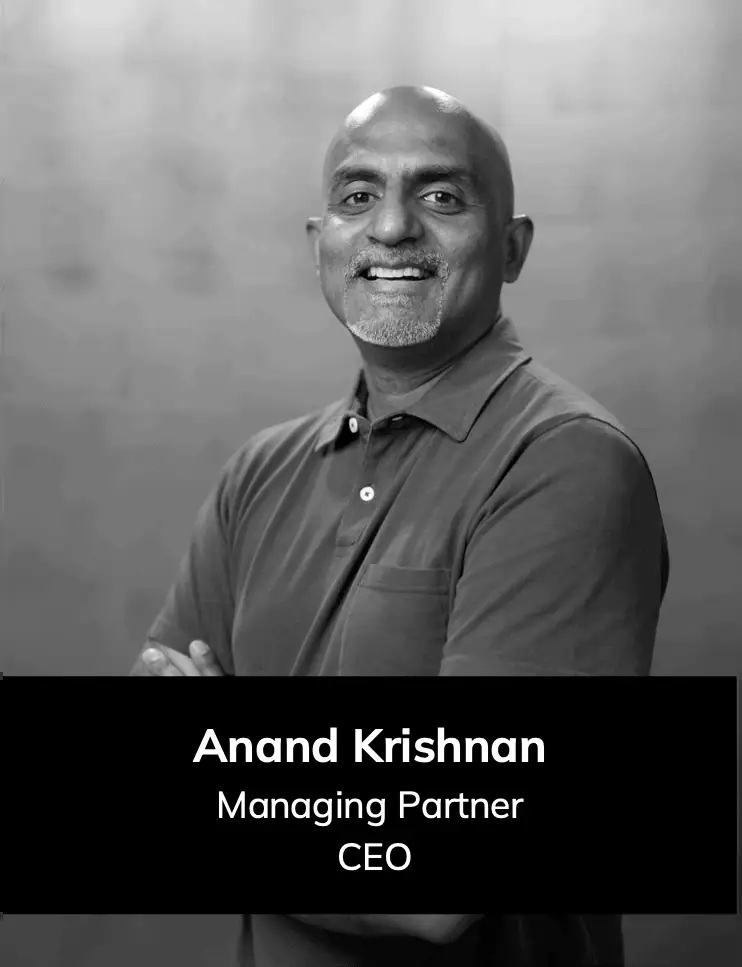
The founders’ shared history contains a pleasingly physical antecedent. The Meaningful Tech biography says Sai Ganesh’s early programming work included a nesting-algorithm platform, developed with Anand Krishnan, to reduce metal waste. Fit the shapes better and less material is discarded. Their later company, founded in 2014, applies its attention to the less visible waste inside business operations.
The comparison is an interpretation, but the continuity is attractive: inspect the arrangement before requesting more raw material. Today the raw material may be an employee’s time. thinkbridge describes a remote-first culture with flexible hours; its Pune thinkSchool program gives early-career engineers six weeks of assessment and practical learning. There is a certain consistency in a software company teaching recruits to see programming as a tool for solving business problems.
The price of finding out
The homepage publishes a discovery price of $6,000 per week for thinkAI. At the stated two-to-six-week duration, that implies $12,000 to $36,000 for discovery, calculated from the advertised weekly rate. thinkTeam pods start at $9,000 per month. thinkOne is scoped to the work, using amortized payments and a managed-care arrangement. These are offer terms, not the historical costs of the customer projects above.
The financial question extends beyond launch. In a September 2026 essay, growth chief Matt DeFrancesco argues that buyers must price keeping a system alive: integration, permissions, documentation, changing requirements and the people who maintain it. Ownership gives the customer control. It also leaves a continuing asset to look after.
The promise of a working system should therefore be tested against the cost of running it. A standard product that already fits a simple operation can be a sensible purchase. Bespoke software earns its keep where the mismatch is substantial enough to justify building and maintaining something specific. A subscription’s existence is hardly an indictment; the surrounding manual labor might be.
Try it on one troublesome handoff
thinkbridge’s September AI-readiness framework checks four conditions: data, workflow, ownership and economics. Each is supposed to be examined against evidence by someone outside the team building the pilot. Clean data in one database is insufficient if frontline staff use another. A correct answer is insufficient if the resulting task lands in a queue nobody watches.
A reader can copy the discipline without buying the engagement. Pick one recurring handoff. Measure its time, inspect the information it actually uses, and name the person accountable when automation is wrong. Price review and correction as well as generation. If the task cannot pass those checks, a more fluent model will have difficulty rescuing it.
That brings us back to the account manager with eight accounts. The persuasive question is what changed in the job, not how impressive the demonstration looked. thinkbridge’s case for itself becomes most interesting at that ordinary level: where an employee used to supply the connection, the system now does more of the work.
Follow the work
Company website · Customer stories · Company writing