In October 2024, as Hurricane Milton approached Florida, Breeze Airways faced a question that a weather app could not answer by itself. Which flights could still operate safely? According to The Weather Company’s customer account, the airline preserved 45 flights used to move employees, families, and guests out of threatened areas. A forecast had become a dispatch decision.
- One forecasting business, many products: apps, APIs, flight tracking, broadcast graphics, and advertising signals.
- The useful distinction: knowing the weather and organizing a response are separate jobs.
- The practical lesson: put the forecast inside the decision people already need to make.
That gap explains The Weather Company. Most people meet it through weather.com or The Weather Channel app. Businesses meet it at a more consequential intersection: weather and a schedule, weather and a budget, weather and an aircraft. The company sells ways to connect those things.
01 / A familiar name, a different business
The story begins with television. Meteorologist John Coleman and newspaper executive Frank Batten helped create The Weather Channel, which began broadcasting in May 1982. Weather information could be a destination people returned to throughout the day. The company’s later digital products carried that habit into the pocket.
Corporate ownership makes the familiar name surprisingly slippery. IBM acquired the digital and technology assets in 2016, excluding the television network. Francisco Partners completed its purchase of The Weather Company from IBM in February 2024. The Weather Channel app and weather.com belong to this business; the separately owned TV network does not.
That distinction helps explain the product catalog. Alongside Weather Underground and Storm Radar sit aviation software, developer services, media production systems, and advertising tools. A consumer brand supplies the recognizable entrance. Behind it is a business selling weather in forms other businesses can use.
02 / The screen was part of the problem
Breeze’s experience makes the proposition concrete. Its previous tracking provider suffered outages, while fragmented information forced staff to move between screens. The Weather Company’s Fusion combined aircraft tracking with weather and air-traffic information. The airline described restarting service when Tampa and Fort Myers airports reopened after Milton.
“I really believe every flight matters.”Travis Yost, Breeze Airways · customer case study
The account comes from the vendor, so it should be read as a customer example rather than a controlled experiment. Still, the mechanism is clear: dispatchers need reliable information assembled around their work. Another weather layer is useful only if it makes the operating picture easier to understand.
Illustrative product map, not a measured performance comparison.
The same logic reaches beyond aviation. Max gives broadcasters weather graphics and tools for distributing updates. ReelSphere automates short weather videos for digital and streaming audiences. Advertising products turn conditions into targeting signals. The information may start in the same atmosphere, but the customer’s job determines the packaging.
03 / Better beginnings make better forecasts
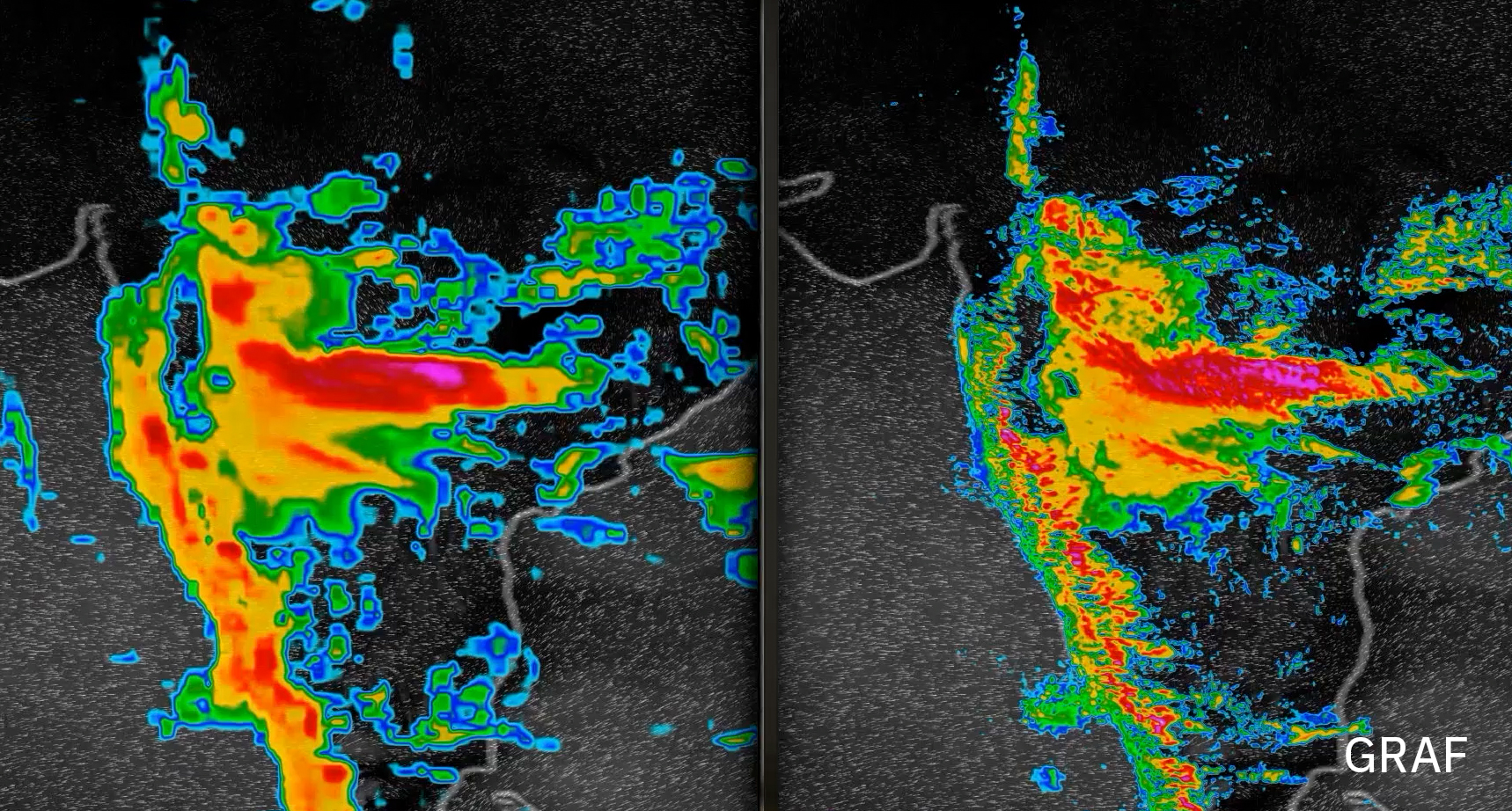
There is substantial machinery underneath those packages. GRAF, the Global High-Resolution Atmospheric Forecasting system, rolled out globally in 2019. Its purpose was to bring finer, more frequently refreshed predictions to places underserved by detailed forecasting. The company’s launch comparison showed the difference between coarse and fine model grids during an Indian monsoon.
In March 2025, The Weather Company announced operational adoption of JEDI, a data assimilation framework developed by the Joint Center for Satellite Data Assimilation. Assimilation brings disparate observations into a consistent starting picture for a model. A sophisticated forecast still depends on a good description of what is happening now.
The company also works with NVIDIA on accelerated computing and AI forecasting. Its broader approach combines models and meteorological judgment. That mixture matters in a market where an impressive model demonstration can attract attention before anyone asks how the output reaches a dispatcher, newsroom, or application reliably.
The people doing that work are part of the product too. On its careers page, the company says nearly half its employees have stayed more than a decade. Its stated working values include listening to customers and inviting constructive debate. That is an employer’s account of its culture, but it fits the practical demands of a field where software specialists and meteorologists must keep checking one another’s assumptions.
04 / Put a price on the next decision
The revenue model follows the distribution. Consumer products carry advertising and offer premium features. Businesses pay for data, software, and specialized services. Developers can integrate weather through APIs rather than building a forecasting operation themselves. AccuWeather also sells commercial APIs, making it one relevant alternative for buyers comparing coverage and features.
1 million calls per month · annual term
Listed October 16, 2026. Major airlines require a custom Enterprise plan.At that published rate, twelve months equals $6,000. A buyer still needs to evaluate integration work and the consequences of missed events or false alarms. Forecast quality varies by location, weather variable, and time horizon. A useful buying test is whether a particular feed improves a particular decision enough to justify its cost. A local broadcaster might care about production time and alert distribution; an airline might put reliability and airspace visibility first. Those requirements call for different evaluations, even when the forecast provider is the same.
Recent partnerships show where the company wants those decisions to happen. In July 2026, Redfin added its historical weather metrics to for-sale home listings. In August, Kalshi announced weather data for verifying market outcomes. In October, Health Action Alliance named the company its weather intelligence partner for workplace preparedness.
The lesson a reader can copy is modest and demanding: choose the action before choosing the dashboard. Decide who responds, how much notice they need, and what a wrong call costs. If nobody can change the schedule, move the inventory, or contact the team, better information may simply arrive at a dead end. The Weather Company’s opportunity lives in making that last connection useful.