The most revealing product The Salvation Army offered in Grande Prairie was not a shelter bed, a sermon or a Christmas hamper. It was a grocery-store gift card. When pandemic school closures abruptly removed lunches and snacks from students who depended on them, the local operation received a C$300,000 Alberta government grant. Four school boards identified more than 200 students. Families received C$100 per child, per month, to shop for themselves.
That detail matters. A standard hamper optimizes distribution: buy in volume, pack identical boxes, move a line quickly. The card optimized for the person carrying it. Parents could pick what their children would actually eat. Captain Peter Kim, who leads community services in Grande Prairie, put the logic plainly: choice was part of dignity.
It also answers the harder questions. What failed first? Access to school food. What changed the team's mind about delivery? A public-health closure that made the old channel useless. What did the alternative cost? C$300,000 in grant funding, with C$100 monthly cards for each registered child. What can another organization copy? Preserve the outcome, not the ritual. The job was feeding children, not defending the hamper.
The red shield is the front door, not the whole house
The Salvation Army in Canada is legally The Governing Council of The Salvation Army in Canada. It is simultaneously a Christian church, a registered charity, a retailer of donated goods and a front-line service provider. Two English converts, Jack Addie and Joe Ludgate, began holding open-air meetings in London, Ontario, in 1882. Today the organization says it is present in more than 400 communities across Canada and Bermuda.
Its customers, if we borrow a commercial word, are not one market segment. They are a family short on groceries, a person sleeping outside, someone rebuilding after addiction, a newcomer learning a language, a trafficking survivor seeking safety, or a firefighter who has worked through the night. Thrift-store shoppers and people donating clothes are part of the system too. So are governments buying contracted services, companies donating stock, volunteers ringing kettles and neighbours writing cheques.
The product line follows the needs: food banks and community meals; emergency and transitional housing; recovery and mental-health programs; disaster kitchens; chaplaincy and spiritual care; camps and school nutrition; human-trafficking response; international development; and 231 thrift stores reported in its 2025 Modern Slavery Act filing. The same filing counted 267 community churches, 110 social-service institutions and more than 9,000 employees in Canada.
Grande Prairie is the model in miniature
The Salvation Army has operated in Grande Prairie since 1919 and runs the city's food bank. By 2025, the local program reported about 400 food-bank appointments a month and nearly 13,000 people served. Its account of food-bank use is startling: from about 5 percent of the city's population in 2016 to a reported 20 percent. The exact denominator deserves care, but the direction is not ambiguous.
We have families who used to give to The Salvation Army, and now they're recipients.Captain Peter Kim, Grande Prairie Community Services
This is the tension under the familiar red shield. Need rises. The donor pool does not automatically rise with it. In 2020, Grande Prairie launched a monetary food drive with a C$100,000 target and approached C$400,000, helped by businesses, individuals, foundations and Rotary. That response was impressive, but it was an emergency surge, not a law of nature.
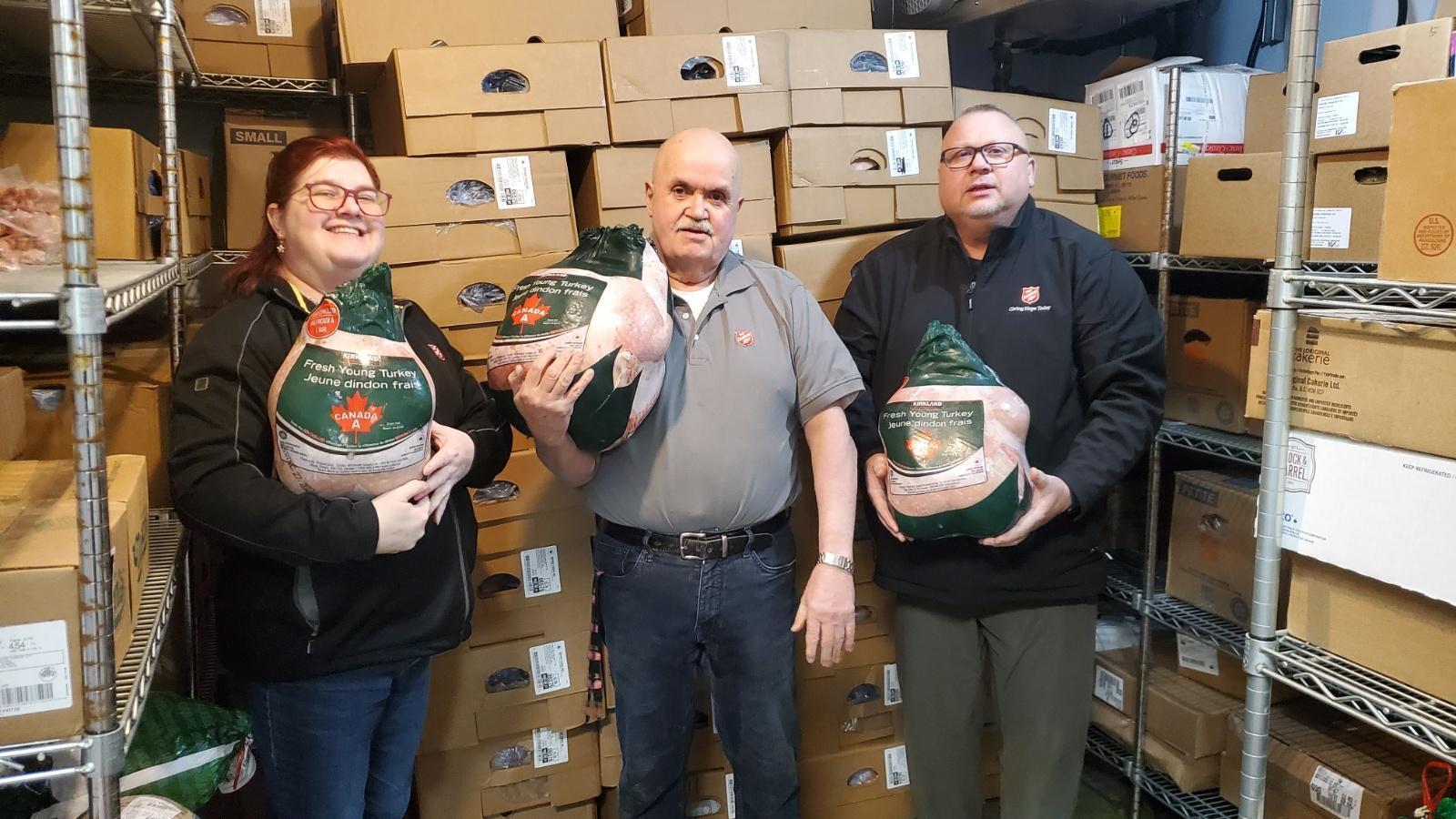
The 2025 Easter partnership with Costco shows a cheaper lever. The retailer donated 75 frozen turkeys that could be added to hampers for larger families. The public cost was not disclosed, so there is no honest price tag to print. The practical value is obvious: the food bank gained protein without buying it, Costco found a social use for surplus inventory, and families gained a meal that felt like a holiday rather than an allocation.
A charity with billion-dollar plumbing
This is not a venture-backed company, so funding rounds and valuation are the wrong lenses. The useful lens is a diversified nonprofit income statement. In the year ended March 31, 2025, consolidated revenue was C$1.1729 billion. Government funding supplied C$487.4 million. Charitable donations contributed C$249.4 million. Sales of donated goods produced C$187.6 million. Investment income added C$136.8 million, with the remainder coming from other sources.
The mix is its strength and its constraint. Government money makes large residential and health programs possible, but it can be restricted. Donations are flexible, but seasonal and sensitive to household finances. Thrift sales turn unwanted goods into revenue, but stores have leases, staff and sorting costs. Investments can move sharply from one year to the next. Fiscal 2025 expenses reached C$1.042 billion, including C$696.8 million for charitable programs and services.
On average across the five years through fiscal 2025, the organization says 87 percent of funding went directly to mission. Headquarters support and accountability represented 9 percent of fiscal 2025 resource investment, while raising resources and awareness took 3 percent. Those ratios do not settle every argument about effectiveness. They do make the machinery inspectable.
Its difference is adjacency
A food bank competes for donations with other food banks. A shelter overlaps with municipal services, YWCAs and local housing nonprofits. Disaster response puts the organization beside the Canadian Red Cross and other emergency agencies. Thrift stores meet Goodwill and Value Village on price, convenience and donations. Looking at any single category makes The Salvation Army seem ordinary.
The difference appears between categories. A meal program can become a conversation about housing. A thrift-store voucher can supply clothing after a fire. A local church can provide volunteers before a national disaster team arrives. A shelter worker can connect someone to recovery support. In Ottawa, a partnership with landlord Behind the Wall paired rental units with Salvation Army case management; the partners reported helping more than 150 formerly unhoused people find housing.
That adjacency also helps in disasters. During the 2024 Jasper and Hinton wildfire response, teams worked for 42 days and served 10,871 meals, 11,593 drinks and 15,416 snacks. The kit included a 36-foot kitchen trailer, refrigeration trucks, a freezer trailer and a mobile bunkhouse. The less glamorous asset was existing presence: people, kitchens and relationships positioned before smoke appeared.
What to steal - and what not to romanticize
The operating playbook is useful well beyond charity. None of it requires military titles or a brass band.
- Define the job before the format. If school lunches vanish, protect nutrition. Do not cling to the lunchroom.
- Design dignity into logistics. Choice-based grocery support can respect taste, culture and family reality better than identical boxes.
- Make the first service a doorway. A meal earns attention; casework can turn that moment into housing, counselling or benefits access.
- Partner for idle assets. Surplus food, retail locations, rental units and volunteer time may be more useful than an unrestricted cheque.
- Pair local judgment with shared infrastructure. Central finance, brand and disaster logistics are valuable only if local teams can still adapt.
Works best when
There is trusted local leadership, a reliable referral network, nearby retailers, accessible grocery options and enough flexible funding to bridge restricted grants.
Breaks when
Cards cannot be used nearby, prices erase their value, fraud controls humiliate users, donated stock does not match need, or volunteers are asked to substitute for permanent capacity.
Choice-based aid is not magic. A C$100 card works differently in a community with one expensive grocer than in a city with transit and competition. Food rescue can be unpredictable, storage-heavy and nutritionally lopsided. A national brand can open doors, but it can also tempt outsiders to assume endless capacity. Even good partnerships fail when the nonprofit quietly absorbs every coordination cost.
The old institution's current test
The Salvation Army's culture is explicit: hope, service, dignity and stewardship, expressed through the vocabulary of officers, soldiers, corps and territories. That structure once looked radically modern. Women preached and led from the movement's early decades. Prison aftercare, salvage work and street outreach turned belief into operating practice.
The current test is less theatrical. It is whether a distributed institution can keep learning faster than hardship changes. Nationally, recent work includes fire-response partnerships with First Nations Emergency Services Society and GlobalMedic, survivor-centred human-trafficking services, and cashless kettle donations. In Saskatchewan, National Recycling Operations took over two thrift stores and a sorting centre so local corps officers could focus on ministry; the stores later reported sales 15 percent over budget.
Grande Prairie supplies the honest ending. The food bank has clever tools, generous partners and more than a century of local memory. It also faces a caseload that has outrun old assumptions about who needs help. A red shield can make trust visible. It cannot make groceries cheaper or donations automatic. The institution's advantage is that it already knows this: when the channel fails, change the channel. Keep the human need in view.
Keep exploring