The O.H.I.O. Fund's portfolio looks less like a venture-capital spreadsheet than a drive across the state. There is a fresh dog-food company near Cleveland, an electric-bus maker in Ottawa, modular housing in Columbus, a logistics business in Dublin, an autonomous steel-fabrication startup in Cincinnati and hundreds of acres positioned for industrial use. The connecting tissue is not a fashionable sector. It is a border.
Since its public launch in June 2024, the Columbus-based private investment adviser has made Ohio the hard edge of its strategy. It raises private capital from institutions, corporations, foundations, family offices and wealthy individuals, many of them in-state, then looks for companies and physical projects capable of producing returns inside Ohio. By March 31, 2026, the private vehicles it manages reported $647 million in commitments from 155 investors. By spring, the platform counted 33 investments and roughly $217 million to $219 million deployed, depending on the reporting date.
Those figures make the firm notable. The design makes it interesting. Traditional venture funds typically specialize in companies. Real-estate funds buy property. Infrastructure managers finance long-lived assets. The O.H.I.O. Fund deliberately puts those categories near one another, seeking situations where an operating business, its factory, its land and a network of local owners can reinforce the same outcome.
Constraint as a product
An Ohio-only rule sounds like a handicap in an industry trained to chase the best deal anywhere. Here, the constraint is supposed to produce information density. Co-founder Mark Kvamme brought experience from Sequoia Capital, JobsOhio and Drive Capital. Co-founder Ray Leach spent two decades building JumpStart's startup and investor network in Cleveland. Founding partners Jill Meyer and Mike Venerable added relationships across Cincinnati business, civic leadership, healthcare and life sciences. Their collective claim is practical: knowing who is building, hiring, selling land, opening a plant or considering a move can reveal opportunities before they become obvious to national capital.
The investor base doubles as a sensing network. By late 2025, the firm said about 120 backers had participated, nearly all from Ohio. The team has said much of its deal flow arrived through that network. A limited partner may know a family-owned manufacturer preparing to scale, a hospital executive who understands a biotech market, or a developer with a site near power and rail. Capital comes with an address book.
“We need major winners here, and we don't need them moving elsewhere when they need later-stage money.”Mark Kvamme, co-founder and CEO
That addresses a familiar regional problem. An early-stage company can grow with local angels, accelerators and seed investors, only to look outside the state when it needs a larger check. New investors may bring useful expertise, but they can also prefer a coastal headquarters, seek control or eventually move intellectual property and senior jobs. The O.H.I.O. Fund focuses heavily on the growth stage - companies with traction and meaningful revenue that need capital to expand. It is trying to make staying local a financially credible option, not a sentimental request.
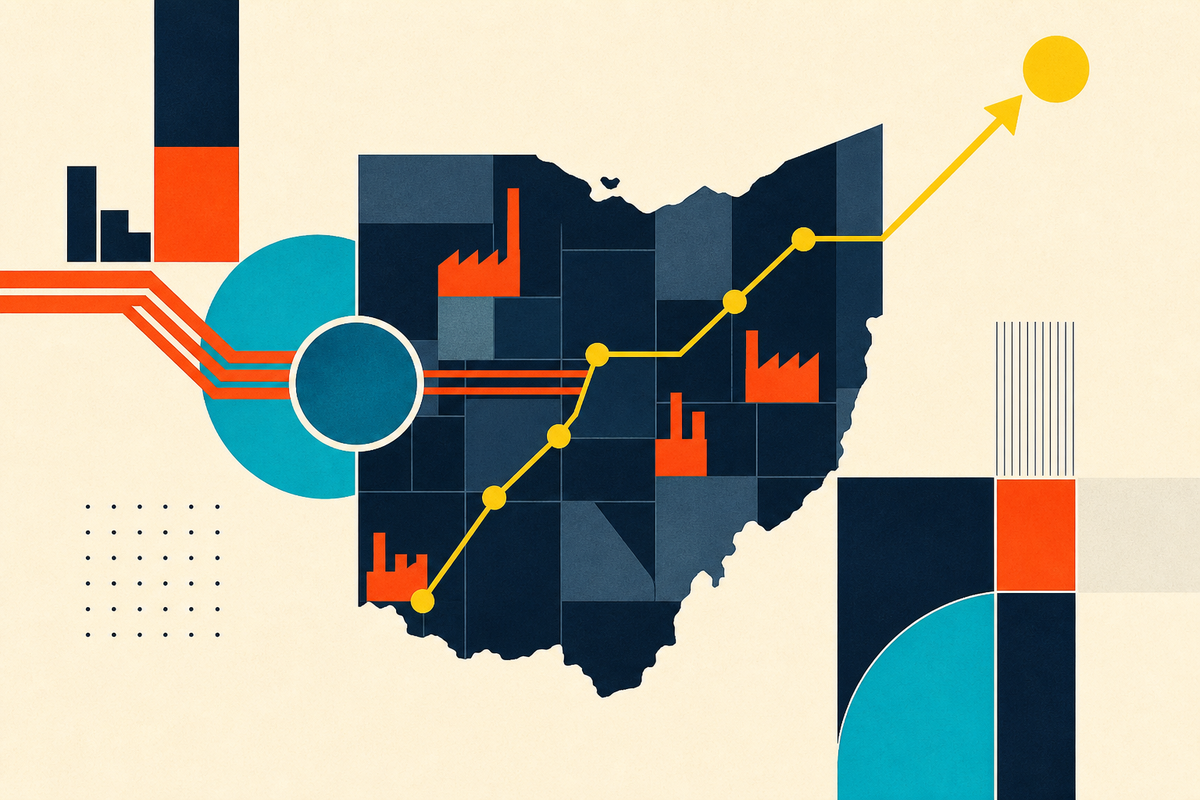
Ohio gets the full geometry treatment: factories, land and a yellow line that refuses to cross state lines.
Three portfolios wearing one coat
The allocation explains how the model works. The firm has described an intended mix of roughly 35 percent growth equity, 30 percent later-stage venture, 30 percent real estate and infrastructure, and 5 percent in other Ohio funds or selected earlier-stage opportunities. In later public descriptions, leaders simplified that to three roughly equal buckets. The point is balance across both risk and time.
An intentionally mixed Ohio portfolio
Growth equity supplies businesses with expansion capital without requiring the fund to buy control. Later-stage venture takes technology risk and offers more upside. Property and infrastructure can produce different cash-flow patterns and may appreciate as factories, data centers and logistics networks expand. Selected fund investments extend the team's reach into deals that do not fit its direct mandate. In January 2026, the firm said its investments had produced more than $75 million in distributions - an early illustration of why near-term and long-term holdings share the portfolio.
The combinations can be literal. The portfolio includes Central Ohio land positioned for digital infrastructure, a 670-acre industrial asset near rail and significant electricity, and companies that need manufacturing space. Hyperframe, which turns digital building plans into snap-together steel framing kits, relocated operations from California to Columbus after an investment. Endera moved its shuttle-bus manufacturing into a former electronics plant in northwest Ohio. The investment is not merely a check; it can be part of a site, workforce and supplier decision.
The network flywheel
+ operators
+ expertise
+ reinvestment
What it actually sells
For investors, The O.H.I.O. Fund sells access to a diversified set of private Ohio opportunities. Its managed products include the evergreen Ohio High Growth Investment Opportunities Fund, the $106 million Ohio Institutional Impact Investment Fund, and special-purpose co-investment vehicles. TOF Manager, LLC operates as an exempt reporting adviser. The interests are private securities, not a retail product, and exact management-fee and carried-interest terms are not public.
For companies and project sponsors, the offering is growth capital plus navigation. A founder can gain introductions to potential customers, executives, co-investors, property owners and public-sector partners. The fund can lead a large financing: in February 2026, its private funds put $25 million into Eagle Wireless' $30 million Series B. It can also syndicate. Endera's financing included Magnetar, Pulse Fund and others. The team works across Cleveland, Columbus and Cincinnati rather than asking every relationship to route through one city.
The products operate on different clocks. A special-purpose vehicle can form around one identifiable deal. The institutional fund offers a defined pool of commitments. The evergreen Opportunities Fund is intended to keep accepting and recycling capital over a much longer life than the standard venture vehicle, whose managers usually invest for several years and then work toward exits before a fixed expiration. That longer horizon fits assets that do not mature together. A logistics company might distribute cash while an industrial site appreciates and a biotech position remains years from liquidity. The mix is meant to reduce dependence on one exit calendar without pretending that private investments become liquid on demand.
A market between impact and private equity
Place-based investing is often grouped with philanthropy or economic-development programs. The O.H.I.O. Fund is explicit that financial return comes first in the underwriting. Its economic-development argument follows from what succeeds: keep a growing company in-state, attract another one, build the industrial site both need, and recycle returns into the next opportunity. That makes it adjacent to impact investing but structurally closer to private markets.
Its competitors change by deal. A software or biotech company might choose a national growth fund, Drive Capital, Narya, Rev1 Ventures, CincyTech or JobsOhio Growth Capital. A family-owned business could sell to private equity. A developer could use a conventional real-estate vehicle. The O.H.I.O. Fund's difference is breadth tied to geography: it can assess several layers of the same regional value chain and convene people who have a stake in more than one layer.
That breadth also creates the main tension. Sector specialists can recognize technical risk faster. National firms can compare a company with hundreds of peers. Concentrating in one state's economy increases exposure to regional policy, labor and real-estate cycles. A network can improve sourcing, but relationships are not a substitute for price discipline. The fund's public materials emphasize its target returns; the durable proof will be realized performance across a much longer period than its first two years.
The useful lesson hiding in the map
Other regions could copy the mechanics without copying the merchandise. Start with a real later-stage financing gap. Recruit local institutions and families as both backers and scouts. Mix operating-company capital with the physical assets those companies require. Build across a state's cities rather than letting one metro dominate the network. Keep the vehicle alive long enough for land, factories and companies to mature on different clocks.
Ohio brings unusually helpful ingredients: a nearly trillion-dollar state economy; depth in manufacturing, healthcare, consumer goods, finance and logistics; research universities; relatively affordable industrial space; and major corporate employers. The model would be harder to transplant where the investable base is thin or local institutions will not commit patient capital. The clever part is not the slogan “Bullish on Ohio.” It is matching a fund's structure to what the place can actually produce.
The portfolio keeps making that argument in concrete form. In July 2026, the fund led a $15 million seed round for 1872, founded by former SpaceX engineers to automate steel fabrication in Cincinnati. The deal sits at the intersection of software, robotics, construction demand, industrial labor and local production - exactly the sort of intersection a single-sector label misses. The O.H.I.O. Fund has put a border around its ambition. Inside that border, it is trying to make the map behave like a market.