The problem with a bus tour is the bus. It arrives with a gratifying amount of noise. There are workers in branded shirts, a local official near a microphone, cameras, handshakes, perhaps a factory floor polished beyond recognition. Then the doors fold shut. The bus moves to the next town. By dinner, the people who gathered around it have dispersed into the immense American category known as everyone else.
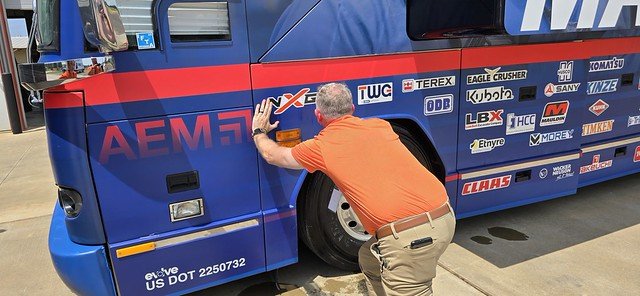
In 2024, the Association of Equipment Manufacturers sent its Manufacturing Express through 22 states and more than 80 stops. The Herald Group, a Washington public-affairs firm, was hired to make the movement last longer than the motorcade. Its solution reveals what the firm actually sells. It is not publicity in the ordinary sense. It is continuity - the careful conversion of a public moment into an audience that can be found, measured, and mobilized again.
The result, in three numbers
The afterlife of an event
The work began in 2023, not with advertising but with an audit of AEM's messaging. The Herald Group built a framework for tone, imagery, and content. When the tour expanded the following year, the firm layered geo-targeted ads around each stop - customized by date, city, and state - and placed them where local audiences and media were likely to see them. It captured attendee data at the stops. Then it followed the event with social posts, earned coverage, and blog content aimed at media contacts, advocates, legislators, and the people who had shown up.
This matters because an event and a campaign have opposite instincts. An event concentrates attention. A campaign preserves it. One wants a crowd on Tuesday; the other wants a constituency in November. The Herald Group's method was to make each physical stop a data-gathering and narrative-producing node in a larger system.
“A lawmaker can ignore lobbyists in Washington. They can't ignore someone they know calling from back home.”The Herald Group on grasstops advocacy
The published results are specific: a five-times ad frequency among key audiences, a 0.46 percent click-through rate, 22 earned-media placements connected to outreach and ad exposure, more than 1.7 million post-tour impressions, 74,000 social engagements, and an 11.24 percent engagement rate. AEM content saw a 36 percent lift in engagement. The work received recognition from the Reed Awards and Ragan PR Daily.
What did it cost? The firm calls the budget modest but does not attach a dollar figure. That makes the allocation more interesting than the total: spend was concentrated by place and moment instead of sprayed nationally, and the audience was reused after each stop. The economy was in precision.
A press shop becomes an operating system
The Herald Group opened in 2005, when Matt Well, Taylor Gross, and Doug McGinn set out to bring what they called a “campaign mentality” to strategic communications. The phrase was less obvious then. The launch office had borrowed or salvaged furniture. The founders bought laptops on already-stretched personal credit cards. There was no Wi-Fi, no iPhone, no Slack, no Zoom, and Twitter did not yet exist.
The original insight was organizational: communications, lobbying, field work, and grassroots mobilization become more useful when they follow the same plan. Two decades later, the list has lengthened. The firm now sells earned media, digital advertising, creative, social and influencer work, coalition management, grassroots and grasstops activation, corporate reputation, crisis response, litigation communications, transaction support, and AI-assisted narrative intelligence.
The customer pays for the engagement, but the users of the message are scattered: a regulator reading coverage, a legislative aide watching constituent calls arrive, a trade reporter deciding which expert sounds credible, or a local business owner asked to sign a letter. The Herald Group's product is the choreography.
What failed first was continuity
There is no public account of a botched first attempt. The failure here is structural. A roadshow naturally resets in every city, forcing organizers to rebuild attention from zero. The Herald Group changed the unit of work. The stop was no longer the finished product; it was raw material for the continuing campaign.
That explains why the firm looks different from a conventional PR agency and from a pure lobbying shop. A PR agency can secure coverage. A lobbyist can carry an argument into a meeting. The Herald Group positions itself between and around those tasks, adding outside validators, constituent activity, paid distribution, measurement, and rapid response. Its alternatives include large consultancies such as APCO, specialized Washington firms such as DCI Group, CGCN Group, Seven Letter, and Narrative Strategies, and the in-house team that believes it can coordinate all of this itself.
The approach is most useful when the decision is political or regulatory, the audience is identifiable, local credibility matters, and there is time to build an infrastructure before the decisive vote, ruling, or news cycle. It is a poorer fit when the actual problem is product quality, price, legal merit, or basic trust. A communications system can distribute a good argument. It cannot manufacture the underlying proof forever.
The part worth copying
- Write the message architecture before you commission the assets.
- Attach distribution to real-world moments when attention is naturally available.
- Collect permissioned audience data while interest is warm.
- Turn every event into reusable proof: coverage, quotes, images, and local validators.
- Measure action after the spectacle, not merely attendance during it.
From clippings to answers
In 2026, The Herald Group made AI and analytics an explicit practice, creating senior leadership around online intelligence and AI innovation. The offering includes narrative monitoring, synthetic-audience testing, analysis of which allies might move a vote, and work intended to improve how an organization appears when policymakers or journalists ask an AI system a question.
There is a neat historical loop in this. The firm began when the communication problem was a 24-hour cable cycle and the novelty was combining old media with a website. Now a client must worry about streaming television, influencers, platform rules, search results, AI summaries, and a hostile story hardening overnight. The channels multiplied. The original proposition did not: decide the outcome, identify the audiences that can affect it, and make every tool serve the same campaign.
The firm's own culture includes a rule that clients should not confuse activity for progress. The bus tour makes the rule visible. Eighty stops are activity. The audience that remains reachable after stop eighty is progress.
Keep exploring