The cloud was supposed to make databases somebody else's problem. In a sense, it did. A managed service can spare a team the ritual of provisioning machines and replacing disks. But a large company rarely has one database, one cloud, or one opinion about who should touch production. It has an Oracle system no one dares rewrite, a SQL Server bill that grows every quarter, a PostgreSQL service in another region, and a recovery plan whose most strenuous exercise was a slide deck. Tessell was founded in 2021 for this untidy reality.
- Tessell manages databases across major clouds from one control plane; the databases and backups run in the customer's cloud account.
- Its core engines are Oracle, SQL Server, PostgreSQL and MySQL. Backup, recovery, data cloning and policy controls are part of the pitch.
- A $60 million Series B in April 2025 brought announced funding to $94 million.
- Public customer cases report savings, faster operations and stronger recovery practice, with results tied to each estate.
The unusual address of the data
Tessell's central distinction is physical before it is philosophical. Its control plane, which orchestrates provisioning and operations, sits in Tessell's tenant and holds metadata. The data plane - databases, backups, snapshots, logs and monitoring data - runs in the customer's cloud account. Customers can use their own network and encryption keys. To an enterprise security team, this is a more persuasive sentence than a hundred adjectives about trust.
The company supports deployments across AWS, Microsoft Azure and Google Cloud, and sells managed service for Oracle, SQL Server, PostgreSQL and MySQL. That makes it an alternative to stitching together a provider's native database service, separate backup tooling, scripts for cloning and one more spreadsheet for licenses. The prospect is especially tempting when an organization has moved much of its technology to one cloud but its stubborn old database remains elsewhere.
The founders knew the disorder well. Bala Kuchibhotla, Kamal Khanuja and Bakul Banthia brought, by the company's account, more than 50 years of combined database and data management experience. The name comes from tessellation, the fitting together of pieces without gaps. It is an apt ambition for a business that sells to people whose job is largely to notice gaps before everyone else does.

The backup that earns its keep
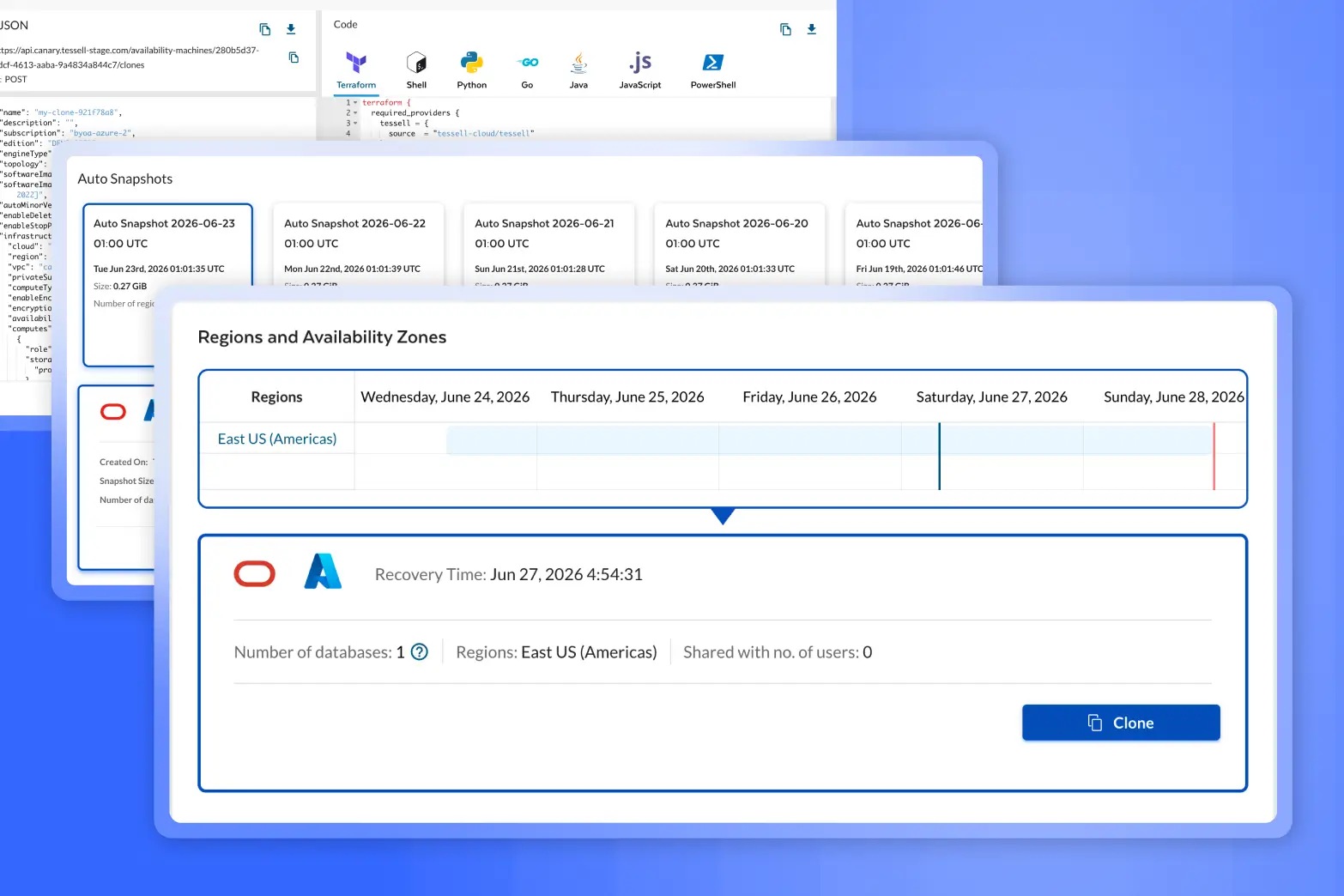
The first thing that often fails in database recovery is not the backup. It is the chain between a backup file and a working service: the right point in time, the right permissions, the right region, and a restore anyone has actually rehearsed. Tessell's Availability Machine is designed to make protection a default part of provisioning. It captures snapshots, transaction logs and engine-native backups; its Dataflix catalog lets authorized people browse recovery points and clone or restore from them.
This is useful on an ordinary Tuesday, too. A developer can request a fresh test environment; an analyst can work from a governed copy; a DBA can offer masked production data to a QA team without exposing raw personal records. Data access policies define who gets which copy and where it may go. A product that makes the recovery copy useful before a crisis has a better chance of finding out whether recovery works.
“Enterprises know they need to modernize their database estates. The question is how to execute with speed without breaking what is already working.”Bala Kuchibhotla, Tessell co-founder and CEO
The bill, the drill, and the benchmark
A Fortune 500 US bank offers a useful example of what changed a buyer's mind. It was dealing with rising Amazon RDS costs and an expensive Exadata estate. According to Tessell's case study, the bank also wanted something its existing arrangement did not make practical: quarterly cross-region disaster recovery drills with a clean return to the primary region. Its DBAs wanted more diagnostic control. Tessell deployed a dedicated control and data plane inside the bank's AWS environment, and the bank reported 30% lower database costs and a 15-minute recovery point objective for its cross-region drills.
The price of a move like that is not just a software quote. It includes migration planning, workload validation, licensing, operations and the cloud resources the customer still pays for. Tessell's public pricing page offers custom quotes based on engines, cloud, performance and availability; it also offers purchasing through cloud marketplaces and committed spend. There is no universal price tag, which is sensible for a product sold into estates that can differ by hundreds of databases.
Figures are from separate customer case studies published by Tessell. Workloads and baselines differ; these are examples, not a general performance guarantee.
The collectibles case is another sharp illustration. A US marketplace moved SQL Server workloads from RDS to Tessell in about six weeks. Its reported IOPS rose from 30,000 to 1.6 million and annual costs fell by roughly a third. The first constraint was the old performance and cost combination; migration of additional workloads followed the initial result. That 53-fold headline is eye-catching, but it describes one comparison, not a promise that anyone's query will run 53 times faster. A reader can copy the method: establish a baseline, test a representative workload, include the full operating bill, and expand only after the first migration behaves as expected.
A database company reaches beyond databases
Tessell is entering a crowded market. AWS, Azure and Google each have managed database products; organizations can also run engines themselves or hire specialist operators. Tessell argues that the gap is between those silos: one operational language for multiple engines and clouds, with deeper administrator access and a customer-owned data plane. The company does not win merely by being multi-cloud. It wins only if that common layer proves cheaper or easier than the tools a customer already has.
Its September 2025 Microsoft Fabric integration hints at a second act. Tessell's Data Ecosystem Pipelines can stream changes from managed Oracle databases into Microsoft OneLake for analytics. Here the company is no longer selling only the safe keeping of operational data; it is selling a path to use fresher data elsewhere. For a customer whose nightly batch job has become the first thing analysts complain about, this is a natural extension. For one with a simple single-cloud PostgreSQL application, a larger control plane may add more ceremony than value.
The Series B money - $60 million led by WestBridge Capital, with Lightspeed, B37 and Rocketship participating - gives Tessell room to pursue that wider platform. Its announced total funding reached $94 million. Funding is evidence of ambition, not proof of the economics. Those will be decided in the unromantic places: an audit, a recovery drill, a renewal meeting, and the morning after a cutover.
That is the appeal of this company. It has taken the least theatrical part of computing and asked a surprisingly human question: when someone says they will take care of your database, how much control do you have to give away? Tessell's answer is that the work can be delegated while the keys remain at home. In enterprise software, that may be the closest thing to romance a database administrator ever gets.