A mortgage closing has the satisfying finality of a finish line. Signatures arrive. Money moves. A borrower gets the keys. For the people responsible for quality control, however, the file remains an argument to be tested: does the evidence support the decision? TENA Companies has made a business out of asking that question, then giving lenders somewhere to put the answers.
- Three checkpoints: before funding, after closing, and throughout servicing.
- Two buying choices: hire TENA’s auditors or license SECONDLOOK for an internal team.
- One unfinished job: assign, challenge and resolve the findings after a review.
The Saint Paul firm dates its mortgage QC work to 1982. Its company description on LinkedIn reports more than 1,000 lender and servicer clients nationwide. That puts it in an easily overlooked part of financial services: the machinery that checks the machinery. Its customers need to know whether files, decisions and servicing practices stand up to the requirements attached to their loans.
The software buyer who counted the training
Consider RIHousing. In February 2021, the housing agency’s board reviewed a proposal to license quality control software. Its servicing audits were then handled by a third party. Two vendors responded to its procurement, and TENA’s proposal received a weighted score of 8.3 out of 10.
The board record singled out SECONDLOOK’s testing scripts, regular updates and access to support representatives. But another detail deserves attention: onboarding the software and training employees would take effort. RIHousing therefore sought a three-year license, with an option for two more years. The software purchase came with an investment in learning how to use it.
That is a useful way to understand TENA’s business model. A lender can buy the company’s audit labor or license its tools. Those choices demand different things from the buyer. Bringing reviews inside requires people who can perform them. Hiring a reviewer still leaves the institution with decisions to make about what the findings mean.
RIHousing’s weighted score for TENA’s software proposal. A procurement result, not a universal product rating.
One engine, two ways to buy
SECONDLOOK arrived in 1993. TENA licenses it to institutions doing their own reviews and uses it in its own outsourced audit division. The interesting feature is that shared foundation: a software customer and a service customer draw on the same audit application.
The questions are maintained through work by TENA’s legal team, Rules and Compliance Group, and internal QA team. Additions, deletions and revisions are published monthly. The company describes thousands of prewritten questions addressing agency requirements and federal and state rules. Consumer lending and servicing are also supported.
This is where specialist knowledge becomes a product. A revised requirement must become something an auditor can test against a particular file. TENA’s state-specific offering includes questions tied to applicable statutes or guidelines and approximately 5,000 questions covering residential foreclosure. The humble question is carrying quite a workload.
A mortgage has more than one moment of truth
Before funding, TENA reviews income, liabilities, assets, origination documents and the appraisal. The company advertises a 48-hour turnaround. The purpose is immediate: identify issues while the transaction is still pending, when the lender can address them before closing.
After closing, selected files get another examination. Income, assets, employment and credit are reverified. In servicing, the questions change again. Payment processing, escrow, adjustable-rate changes, loss mitigation, foreclosure and servicing transfers become subjects for review. TENA targets servicing functions through what it calls Areas of Inquiry and combines recent findings with historical results to analyze trends.
The portfolio extends to MERS document reviews, data reconciliation, annual reviews, customized QC plans and forensic audits. This places TENA among specialist providers of mortgage audit work and audit technology. Cogent QC Systems offers another software route. An institution can also retain its own QC operation. TENA’s particular proposition combines the reviewers, their software and the follow-up workspace.
The report is where the next job begins
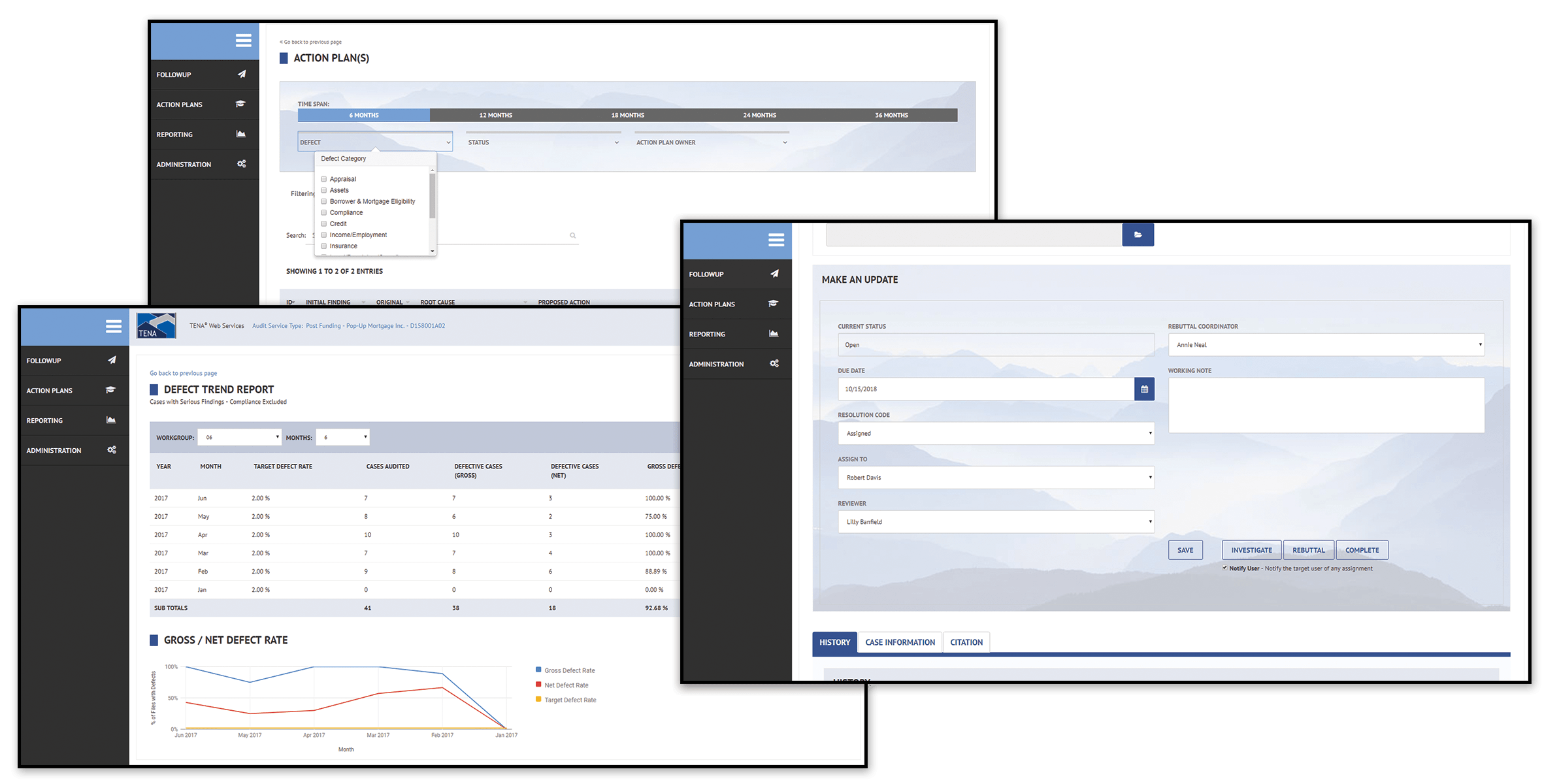
TENA Web Services, or TWS, handles file transfers, reports, audit follow-up and action plans. A client can assign a defect to a responsible person, add notes, dispute a finding and track its resolution. TENA includes the cloud-based platform for its clients at no additional cost.
“Come for the opportunities, stay for the people.”TENA’s careers page
Fannie Mae’s QC reporting guidance makes a related point: management needs information it can use to evaluate loan production quality. It calls attention to defect trends, reverification success and the accuracy of testing itself. That last category is a pleasing complication. The people doing the checking need checking, too. Read this way, TENA’s reporting and remediation tools belong to a larger discipline: keeping the review process accountable alongside the loans it examines.
The operational lesson is straightforward. A finding needs an owner and a recorded response. A report can identify a problem; an assignment makes it somebody’s next task. The platform gives teams a place to preserve that exchange. Its usefulness still depends on people providing evidence, deciding what to change and following through.

The price of keeping a small portfolio interesting
RIHousing’s September 2024 procurement recommendation supplies another revealing detail. Three vendors bid for post-closing audit work. TENA scored 8.6 out of 10, and staff recommended a three-year engagement capped at $200,000 annually. That ceiling describes one proposed contract, rather than a general price list or actual spending.
The rationale was unusually candid. Small annual audit volumes had previously discouraged vendor interest. Offering three years of work yielded multiple bids. The lesson for another buyer is practical: contract duration can matter alongside price. For TENA, the recommendation also shows what a buyer valued: current testing content backed by dedicated legal and compliance staff.
The same attention to people appears in TENA’s community activities, which include volunteering and support for Neighborhood House, Open Arms and the Military Heroes Foundation. Inside the business, the work remains deliberately specific. Check the evidence. Record the problem. Give someone responsibility for the next move. The keys may have changed hands; the loan still has a life ahead of it.