Imagine a payment that looks harmless until you remember the twelve payments that came just before it. The model judging the thirteenth transaction may be clever. It may have read millions of examples. But if those twelve payments are still waiting in a batch job, its cleverness is beside the point. This is the small, expensive interval in which Tecton built a company.
The short version
- Tecton turns raw, streaming, and request-time data into features that models can use immediately.
- Its founders helped build Uber's Michelangelo machine-learning platform, then sold similar infrastructure to other teams.
- Customers have used it for fraud, risk, search ranking, pricing, and personalization.
- Databricks announced an acquisition in 2025; the deal price was not disclosed.
A feature is a useful fact distilled from raw data: the number of transactions in the past half hour, perhaps, or how often a shopper has opened a product page. The facts sound ordinary. Making them correct, recent, reusable, and available at the instant a model asks is not. A data scientist can calculate one in a notebook by lunch. Putting the same calculation into a dependable live service can consume months.
An Uber problem, sold to everyone else
Mike Del Balso, Kevin Stumpf, and Jeremy Hermann had already met this problem at Uber. They worked on Michelangelo, the company's internal machine-learning platform, which supported uses from arrival-time estimates to fraud detection. Tecton, founded in 2019, was their attempt to make a version of that production machinery available beyond one unusually well-equipped technology company.

The company launched publicly in 2020 with $25 million across seed and Series A funding from Andreessen Horowitz and Sequoia Capital. By December it had made its platform generally available and raised another $35 million. In July 2022, a $100 million Series C led by Kleiner Perkins brought its announced funding to $160 million. Databricks and Snowflake Ventures joined that round as strategic investors. The money bought room to build an enterprise product around a stubborn operational headache.
The first thing that fails in many machine-learning projects is not the model. It is the journey from a promising experiment to a live decision. A company may have a warehouse, a stream of events, an online database, a scheduler, and a service that makes predictions. Each piece works. The trouble begins when the same feature must mean the same thing in every piece, at every time, for every team.
One definition, two clocks
The critical test: did the model learn from the facts it could really have known at the time?
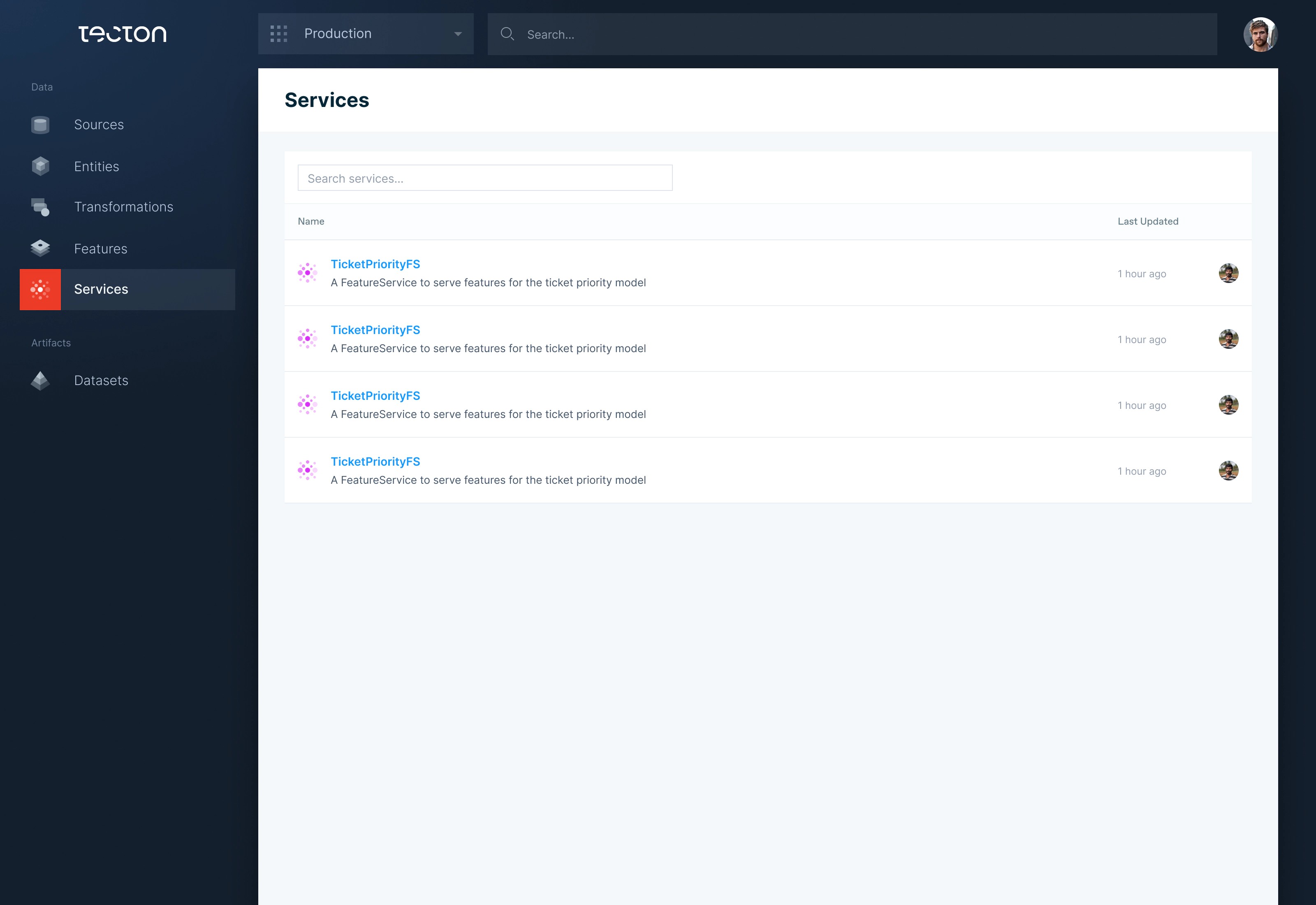
Tecton's answer is to let teams define a feature in code, then manage its computation, backfill, monitoring, and serving. Its Feature Views describe the transformations; Feature Services bundle features for a model. Historical retrieval reconstructs what was known at a given moment, while the online service supplies current values for a live prediction. The point-in-time distinction matters: if a model trains on tomorrow's information while pretending it lived yesterday, its test score becomes a flattering fiction.
The invoice arrives in engineering hours
Tecton is a managed enterprise platform, sold on a consumption basis according to its product material. Its public site asks prospective customers to book a demo rather than presenting a simple list price. The bill is only one cost. A buyer also has to connect sources, define features, check correctness, and decide how much freshness a particular decision is worth. The alternative is often an internal platform with its own permanent maintenance crew.
The choice becomes sharper when the customer story gets specific. Tide, the UK business-finance platform, tested Tecton over six weeks for onboarding risk and transaction matching. Its team had been generating features through separate Spark pipelines that were hard to share or catalog. After the trial, Tide made Tecton a core part of its ML stack and used it for most production models. What changed its mind was a working proof of concept across real use cases, including data monitoring it did not want to build itself.
“We didn't want to be in the business of creating MLOps tools when there are so many companies out there who are ahead of us in the game.”Erik Widman, HelloFresh
HelloFresh arrived at a related calculation. It considered building a feature store, using open source, or buying a more complete platform. A home-built system would take time; the open-source options it evaluated did not cover everything it needed; an all-in-one replacement for its ML stack would be hard to win support for. Tecton fit the narrower job: standardize features and help models reach production without asking the organization to reorganize around a new master system.
Atlassian offers the most memorable measure. Its case study says feature build and deployment fell from one to three months to one day, and that the work improved more than 200,000 customer interactions a day. Those are customer-reported results, tied to Atlassian's own workflow. They do not promise the same return for a company whose models run weekly or whose data is already clean. But they show precisely what Tecton was selling: time returned to people who wanted to improve a product, not nurse its feature pipelines.
The clever part is the unglamorous part
A basic feature store can hold values and hand them back. Tecton's broader claim is that it manages the life around those values: definitions, scheduled and streaming transformations, historical correctness, governance, deployment, and monitoring. That is its difference from a plain database, and from stitching a store to a collection of separate pipeline tools. Its managed service also differs from Feast, the open-source feature store to which Tecton contributed heavily. Feast began at Gojek and Google Cloud and later broadened its maintainer group; it is a project in its own right.
In 2024, Tecton widened its vocabulary. Rift, its Python-native compute engine, entered public preview. The company also announced support for embeddings, prompts, and other context used by generative AI systems. A chatbot answering a customer question and a fraud model assessing a payment share one awkward need: each must retrieve the right current facts at the moment of use. Tecton could stretch its feature machinery toward that wider category without abandoning the problem that gave it a reason to exist.
The market around it is crowded. An engineering-rich company can build its own pipelines; a team with modest requirements can use Feast or features in a cloud ML platform; other vendors sell competing feature platforms. Tecton makes most sense when decisions are frequent, the data changes quickly, and mistakes or delays are expensive. A weekly forecasting model fed by a tidy warehouse has little reason to pay for millisecond serving. That boundary is useful: expensive infrastructure should earn its place by solving an expensive problem.
A buyer who had already been a partner
Databricks had invested in and partnered with Tecton before announcing in August 2025 that it would acquire the company. Its stated aim was to bring Tecton's real-time serving into workflows for AI applications and agents. The logic is plain enough. Databricks holds and processes enormous amounts of enterprise data. Tecton specializes in turning the relevant slice of that data into something an application can use now.
The announced transaction price was not public. Reports of a $900 million figure referred to Tecton's valuation in its 2022 funding round, not to what Databricks paid. It is an instructive distinction for a company whose value rests on getting the timing of facts exactly right.
There is a practical lesson here for anyone building an AI product. Start with the decision, then identify the few pieces of information that must be fresh for that decision to improve. Measure how late they arrive, whether the training set could really have seen them, and what it costs to keep them current. Build or buy only after those answers are visible. Tecton's bet was that many companies would discover the same thing its founders found at Uber: the dramatic model is the easy part to demonstrate. The quiet data system is the part that lets it be believed.