The first TaxSlayer product was not dreamed up by a founder pacing in front of a whiteboard. It came out of a tax office. In 1965, Aubrey Rhodes Sr. opened Rhodes-Murphy & Co. in Augusta, Georgia. By 1989, the second generation had a practical problem: tax preparation was becoming a software business, and the software available to the family did not fit the way its preparers worked. So they decided to write their own.
A professor at what is now Augusta University heard the pitch over a round of golf. His review, recalled years later by Aubrey's grandson Brian Rhodes, was admirably concise: “That is the dumbest thing I've ever heard.” The family shipped anyway. The software escaped the office, became TaxSlayer Pro and reached accountants around the country. In 1998, the company went direct to consumers online.
That sequence explains TaxSlayer better than any sports sponsorship or aggressive brand name. It is a vertical-software company with tax preparation in its muscle memory. It serves the professional doing hundreds of returns and the person who would rather never meet that professional. The overlap sounds dangerous. In practice, it gives TaxSlayer two ways into the same unavoidable annual ritual.
The product is confidence with a calculator attached
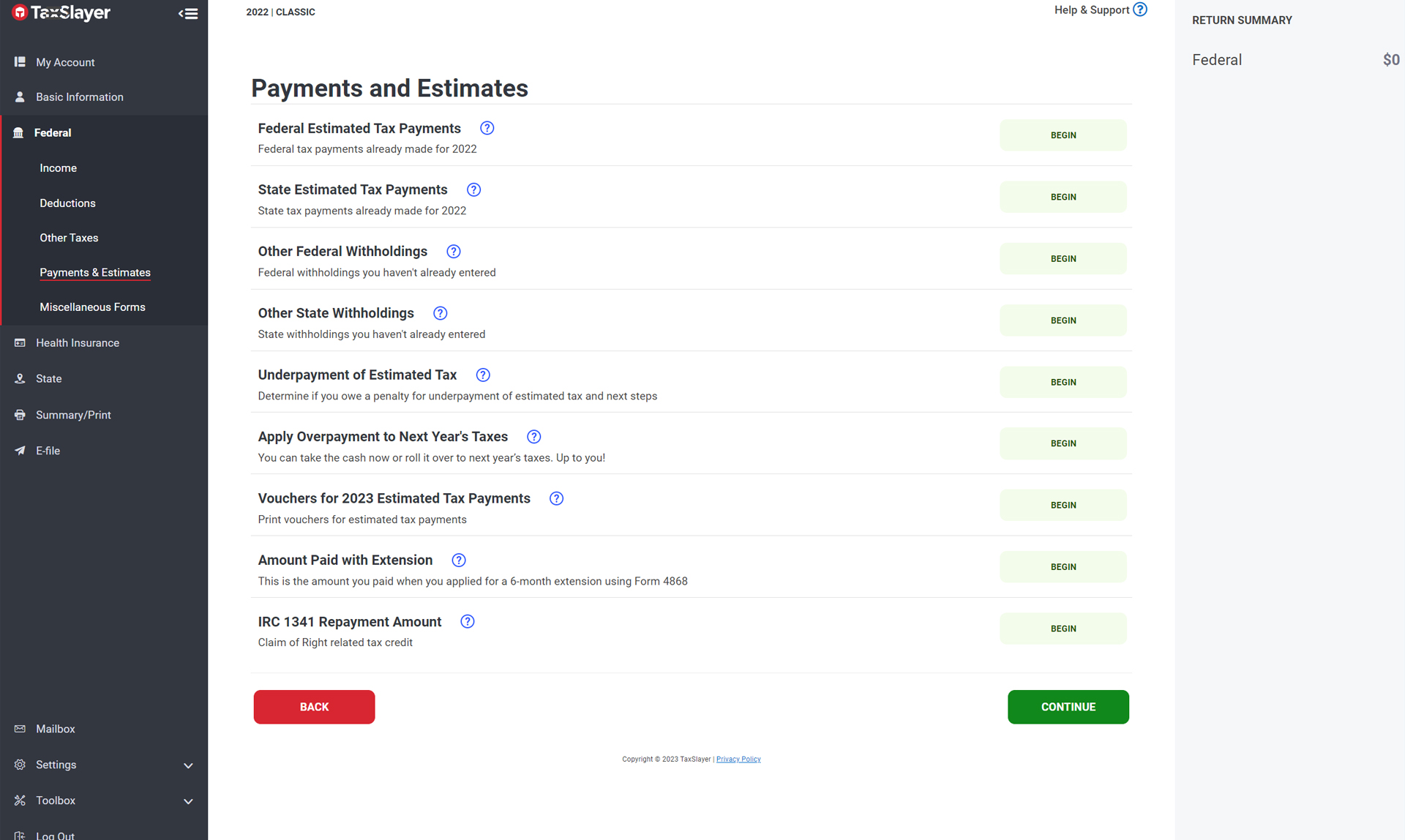
For consumers, TaxSlayer asks questions, performs calculations and transmits supported federal and state returns electronically. Simply Free handles a limited simple-return profile. Classic opens the catalog to all major supported forms, income types, credits and deductions. Premium layers in priority phone and email support, technical chat and access to a tax professional. Self-Employed adds guidance for 1099 income, Schedule C expenses and estimated payments.
This is where the company makes a sharper choice than its branding suggests. The paid tiers are largely arranged around confidence. A Classic customer may have rental income, stock sales or a mortgage and still get broad form coverage. A Premium customer pays more because she wants a human within reach. The software task is calculation; the emotional task is reducing the fear that one strange box on a 1099 has just ruined April.
Its audience is therefore wider than “people with easy taxes,” but narrower than everybody with a Social Security number. Wage earners can use the basic interview. Investors, homeowners and landlords can use Classic when their supported forms fit. Contractors and side hustlers get a product named for them. People who want live reassurance move toward Premium or Self-Employed. Compared with TurboTax and H&R Block, TaxSlayer's public pitch is price. Compared with bare-bones free tools, its pitch is guided preparation and reachable support. The product lives in the middle: less ceremony than an appointment with an accountant, more guardrails than filling government forms alone.
What it cost at the time of reporting
Federal return list prices shown by TaxSlayer for the 2026 season. Paid state returns were listed separately at $47.99. Promotions, eligibility and final checkout prices can change.
Free has a trapdoor - and a label
The first thing that can fail is eligibility. Simply Free is not “the same product, but free.” It is a narrow lane. TaxSlayer's published criteria exclude dependents, itemized deductions and many kinds of income; the company says fewer than a majority of U.S. taxpayers qualify. Add a form or item outside that lane and the return can move to Classic. Users can inspect which item caused the upgrade and remove it before paying if it was entered by mistake.
That boundary is the most important condition in the consumer offer. A student with wages and education credits may find the free path unusually useful. A parent claiming children, a landlord, an investor or a gig worker should assume the paid lane is more likely. Starting free still lets someone enter information before paying, but time invested in a return creates its own switching cost. The copyable lesson is to show the upgrade cause, not merely the upgrade button.
“The best SaaS wedge is often a messy internal workflow that somebody already knows by heart.”The TaxSlayer pattern, in one sentence
One market, two very different desks
TaxSlayer Pro is the other half of the business. Its Classic desktop package offers unlimited 1040 e-filing, all states, support and bank-product integrations. Premium adds paperless-office features and the TaxesToGo mobile app. Pro Web moves the workflow into a browser, with a client portal and digital signatures. The mobile app lets a preparer's clients photograph documents instead of waiting under fluorescent office lights with a folder full of W-2s.
The customer here is not buying a once-a-year filing. She is buying throughput. The expensive failure is a blocked preparer, a missing state form or a support queue during the few weeks when the practice earns most of its annual revenue. TaxSlayer's expertise comes from having operated the original workflow itself. It knows why unlimited filing, prior-year pull-forward and fee collection from refunds matter to a small office.
Where TaxSlayer sits
H&R Block
TaxAct
FreeTaxUSA
Cash App Taxes
CCH
Lacerte
Drake
TaxWise
The company also appears in the public-service layer of the market. TaxSlayer software has been used in IRS Volunteer Income Tax Assistance and Tax Counseling for the Elderly workflows, where trained volunteers help lower-income filers, older adults, people with disabilities and taxpayers with limited English. That is a very different distribution channel from a college bowl game, but it draws on the same compliance engine.
What changed their mind?
The family did not pivot because tax preparation stopped working. It changed because technology was going to reorganize the work. The first move was defensive: build a better tool for the desks they already owned. The second was commercial: sell it to other preparers. The third was expansive: let consumers use the web product themselves. By 2019, CEO Brian Rhodes was publicly describing a shift “from a tax company to a tech company.”
That year TaxSlayer opened a technology campus in a restored 1923 building on Broad Street in downtown Augusta. The multimillion-dollar project could hold more than 200 full-time employees across five stories, while a separate center handled a seasonal support force that swelled by more than 300. Open floors, huddle rooms, an arcade and a gym were not the strategy. They were recruiting infrastructure for a company trying to hire software talent without abandoning its home city.
Outside capital came late. In January 2021, Marlin Equity Partners made an undisclosed growth investment. The prior filing season had produced more than 10 million federal and state returns and $15 billion in refunds through TaxSlayer products. This was capital arriving after decades of domain learning, not a check funding a theory. The amount and valuation remain private.
The part worth stealing
Solve a workflow your own operators repeat. Their complaints are a better backlog than abstract market research.
Package the internal tool for peers before chasing every consumer. Similar operators reveal what is truly reusable.
Separate functional complexity from emotional support. Customers may need the same forms but different amounts of reassurance.
If free ends, identify the exact input that ended it. A transparent boundary preserves more trust than a surprise checkout.
TaxSlayer also understood the peculiar marketing calendar of tax software. Demand spikes, then disappears. Its answer was to buy memory: NASCAR, golf and a title sponsorship of the Gator Bowl that began in 2012 and now runs through the 2027 game. “TaxSlayer” sounds faintly absurd until a sports announcer repeats it through December. Then April arrives and the joke has become recall.
When this model does not work
The playbook needs three conditions. First, the workflow must repeat often enough that internal expertise becomes software advantage. Second, mistakes must be costly enough that customers value trust and support. Third, the underlying rules must be standardized enough to encode. A rare bespoke service with no recurring process will not productize cleanly. A casual tool with trivial consequences cannot charge much for reassurance.
TaxSlayer itself is not the right fit under every condition. A filer with a very complex business, cross-border issues or a need for tax planning may be better served by a credentialed professional. A qualifying taxpayer may get a better price through an IRS-linked free program, VITA or another free competitor. A tax practice that requires a specialized form, deep advisory workflow or a particular integration should test that exact case before switching platforms. “All tax situations” is always bounded by the forms a product supports.
Still, the company's path is unusually legible. Do the work. Build the tool. Sell it to people who do the same work. Then decide which parts a consumer can do alone and which parts deserve human backup. TaxSlayer's helmet logo is decoration. The durable idea underneath it is that software can automate the return without pretending the customer has stopped being nervous.