A job at Chicago City Hall comes with an organizational chart. Tarrah Cooper Wright also brought a family tree. All four of her grandparents had migrated to the city from the Jim Crow South, pursuing the opportunities denied to them there. Years later, their granddaughter was working on the mayor’s messages about the place they had chosen. When education, transportation and public housing reached her desk, she thought about representing them. The people affected by a municipal decision had familiar faces.
That connection gives Cooper Wright’s career a useful point of entry. She is the CEO and founder of Rise Strategy Group, a communications and public affairs firm. Before that came television reporting, presidential campaigning, federal government work and a mayor’s press office. The résumé travels widely. Chicago keeps pulling it home.
There are several ways to count professional progress: titles acquired, offices occupied, introductions accumulated. Her public commitments suggest another calculation. Once a person has access, how many other people can use it? An open door becomes more interesting when somebody else walks through.
A reporter changes sides of the microphone
Cooper Wright studied journalism at the University of Missouri-Columbia, graduated cum laude and began as a general assignment reporter at KOMU-NBC 8 in Columbia. Reporting offered a way to engage with public life. It also revealed a professional preference: she wanted more room to argue for an outcome.
“I wanted to be an advocate instead of being objective.”
Tarrah Cooper Wright, reflecting on her move from journalism
A college internship on Capitol Hill helped point her toward politics. In 2008, she worked on the Obama-Biden presidential campaign in Florida. Her responsibilities included recruiting, training and managing community leaders and volunteers, increasing voter contact and helping execute community events. This was communication measured in participation. A message had to become something another person could act upon.
She subsequently worked in the Obama administration at the Department of Homeland Security in Washington. Her assignments included messaging around the Haitian earthquake and the Deepwater Horizon oil spill. The move from campaign work to government brought a different responsibility: communicating an institution’s actions as events unfolded.
Campaigns and government offices have their own vocabularies, but both depend on translation. People outside the organization need to understand what is happening and why it concerns them. The press release is only the visible object. Behind it sits the harder business of deciding what can be said clearly and supported.
- 2008Obama-Biden campaign
Florida organizing - 2010Emanuel campaign
Deputy press secretary - 2011Chicago City Hall
Mayor’s press secretary - 2016Rise Strategy Group
Founded with Tara Swords
A city has more than one audience
Cooper Wright joined Rahm Emanuel’s mayoral campaign in 2010 as deputy press secretary. When he became mayor, she became his press secretary. Her work included being the administration’s day-to-day spokesperson and developing messages for major public events.
Consider the range: the 2012 NATO Summit, the 2015 NFL Draft, Chicago Gourmet and the 2015 James Beard Awards. Diplomacy, football and food share a city without sharing an audience. Each occasion requires a different explanation of what Chicago is offering and what people should expect. A city’s public voice has to accommodate more than one conversation.
The mayor’s spokesperson also occupies an awkwardly exposed position. A question arrives from outside; an answer must carry the authority of the office. Being articulate helps. Understanding the institution, the issue and the person asking helps considerably more. Any elegant sentence still has to survive the follow-up question.
Her next stop was Mercury, where she became managing director in its Chicago office, responsible for business development and strategic communications. The move placed her government experience inside a consulting business. By then she had worked on several sides of the same exchange: asking questions, mobilizing people and explaining official decisions.
A firm of her own, a city still in view
In 2016, Cooper Wright and Tara Swords founded Rise Strategy Group. Today Cooper Wright leads the firm as CEO and founder; Swords is chief content officer and partner. Rise lists offices in Chicago and Los Angeles and offers work ranging from media relations and community engagement to content, polling, advertising and event production.
Its colleagues bring different kinds of experience to those assignments. Executive vice president Darlene Hill has a long career in media and storytelling. Vice president Kiera Ellis previously worked as a press secretary for Senator Tammy Duckworth and as a senior adviser to the Illinois Democratic Party’s chair. Content staff have written for nonprofit organizations, businesses and government. Design and digital work sit alongside those editorial skills.
The combination matters because public affairs rarely arrives as a single writing problem. An organization may need to explain a decision, prepare a leader for questions and reach people who have never visited its website. Those are related jobs, with different tools. A well-written paragraph can have a surprisingly uneventful life if nobody encounters it.
One early civic assignment makes the work concrete. In July 2019, the Cook County Land Bank Authority selected Rise and Rudd Resources as its agencies of record. The assignment covered marketing, communications and community outreach for an organization working to return distressed properties to productive use. Awareness had a practical purpose: helping potential property owners and community organizations understand the opportunity.
“Empowered residents build stronger communities.”
Tarrah Cooper Wright, on the Land Bank assignmentOther public assignments place her in Chicago’s institutional life. A 2022 Chicago Architecture Center leadership announcement listed her as its media contact. That same year, she spoke on behalf of an effort exploring a Chicago bid for the 2024 Democratic National Convention. An organization announcing its next leader and a city presenting itself to a national party require different scales of persuasion. Both need someone who can make the case intelligible.
The small detail that makes a story travel
For a less ceremonial glimpse of her work, consider a board meeting. In February 2020, while serving on the Illinois Lottery Control Board, Cooper Wright suggested reusing a winner’s video around Mother’s Day. The winner’s story involved playing numbers connected to her mother’s birthday.
It is a modest entry in meeting minutes, without the polish of a career retrospective. That is its appeal. Here is a communications professional noticing that the material already contains an occasion: a family connection, a date on the calendar, a reason someone might care. Sometimes the useful contribution is spotting what can be made relevant again.
Earlier Lottery board minutes recorded her interest in communications, marketing and community outreach. Those are recognizable extensions of her professional work. In March 2022, the Illinois Senate also confirmed her appointment to the Illinois Sports Facilities Authority. Public boards add another setting for the questions running through her career: what an institution does, how people understand it and whom it reaches.
Who gets the microphone next?
In July 2020, Cooper Wright joined chef Stephanie Izard in Chicago’s version of #ShareTheMicNow. Organized locally by the Executives’ Club of Chicago and I Choose the Ladder, the initiative paired Black women leaders with white women executives who made their social channels available to them. Cooper Wright’s conversation with Izard was recorded and shared.
The mechanism was simple and specific. An existing audience could hear from someone it might otherwise miss. Cooper Wright’s own LinkedIn post about the conversation emphasized the importance of Black women being heard and being able to bring their own experiences into professional life. For someone whose business concerns communication, the distribution of attention is an especially relevant subject.
In 2021, she publicly discussed supporting women’s careers and the pleasure of working alongside other women.
Her participation in Black Bench Chicago extends that interest into training. She appears on the program’s advisory board. The Bench develops Black civic leaders, with teaching that covers Chicago political history, government, public opinion and campaign operations. The curriculum includes budgets, legislative processes, field work and fundraising: the machinery that makes public life move.
There is an appealing practicality to that list. Encouragement can get a person interested. Knowing how a budget works can help them participate. A leadership program has to make room for both. The map of an institution becomes more useful when somebody explains where the doors are and how to approach them.
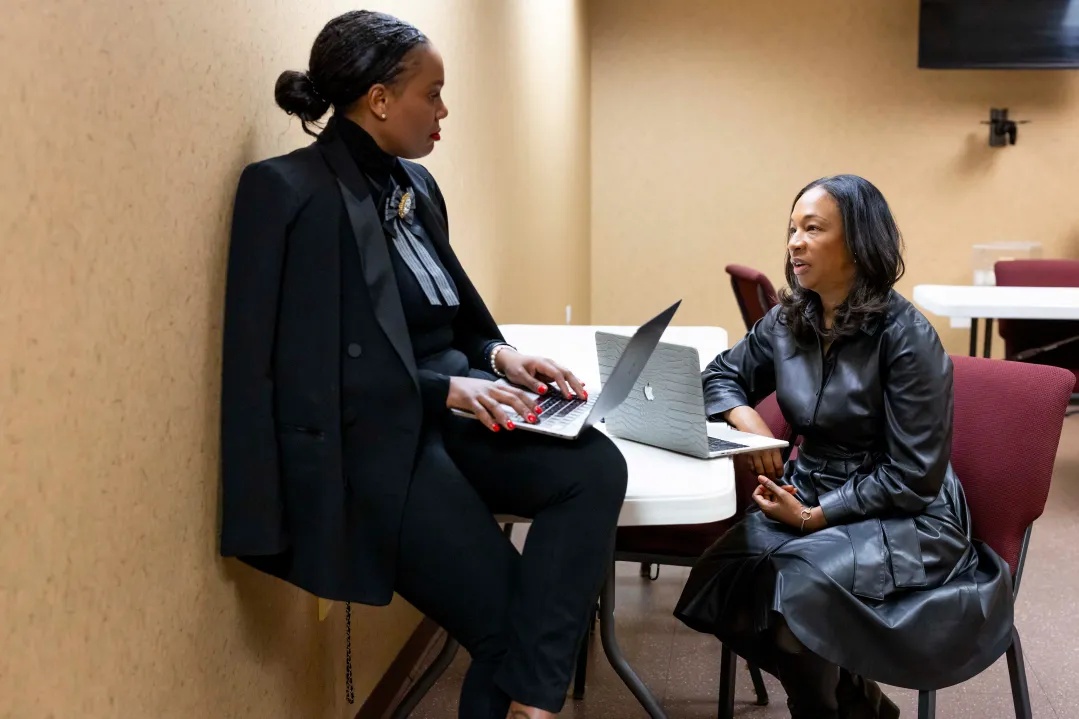
The work of bringing people along
Cooper Wright’s civic responsibilities also include cultural governance. The Museum of Contemporary Art Chicago lists her as secretary of its trustees as of June 30, 2026. Her professional biography identifies involvement with Loyola University’s Council of Regents, the Economic Club of Chicago and the Business Leadership Council. She previously chaired Breakthrough Urban Ministries’ board.
In March 2026, a more personal assignment brought her relationship with public leadership into focus. She and Alexandra Sims-Jones coordinated Jesse Jackson’s homegoing events in Chicago. Cooper Wright recalled calling Jackson and his staff for advice and finding them accessible. She connected his example to widening access in business and to including people from different generations and backgrounds.
The governor’s public schedule for March 6 named her as the media RSVP contact for the People’s Celebration. It is a small administrative line attached to a large public occasion. For a communications professional, such lines mark where the work meets the world: somebody has to receive the questions, connect the participants and help the occasion happen.
Her story began with four people choosing Chicago because they wanted greater opportunity. It now includes a company, public institutions and work helping other people enter civic life. The connection is clearest when the impressive titles recede. A person receives help. She acquires experience. She puts that experience to work where someone else can use it. The arithmetic of an open door is addition.