root-cause-analysis
(24)
eG Innovations and the Case of the Innocent Server
Every team has a healthy dashboard. The user still has a slow application. eG Innovations built a business around finding the trouble between those two facts.
The Machine That Learned to Ask Better Questions
NeuBird built an AI engineer for the 3 a.m. outage. When its first version hit an accuracy ceiling, the fix was to let the machine investigate instead of handing it a prepared answer sheet.
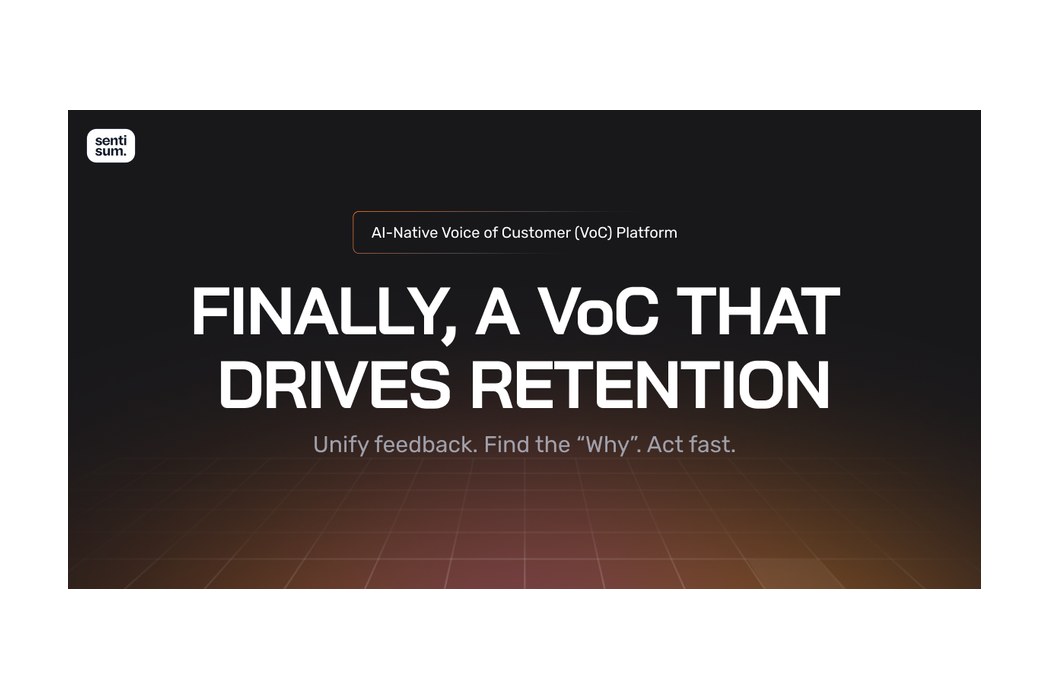
SentiSum
AI-native CX intelligence that tells you what's breaking, what it's costing, and what to fix.

Corelayer
Corelayer is an AI-native production support platform - an 'AI on-call engineer' - built for regulated, data-heavy industries like finance, healthcare, and insurance. It continuously watches alerts, logs, infrastructure, and the underlying data itself, then uses multi-agent AI to trace anomalies to root cause and suggest fixes. Founded in 2025 by former Goldman Sachs data-infrastructure engineers Mitch Radhuber and Shipra Jha, the company is part of Y Combinator's Winter 2026 batch.

Poth Labs
Poth Labs is a San Francisco startup building an AI-native customer research platform. Poth connects to a company's scattered customer data - analytics, call transcripts, support tickets, surveys, CRM notes - and unifies it into a searchable model of the customer. It then generates hypotheses about why users behave the way they do, and validates them using existing data plus adaptive interviews that adjust to each response. The goal is to move product, growth, and leadership teams past knowing what users did toward understanding why. Founded in 2026 by ex-Palantir engineer Matthew Wong and ex-Tietoevry engineer Mojmir Horvath, Poth Labs is part of Y Combinator's Summer 2026 batch.

Sonarly
Sonarly is a San Francisco startup (Y Combinator W26) building an autonomous AI on-call engineer for production software. It wires into a company's monitoring stack - Sentry, Datadog, Grafana, Slack and more - triages every alert to strip out noise and duplicates, investigates logs, traces, metrics and code to find the root cause, and opens a ready-to-merge fix pull request before a human engineer is paged. Founded by Dimittri Choudhury and Alexandre Klobb, who previously scaled an edtech app to 100k+ users, Sonarly aims to cut Mean Time To Repair by handling the 3am pages that engineers dread.
Aquant
Aquant is a New York-based enterprise AI company that builds agentic AI purpose-built for servicing complex equipment. Its platform turns an organization's service data and expert knowledge into AI agents that guide field technicians, call-center agents, customers and service leaders in real time - improving first-time fix rates, cutting repeat visits and closing the service skills gap across industries like medical devices, industrial machinery and manufacturing.
Checkly
Checkly is a developer-first synthetic monitoring and reliability platform that lets engineering teams define uptime, API, and browser checks as version-controlled code. Built on Microsoft's Playwright framework and OpenTelemetry, it runs checks from 20+ global locations and layers in AI-driven root cause analysis. Founded in 2018 and headquartered with roots in Berlin, Checkly serves 1,000+ customers - including Vercel, 1Password, CrowdStrike, and Mistral - and has raised $32.25M, most recently a $20M Series B led by Balderton Capital in 2024.
EthonAI
EthonAI (now branded Ethon) is a Zurich-based industrial AI company, spun out of ETH Zurich in 2021, that builds a Manufacturing Analytics System for factories. Its no-code platform layers on top of existing factory data sources to detect visual defects, monitor processes and run autonomous root cause analysis, using causal AI to explain what drives production variation. Customers including Siemens, Lindt & Sprüngli, Bosch and Roche use it to cut quality losses by up to 50% and raise productivity while keeping engineers in the decision loop.
Avanseus
Avanseus is a Singapore-based artificial intelligence company that builds predictive maintenance software for telecommunications and industrial IoT networks. Its flagship Cognitive Assistant for Networks uses a patented unsupervised learning algorithm to forecast network faults and degradations days in advance and to surface likely root causes, letting operators fix problems before customers feel them. Founded in 2015, the company was acquired by Accenture in February 2026 to strengthen Accenture's push toward autonomous telecom networks.
Invisible AI
Invisible AI builds edge-based computer vision systems for manufacturing floors. Its self-contained camera devices - each pairing an Intel RealSense 3D depth camera with an NVIDIA AI chipset and on-board storage - mount to existing factory infrastructure and turn manual assembly work into structured, cycle-level data without sending video to the cloud. Founded in 2018 by veterans of the autonomous-vehicle world, the company helps automakers and aerospace manufacturers such as Toyota spot cycle-time variation, ergonomic risk, and quality defects in real time. In 2026 it launched what it calls the world's first Vision Execution System, built on NVIDIA Metropolis and Cosmos Reason models, to run AI agents that analyze every production cycle at the edge.
SixSense
SixSense is a Singapore-based deep tech company building an AI platform that helps semiconductor manufacturers spot, classify and predict chip defects in real time. Founded in 2018 by Akanksha Jagwani and Avni Agarwal, its no-code software lets process engineers train and deploy computer-vision models on their own fab data in under two days - automating visual inspection, lot disposition and root-cause analysis. Used by chipmakers including GlobalFoundries and JCET, the platform has analyzed more than 100 million chips and raised roughly $12M to date, including an $8.5M Series A in 2025.
Scoop Analytics
Scoop Analytics is a San Francisco AI analytics company that gives every employee the reach of a data science team. Its agentic 'Domain Intelligence' platform autonomously investigates business data - screening every location every week to explain what happened, why it happened, and what to do next - and delivers those findings inside Slack. Founded by Birst creator Brad Peters, Scoop raised $3.5M in seed funding to make self-service business intelligence real for people who have spreadsheet skills, not data teams.
Vibranium Labs
Vibranium Labs is a New York-based AI company building Vibe AI, an agentic 'AI Site Reliability Engineer' that acts as the first responder to IT incidents. Its Vibe OnCall platform pages AI agents to detect, triage, and resolve outages before human engineers are woken up, integrating with tools like Slack, PagerDuty, Datadog, Jira, and ServiceNow. The company says its agents cut mean time to resolution by up to 85%, and positions itself as an AI-native alternative to PagerDuty and Opsgenie. Founded by Sang Lee (ex-Google, ex-AWS) with FiscalNote co-founder Tim Hwang, it raised $4.6M in seed funding in September 2025.
WellTheory
WellTheory is a virtual autoimmune care platform founded in 2020 by Ellen Rudolph, Claire Rudolph, and Wallace Torres — all personally affected by autoimmune disease. The company pairs licensed registered dietitians and board-certified health coaches with advanced diagnostic testing to help the 50+ million Americans living with autoimmune conditions reduce symptoms and reclaim their lives. Members follow a 12-month personalized program covering nutrition, sleep, stress, and movement. Clinical outcomes show 92% of members reduce symptoms within four weeks, 85% cut ER visits within 16 months, and average annual healthcare savings of $5,181 per patient. Backed by $33.4M in total funding led by General Catalyst, WellTheory serves both individual members ($175/month) and self-insured employers and health plans like Sentara Health Plans.
Riverbed Technology
Riverbed Technology is a San Francisco-based IT software company that helps large enterprises see, optimize, and troubleshoot the digital experiences their people and customers depend on. Originally famous for the SteelHead WAN-optimization appliance, Riverbed has reinvented itself around AI-powered unified observability - stitching together network, application, and end-user telemetry, then layering predictive, generative, and agentic AI on top to spot problems and increasingly fix them automatically. Founded in 2002, taken private by Thoma Bravo in 2015 and again by Vector Capital in 2023, it serves thousands of global organizations across finance, government, healthcare, retail, and beyond.
Unravel Data
Unravel Data is a Mountain View, California company building an AI-native data observability and optimization platform. It plugs into modern data stacks - Databricks, Snowflake, Google BigQuery and Cloudera - and uses AI, machine learning and a context graph of workloads, infrastructure and users to automatically troubleshoot, tune and control the cost of data pipelines. Where most monitoring tools stop at telling teams what is wrong, Unravel aims to fix it: its newest engine, Arvix AI, rewrites code, reconfigures infrastructure and validates the changes before deploying them, so data engineers can build instead of firefight.

ControlRooms.ai
ControlRooms.ai is an Austin-based industrial AI company that builds an AI-assisted troubleshooting platform for heavy industry - chemical, energy, and materials producers. Instead of relying on static, pre-programmed rules, its software learns a plant's normal behavior on its own and flags anomalies in real time across thousands of sensor parameters, helping operators catch small problems before they become unplanned trips, flaring events, or costly downtime. Founded in 2021 by serial AI entrepreneur Monte Zweben and Omar Talib, the company raised an oversubscribed $10M Series A in 2023 led by Origin Ventures and is live at industrial leaders including OCI Global and Ardagh Group.
Monte Carlo
Monte Carlo is the data and AI observability company that pioneered the 'data observability' category. Its platform helps enterprises detect, resolve, and prevent data and AI quality issues - what the company calls 'data downtime' - by monitoring data pipelines end to end, mapping lineage, surfacing anomalies, and tracing root causes. Founded in 2019 by Barr Moses and Lior Gavish, Monte Carlo serves 400+ enterprises including PepsiCo, Cisco, Nasdaq, and Comcast, and has raised $236M at a valuation of roughly $1.6B.

PlayerZero
PlayerZero is a predictive software quality platform that uses agentic AI to help enterprises fix, learn from, and prevent software bugs before they reach customers. Its CodeSim technology, powered by a custom model called Sim-1, simulates how code changes will behave across large codebases without unit tests or human intervention - acting as an 'immune system' for code in an era when more than 20% of new enterprise code is AI-generated. Founded by Animesh Koratana out of Stanford's DAWN lab and based in Atlanta and San Francisco, the company raised $20M total across seed and Series A rounds in 2025.

BigPanda
BigPanda is an AIOps platform that uses machine learning to correlate noisy IT alerts from hundreds of monitoring tools into actionable incidents, helping enterprise operations teams detect, triage and resolve outages faster. Founded in 2012 and based in Mountain View / Redwood City, it serves large enterprises including Intel, PayPal, Workday and Gap.
Resolve AI
Resolve AI builds an agentic AI Production Engineer that handles alerts, investigates incidents, and performs root cause analysis on production systems - reducing on-call toil for engineering teams at companies like DoorDash, Coinbase, and Snowflake.
Selector
Selector is an AI-powered network and infrastructure observability platform founded by ex-Juniper Networks executives. It combines a network-specific large language model, knowledge graphs, and causal reasoning to ingest telemetry from across complex hybrid environments, cut alert noise, surface root cause, and reduce mean time to resolution for telecoms, cloud providers, and global enterprises.
Instrumental Inc.
Instrumental is a manufacturing AI and data platform that helps brands like Meta, NVIDIA, Cisco, and Bose catch defects on the factory floor by aggregating images and signals from production lines and running discovery-driven machine learning on them. Founded by ex-Apple engineers, the company turns the noisy, siloed world of high-mix electronics assembly into a searchable, controllable dataset.