process-optimization
(9)
Imubit Put an AI on the Refinery Controls - The Bet Is Whether Operators Will Let It Drive
Most industrial AI stops at the dashboard. Imubit wants its reinforcement-learning models to touch the controls - a higher-stakes proposition now running across more than 100 applications in refineries, chemical plants, cement kilns and other process facilities.
Altizon Gave the Factory Floor a Brain That Talks Back
A Princeton-and-Pune software company spent a decade wiring up shop floors. Now it is betting the most useful worker in the plant will be a piece of software you can talk to.

Foaster.ai
Foaster.ai is a San Francisco startup building an AI-native alternative to management consulting. Its AI agents run 30-45 minute interviews across a company to rebuild an 'operational graph' - a structured map of workflows, handoffs, bottlenecks and information flows - then surface where AI should be deployed first. Human experts review and prioritize the roadmap. Founded in 2026 by Raphael Dabadie and Alexandre Combes, the company joined Y Combinator's Spring 2026 (P26) batch after building two widely shared LLM benchmarks, including the Werewolf Benchmark for social intelligence.

Celonis
Celonis is a German-American enterprise software company that pioneered the process mining market. Its Process Intelligence platform reconstructs how a company's work actually flows by reading event logs from systems like SAP, Oracle, Salesforce and ServiceNow, then surfaces bottlenecks, rework and hidden inefficiencies and helps fix them through automation, simulation and, increasingly, AI agents. Founded in 2011 by three Technical University of Munich graduates, Celonis serves more than 1,500 enterprise customers and was last valued at roughly $13 billion.

SixSense
SixSense is a Singapore-based deep tech company building an AI platform that helps semiconductor manufacturers spot, classify and predict chip defects in real time. Founded in 2018 by Akanksha Jagwani and Avni Agarwal, its no-code software lets process engineers train and deploy computer-vision models on their own fab data in under two days - automating visual inspection, lot disposition and root-cause analysis. Used by chipmakers including GlobalFoundries and JCET, the platform has analyzed more than 100 million chips and raised roughly $12M to date, including an $8.5M Series A in 2025.

AVISIO
AVISIO was a Vienna-based hospitality-tech startup that built a cloud, AI-assisted procurement and inventory platform for independent hotels and restaurants. Founded in 2019 by Matthias Depenbusch and Johannes Ossanna, it integrated with POS and PMS systems to automate stocktaking, compare supplier prices in real time, and suggest order quantities from booking data - promising roughly 10% lower purchasing costs and less waste. It raised over EUR 2 million from backers including Falkensteiner Ventures and Next Floor Ventures before filing for insolvency in April 2023.

Pani
Pani (Pani Energy Inc.) is a Canadian climate-tech software company that puts a digital brain on top of the world's water treatment plants. Its flagship cloud platform, Pani Zed, consolidates messy sensor data from desalination, industrial and municipal facilities, builds a digital twin of each plant, and uses machine learning to tell operators exactly how to cut energy use, extend membrane life, and lower emissions - without new capital equipment or retrofits. Founded in 2017 by Devesh Bharadwaj and based in Victoria/Vancouver, British Columbia, Pani deploys across facilities in multiple countries and has landed on the Global Cleantech 100 list.
FloVision Solutions
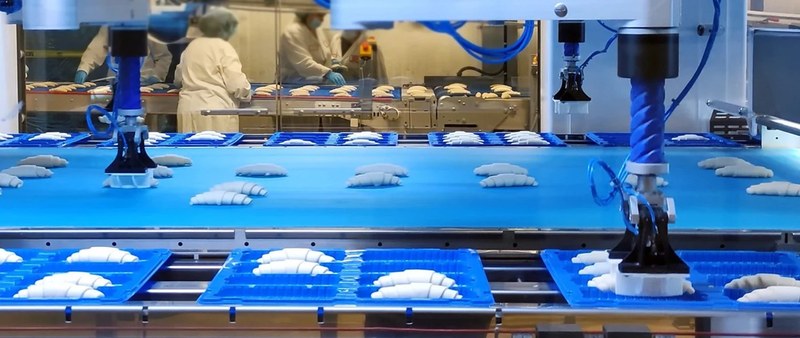
FloVision Solutions builds AI-powered sensors that bolt onto food processing lines to measure yield, monitor quality, and track staff performance in real time. Founded in 2020 by Rian McDonnell and Elise Weimholt, the South Bend, Indiana company helps beef and poultry processors recover lost yield and cut waste at the source. Its compact vision, depth, and load-cell sensors have scanned over 23.2 million kilograms of food across North America, Europe, and Australia, with customers reporting up to 1.5% yield recovery and as much as 15x ROI. In July 2025 it raised an $8.7M Series A led by Insight Partners.

Sight Machine
Sight Machine is an industrial AI company that turns the messy, unstructured exhaust of factory floors into a single live model of production. Its Manufacturing Data Platform connects machines, lines and plants - then runs AI on top so Global 500 manufacturers can see, decide and act in real time.