critical-care
(10)
Consure Medical discovered the hidden cost of a clean bed
A stool management device can protect a patient’s skin. Getting it adopted means understanding the nurse’s shift, the hospital’s ledger and the habits no inventor gets to wish away.

Ceribell and the four-hour wait for a five-minute EEG
A seizure can be invisible. Ceribell puts brain monitoring within reach of the bedside team - and builds a business around the hours hospitals used to spend waiting.

Picis and the Case of the Vanishing Form
At Albany Medical Center, a software cleanup meant fewer screens, fewer fields, and faster case closure. Picis makes its living in the places where a hospital’s information has to keep up with its patients.

The Hospital Gas That Refused to Stay in a Cylinder
Novlead Biotech built a portable machine to make inhaled nitric oxide where clinicians need it. The clever part is not making a gas; it is controlling every breath, then turning that expertise into a wider device business.

The ICU Has a Second Pair of Eyes - Twenty-Four Hours a Day
Cloudphysician built a remote ICU around a simple scarcity: critical-care specialists cannot stand beside every bed. Its answer combines clinicians, cameras and software - and makes the local team part of the design.

CALSTAR and the art of getting there in time
The helicopter gets the attention. CALSTAR’s more interesting story is about the decisions around it: where to fly, who gets a say, and how to keep the service alive.

The Startup Teaching Ventilator Patients to Breathe on Their Own Again
Every long stint on a ventilator quietly weakens the one muscle you need to breathe. XN Health's Phlex device stimulates the phrenic nerve through the breathing tube to keep the diaphragm working - and get patients off the machine sooner.

Inflammatix, Inc.
Inflammatix is a Sunnyvale, California molecular diagnostics company that reads the body's own immune response instead of hunting for the pathogen. Its FDA-cleared TriVerity test measures 29 host mRNAs from a blood sample and, using machine-learning algorithms, returns three scores in about 30 minutes: likelihood of bacterial infection, likelihood of viral infection, and overall illness severity. Run on the company's benchtop Myrna instrument, it is built for emergency and critical-care clinicians who need to decide fast whether a patient is heading toward sepsis. Spun out of Stanford in 2016, the company has raised more than $205M.
ImaCor, Inc.
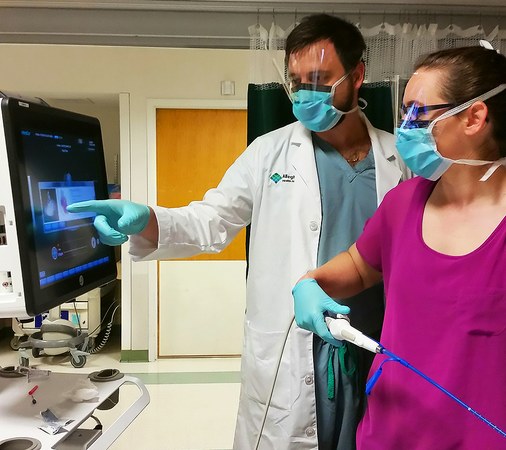
ImaCor, Inc. is a New York medical-device company that built the world's first and only hemodynamic transesophageal echocardiography (hTEE) platform for the intensive care unit. Its miniaturized, disposable ClariTEE probe can stay safely in a critically ill patient for up to 72 hours, giving clinicians a continuous, direct window onto the heart - preload, contractility, and right- and left-ventricular function - so they can guide fluids and drugs in real time instead of guessing. In 2022 ImaCor and Clarius Mobile Health launched the FDA-cleared Zura Handheld Hemodynamic Ultrasound, a pocket-sized, 22-ounce TEE system that puts that window in a clinician's hand.

Vituity
Vituity is a 100% physician-owned and led multispecialty partnership delivering acute care across the United States. Founded in 1971 as California Emergency Physicians (CEP America), it rebranded as Vituity in 2018, combining 'vital' and 'acuity.' Today roughly 5,500 doctors and clinicians staff emergency departments, hospital medicine, critical care, anesthesiology, psychiatry, neurology, telehealth and more across hundreds of care sites in 27+ states, treating millions of patients a year - all without private equity, insurer, or hospital-system ownership.