The keys had already changed hands. Julia and her husband were first-time homebuyers, and Tadashi Kondo had helped them through the purchase. What she remembered afterward included the questions he kept answering once they had moved in, and a bottle of champagne waiting at the new place with a congratulatory note. In the paperwork-heavy business of buying a house, someone had remembered there ought to be a celebration.
It is a small episode, told by the client, with a useful sense of proportion. A bottle cannot redeem a bad transaction. Nor does it explain a career. But the timing matters: the buyers had their keys, and Kondo was still paying attention. The part of the relationship that could have ended at closing had continued into the awkward, question-filled business of actually becoming homeowners.
Kondo, known professionally as Tad, owns and leads The Kondo Group at Compass. His career began in 2004. He works in a trade where the results are recorded in prices, production tables and completed transactions. The champagne belongs to another ledger, the one clients keep in their heads. His story runs between those two ways of counting.
An apprenticeship that became a team
Kondo started at Century 21 before working at Keller Williams Palos Verdes Realty. Those names trace a conventional route through residential brokerage: training, experience and the eventual responsibility of leading other people. By 2017, The Kondo Group was the leading team by production in its Keller Williams office. The boundary around that achievement matters. An office ranking is a concrete accomplishment with a defined field.
His work there also included the agent leadership council, a role in the office’s decisions. In 2017, he was named a regional Keller Williams Cultural Ambassador. These are different forms of recognition. Production measures completed business; a leadership role adds responsibility for the working environment around it. Kondo’s record at Keller Williams included both.
The next move would ask a familiar question of an established agent: what should a brokerage supply once a team already knows how to sell homes? A name on the door can introduce a business. Training can help someone begin. For a team planning its next stage, access to customers and the means of reaching them become more pressing considerations.
Kondo’s answer arrived in August 2018, when he partnered with Movoto Real Estate. He brought a team of eleven professionals. After fourteen years in the industry, he was making a decision about how that group would find its next clients.
- 2004Century 21
Career begins - 2017Keller Williams
Office production milestone - 2018Movoto
Partnership announced - TodayCompass
The Kondo Group
The search box enters the picture
Movoto’s appeal to Kondo was specific. It had an online audience and a property-search business; he came from a traditional brokerage background. He saw a way to connect the two. His explanation was blunt enough to survive the intervening years: “the future of real estate is technology.”
That was a business judgment about how buyers and sellers were finding their way into a transaction. The search box had become a front entrance. An agent could be skilled, experienced and available, yet still need a way to meet the person scrolling through homes before breakfast. A digital platform offered a different route to that introduction.
Kondo also described growth in terms of the people working with him. The partnership was meant to expand his group and support their continuing success, while helping Movoto develop its Southern California presence. The ambition was reciprocal. He was bringing a local practice to an online business that wanted a larger physical presence.
Today, his affiliation is Compass, where his profile again pairs client service with technology. There is continuity in that choice. Across different brokerage names, the underlying problem remains recognizable: how to give a team broader reach while keeping its work useful to the individual buyer or seller. Software can make the introduction. The questions afterward still need answers.
Broader reach. Enough time for the person who calls.
The question behind a growing team
A group photograph, taken literally
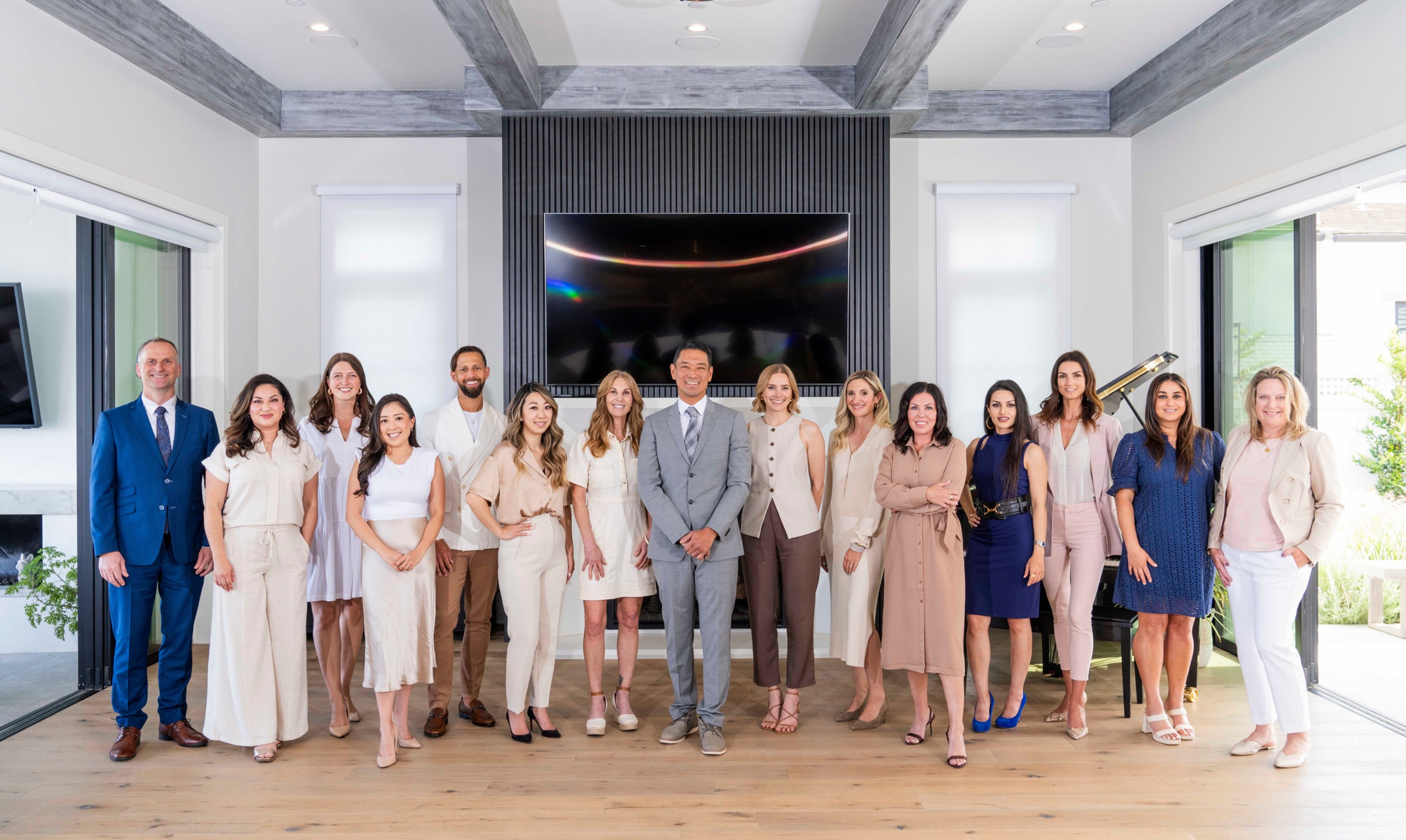
In the team photograph, Kondo stands near the middle in a gray suit, surrounded by colleagues. It is a fitting image for a business carrying one person’s surname and relying on many people’s work. The founder gets the identifying name. The group has to deliver the experience attached to it.
The current team directory includes agents alongside a transaction coordinator who is also a Realtor. That distinction supplies a glimpse of the work behind the public-facing business. A home sale needs someone to help the client make decisions and people to keep the transaction moving. The polished listing is only the part that gets its own photograph.
The group’s current description puts its presence in both Los Angeles and Las Vegas. It also says its members collectively speak seven languages. Those are team capabilities, and the distinction is useful: Kondo himself lists English and Japanese. Building a group creates room for a wider range of clients and circumstances than any single agent can personally cover.
His challenge as its leader is easy to state and harder to carry out. Each additional person widens what the business can do, while adding another relationship to coordinate. The surname stays short. The organization beneath it becomes more complicated.
What the numbers actually count
Recognition gives this story a second scale. AREAA’s 2024 A-List records The Kondo Group at $50,706,235 in team sales volume for 2023, placing it 26th in that category. The same list records 50 transaction sides and a rank of 41st by team sides. These are different measurements of the same year’s work.
Sales volume is the combined value of transactions represented in the ranking. Transaction sides count representation in deals. Neither figure describes Kondo’s personal income. Together, they give a more useful view of the operation than a stray large number lifted out of its column.
A ranking also freezes a moving business. Its publication year and the year being measured can differ; here, the 2024 recognition concerns 2023 production. Keeping those dates attached lets the accomplishment retain its actual shape. It also keeps later work from being folded into an older result.
There is a human reason to care about the distinction. Every completed side begins with somebody making a decision about where to live, what to sell or what to buy. The table gathers those decisions into a total. The agent’s daily task is to deal with them one at a time, with all their inconvenient differences intact.
Volume is rounded from $50,706,235. Rankings are within the A-List team categories.
A local practice with a wider conversation
Kondo’s connection to AREAA extends beyond a production list. The association’s LA Coastal leadership page lists him as a board director. His earlier biography identifies board service with AREAA South Bay. The connection places him in a professional community concerned with Asian American homeownership, alongside his work for individual clients.
Language is one practical part of that story. English and Japanese are listed among his capabilities, and UCLA appears in his education. For a buyer discussing an unfamiliar process, being able to ask a question in a comfortable language can matter as much as receiving the document itself. Understanding needs room for a follow-up.
His geographic base remains the Palos Verdes area. The service areas attached to his Realtor.com profile include Harbor City, Rancho Palos Verdes, San Pedro and Torrance. That cluster gives the business a more definite location than the broad promise of Southern California. A client is buying a particular home, on a particular street, within a particular daily routine.
The wider team’s Las Vegas presence adds another market to the picture. Expansion creates possibilities, but the work still arrives locally. A person moving between places needs help with the details at either end. Geography turns a broad business plan into a series of very specific conversations.
The questions that survive closing
Kondo’s work spans buyers, sellers, relocation and multi-residential property. His Realtor.com specialties include residential and multi-residential real estate. This range puts different kinds of decisions on his desk: choosing a first home, preparing a property for sale, or evaluating a building with more than one household in it.
His public professional identity also includes a quieter detail: he is a father of two. His biography connects that family focus with the care he aims to bring to transactions. It is a stated professional intention, and clients have their own way of deciding whether such intentions become visible in practice.
Julia’s account offers one example. Her recollection includes responsiveness during the purchase and continued help after the move. Another buyer describes patience with a purchase that took longer than expected. These are individual experiences, but they identify something a production ranking cannot measure directly: whether the person asking the question felt there was time to answer it.
That is where the technology argument meets the service argument. A faster way to search makes discovery easier. A larger team can broaden the available help. Neither changes the fact that a buyer may still be uncertain after the keys arrive. Kondo’s career has involved choosing organizations and tools that promise greater capacity; the client experience depends on what happens when that capacity is needed.
“Helping people is our passion,” he said when announcing the Movoto partnership. It is a common sentiment in real estate, and daily work gives it a demanding test. Calls need returning. Processes need explaining. A celebration deserves a note. The bottle of champagne is the cheerful detail; being available afterward is the part with a longer shelf life.