Before Sukup Manufacturing had a million square feet of office, factory and warehouse space, it had an unhappy farmer. In 1962, Eugene Sukup bought a grain bin for shelled corn. The grain dried slowly. Hot pockets formed. Spoilage followed. His answer was an improvised stirring auger made from a coal-furnace stoker and an electric drill, suspended by a chain from the top of the bin. It was practical, inelegant and close enough to a product to reveal the next problem.
Eugene made five units at a welding shop in Sheffield, Iowa, and sold them to a local dealer for $29 apiece. Only three sold; one came back. So he changed the design, running a horizontal auger through the drill handle to automate its travel. The patented Stirway stirring machine became the beginning of the company Eugene and Mary Sukup founded in 1963.
That returned machine is the more instructive artifact. Sukup’s origin was not a lightning-bolt invention followed by effortless demand. It was a field complaint, a crude fix, a discouraging first batch and another pass at the mechanism. Six decades later, the company still describes listening to farmers and dealers as part of the job.
“The people who run the company aren’t the only ones with good ideas. We want to listen to the farmers and dealers who buy our products.”Eugene Sukup, co-founder
01 / The actual problemA harvest is a deadline with weather attached
Grain storage looks passive from the highway. Operationally, it is a chain of decisions. Corn or soybeans arrive at a certain moisture level. They must move off trucks, dry without excessive damage or fuel use, enter storage evenly, remain aerated, and leave without sending a worker into a dangerous bin. Every transfer costs time. Every failure can lower grain quality or slow the combines waiting in a field.
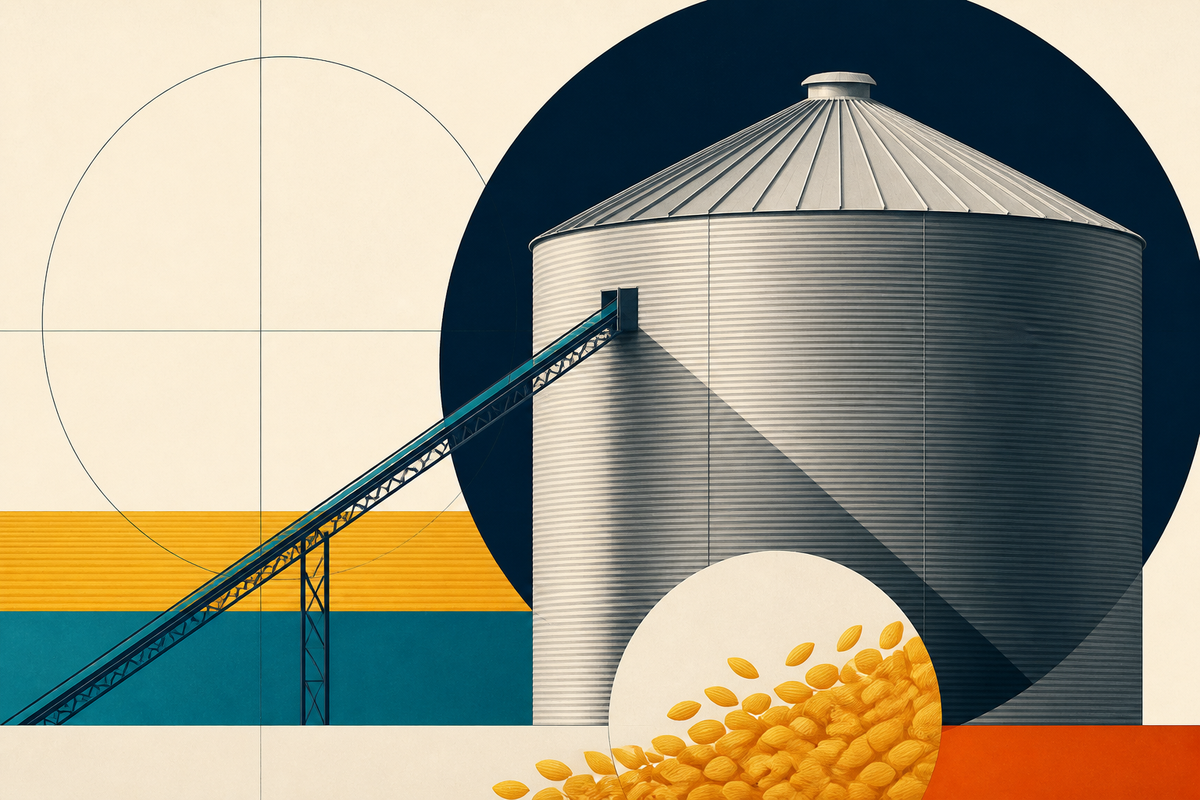
Sukup has expanded across that chain. Its catalog includes farm and commercial bins, portable and mixed-flow dryers, fans and heaters, stirring systems, floors, spreaders, unloaders and sweeps. Outside the bin are bucket elevators, drag conveyors, enclosed belts, towers, catwalks and support structures. It also makes pre-engineered steel buildings. The commercial end reaches equipment measured on another scale entirely: the 165-foot-diameter bin at Golden Grain Energy in Mason City, Iowa, holds roughly 2.25 million bushels beneath a free-span roof.
Its customers range from family farms to cooperatives, commercial grain operators and ethanol plants. Public projects name CHS, Landus Cooperative, Elite Octane and Golden Grain Energy alongside individual farms. Dealers sit between factory and field, handling quotes, installation and front-line service. Sukup does not install every system itself; the dealer network is part of the operating model.
02 / The moatThe one-stop shop is really a seam remover
Competitors include GSI, Brock, Chief, AGI’s portfolio of brands and regional fabricators. Sukup’s pitch is not that a bin is a mysterious object no one else can form. Its advantage is breadth, integration and the accumulated detail of manufacturing many of the pieces. A buyer planning future expansion can work through one dealer on storage, drying and movement rather than asking separate vendors to arbitrate every interface.
The company brought grain-bin production in-house in 2001, using roll-forming equipment to hold tight tolerances. In Sheffield, CNC machining and punching centers, lasers, progressive dies and welding robots sit beside the agricultural experience of employees who farm themselves. A 2026 company interview said the plant receives about one million pounds of steel from U.S. mills in a typical week. Hardware is the visible product; process control is the quieter one.
Patents turn small operational observations into defensible features. Sukup’s Quad Metering Roll system pulls hotter inner grain through a portable dryer faster than the cooler outer layer, aiming for more even moisture. Its large bins use laminated sheet details and splice plates to manage immense loads while reducing leak points. Its Paddle Sweepway targets one of the industry’s ugliest hazards by reducing the need for workers to enter a bin during cleanout.
03 / Software meets steelThe next bin comes with fewer midnight drives
Matt Koch, Sukup’s chief marketing officer and a third-generation family member, started at the company as an electrical engineer in 2007. His early assignment was to simplify and expand dryer electronics. That work led toward networked controls, the QuadraTouch Pro interface and mobile tools. The benefit is prosaic and valuable: better visibility into a dryer can mean fewer anxious trips across a farm at night.
In December 2023, Sukup acquired Ramco Innovations, a Midwest automation distributor. Ramco kept its name and operations, while a new Sukup Innovations group brought it together with Maple Studios and Sukup’s agricultural technology work. Synk, the emerging product platform, began with bin monitoring and a longer ambition to connect controls across grain management.
“We don’t want to overpromise. Let’s go beyond creating a demo...let’s show can it be awesome in real life.”Matt Koch, chief marketing officer
The acquisition also opens a second lane. Ramco’s robotics, control panels and integration expertise can help automate Sukup’s own factories, then be sold to manufacturers outside agriculture. That is a sensible adjacency: first use automation to improve the plant you know, then package the capability for other plants. The risk is familiar to every hardware company adding software. Reliability standards do not become looser because a dashboard is involved. In grain drying, a slick demo is less important than a control system behaving predictably during the busiest week of the year.
04 / A family factoryStaying put became part of the strategy
Sukup never left Sheffield, a north Iowa community of roughly a thousand people. The company has expanded elsewhere - facilities in Manly, Clear Lake and Hampton, a European operation in Denmark, distribution centers across the Midwest, and an engineering presence in Ames - but Sheffield remains the center. The core business employs more than 600 people; Sukup reported more than 800 across combined locations in 2024.
Long tenure is an explicit cultural asset. Company materials say nearly 30 percent of full-time employees have worked there for more than a decade. Benefits described publicly include an on-site health clinic, and employees reaching 10 years have been invited to Hawaii with a spouse. The gesture is unusually concrete. So is the fact that three generations of the family remain active.
Family ownership is now testing a transition. In March 2025, Sukup’s board named then-CFO Tom Mangan as the next president and CEO, effective that October. He was the first non-family executive in company history. Steve Sukup began moving toward the chairman role, while third-generation leaders Emily Schmitt and Matt Koch stayed on the executive team. It is a classic private-company handoff: keep ownership and values in the family while giving daily management to a professional operator.
Eugene and Mary Sukup found the business around the patented Stirway.
Sukup brings grain-bin forming into its own manufacturing system.
The Golden Grain Energy project sets a free-span size record.
Ramco joins, Synk takes shape and Tom Mangan is selected to lead.
05 / The useful detourWhen a grain bin becomes a home
One of Sukup’s most memorable products is not sold as farm equipment. After Haiti’s 2010 earthquake, the company’s engineers adapted corrugated-steel methods into the Safe T Home, a round shelter designed to resist earthquakes, hurricanes, fire, termites and other hazards. Working with the nonprofit GoServ Global, the project placed more than 500 structures in Haiti and elsewhere by 2023. Some became schools, clinics, churches and birth centers.
The Safe T Home reveals what Sukup actually knows. It knows how thin steel behaves, how panels can travel, how small teams assemble structures and how a round form handles wind. A catalog says the company makes grain equipment. The shelter says its deeper expertise is turning sheet steel into durable systems under unforgiving conditions.
That puts Sukup in an interesting market position. It is an agricultural machinery company, an advanced manufacturer, a dealer-driven infrastructure supplier and, increasingly, an automation business. Its machines help farmers decide when to sell rather than accepting harvest-time logistics as destiny. They help commercial operators move larger volumes with fewer bottlenecks. They can also reduce human exposure to dangerous cleanout work.
The company’s story is easy to make sentimental: family, Iowa, a farmer-inventor, three generations. The sturdier interpretation is operational. Eugene found one expensive problem, learned from a failed first version and expanded into every adjacent mechanism that made the original product more useful. Sukup’s future depends on doing the same with data and controls, without forgetting why anyone bought the steel in the first place.