A thousand new devices sound like progress. They also sound like a thousand opportunities for something to arrive unconfigured, go missing in a cupboard or require a support ticket before lunchtime. At leisure operator Everyone Active, Storm Technologies helped procure approximately 1,000 assets at the beginning of 2023. The interesting part happened around the purchase: holding stock, testing equipment, tagging it and preparing it for deployment.
That is a useful way into this Watford company. Storm sells the recognisable contents of an IT budget: computers, software, networks, servers and support. Its value depends on how well it connects those purchases to the less photogenic realities of running an organisation. Somebody has to know where the laptop is. Somebody has to answer when it stops working.
Founded by John Brooker in 2000, Storm occupies the space between technology manufacturers and the organisations using their products. The industry calls this a value-added reseller. The term can make a substantial operation sound like a shop with a help desk. Storm combines procurement with technical design, implementation, managed services and a device reuse programme. Its customers include businesses, public-sector organisations and charities.
The distinction matters because the equipment itself is available elsewhere. A customer choosing Storm is also choosing a way to buy, configure, operate and eventually retire that equipment. The test is whether those services remove enough work from the customer’s own team to justify the relationship.

The warehouse has a software front door
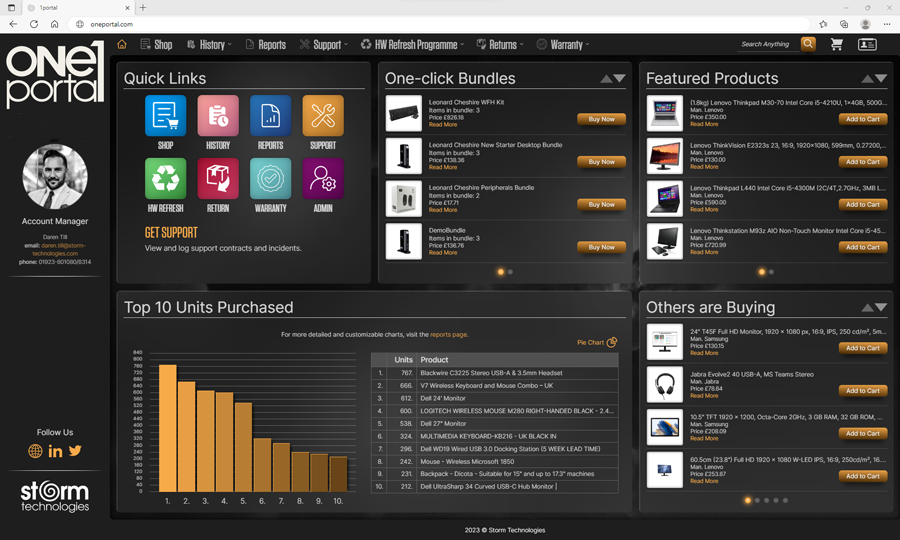
Storm’s OnePortal is the digital entrance to that operation. Developed in-house, it offers ordering, quotations, reports and analytics, with a catalogue advertised at more than three million products. It also supports punchout integration with purchasing systems including Coupa, ServiceNow, SAP Ariba and Oracle. In practical terms, that lets a customer connect supplier shopping to an established procurement workflow.
For Everyone Active, which has worked with Storm since 2015, the portal also handles collection requests, stock withdrawals and visibility of inventory. Storm’s warehouse holds equipment until it is needed. The company prepares devices to the customer’s specification before dispatch, while its Sustainable IT Programme collects faulty or obsolete equipment from leisure centres for refurbishment or disposal.
The combination gives the relationship its commercial logic. Once purchasing, inventory and deployment are joined together, switching supplier involves more than comparing prices on the next laptop. That is an inference about the business model, rather than evidence that customers are locked in. It explains why a reseller would invest in its own software alongside warehouse space.
Storm describes a 20,000-square-foot logistics centre containing warehousing, configuration and sustainable IT operations. It also lists fulfilment and distribution locations in Austin and Amsterdam, and says it delivers to 110 countries annually. Those are company-reported operating claims. Their significance is practical: a business with staff in several countries needs an answer to where the kit will come from.
When the support queue becomes the problem
At Simba Sleep, the difficulty was a support model that struggled as the business grew after the pandemic. Storm’s account describes reactive assistance, poor visibility and concerns about scaling. The response was a dedicated service desk, continuous monitoring, preventive maintenance and more structured incident, problem and change management. A central knowledge system gave users a way to handle routine issues themselves.
The reported results were faster resolution and improved satisfaction. Those are qualitative customer-case-study outcomes, so they should be read as evidence of the approach rather than a numerical performance guarantee. The useful detail is the change in operating rhythm: issues could be monitored and organised before they became another interruption to somebody’s working day.
Crisis presents a different version of the same pressure. The homelessness charity had grown, but its technology and working practices had not kept pace. The pandemic made hybrid access and security more urgent. Storm helped scope and introduce Veeam backup, DSP database services and Sophos cybersecurity, alongside hardware support and assistance with hybrid working.
Daniel Gray, Crisis’s director of data, digital and technology, described the effect as keeping “core operations running” while improving the technology environment. The case also reports that colleagues sometimes mistook Storm engineers for Crisis employees. That small confusion says more about service integration than another photograph of a handshake could.
Storm’s managed-services offer formalises this work through a UK service desk, 24-hour coverage, patching, monitoring, onboarding and scheduled reviews. Customers can choose dedicated or shared provision. The decision is about how much operational responsibility to buy: an organisation with a capable internal team may need specialist coverage, while another may want a broader day-to-day service.
“Core operations running”Daniel Gray, Crisis, on the partnership’s practical value
The reseller needed help, too
Storm’s own security experience provides an unusually useful admission. Its vulnerability tool did not provide sufficient coverage, remediation happened too infrequently, and the team struggled to prioritise what to fix. The published account describes patches that did not take and vulnerabilities that were unintentionally overlooked. It describes operational gaps, not a disclosed breach.
Head of IT Chris Gill evaluated alternatives including an outsourced security information and event management system and an internal security operations centre. Storm chose Arctic Wolf Managed Detection and Response and Managed Risk for continuous monitoring and help prioritising remediation. Gill said alternatives appeared more labour-intensive; the choice turned on coverage, capability and staffing economics.
Gill estimated equivalent round-the-clock coverage would require three times the expenditure in salaries alone. That is his comparison, not a published project price or a universal saving. The lesson readers can copy is narrower: price the people required to operate a security system, then compare that full service with the outsourced proposal. Buying a tool does not automatically create the hours to use it.
A bill with more than one moving part
Storm’s commercial offer combines product resale, software licensing, project services and ongoing support. A purchase might begin with hardware and expand into configuration, deployment or management. Cloud and software work adds another task: deciding which subscriptions and capabilities a customer actually needs, and keeping renewals and usage under control.
Its licensing team offers help with agreement negotiation, licensing terms, cost optimisation and audit preparation. Its cloud service includes Microsoft support and reviewing overlapping products. These are useful services when a technology estate has accumulated a little of everything. The purchasing problem becomes understanding what is already being paid for before adding another line to the bill.
One published insurance-sector project illustrates a different cost structure. A hosting provider’s departure forced a datacentre move. Storm worked with HPE GreenLake on server and storage requirements under a consumption model, and handled planning, procurement, testing and implementation. The migration was staged across weekends; the account describes rehearsals using Zerto and separate scaling of compute and storage.
That arrangement changes when and how capacity is paid for. It does not establish that consumption billing is always cheaper. For a buyer, the sensible comparison includes migration work, committed capacity, support responsibilities and future demand. The point of bringing in an infrastructure specialist is to make those choices explicit before a deadline turns them into emergencies.
The old laptop gets another shift
Storm’s device programme starts with collection from an office or home. Equipment enters a configuration lab for testing, cleaning, grading, wiping, re-imaging and, where appropriate, repair. Once ready, it returns to the customer’s available stock. OnePortal supplies the administrative thread running through collection and redeployment.
The company advertises savings of up to 90% against buying new hardware. The words “up to” do considerable work. This is a stated upper bound for extending the life of existing equipment, not a promised reduction in an organisation’s total technology budget. A working device suitable for the next employee presents a different calculation from a damaged machine that cannot handle the required software.
The transferable practice is to make reuse an operational process. Record what exists, establish its condition, remove previous data, prepare it for the next user and make it visible to whoever places orders. A shelf full of unidentified laptops cannot deliver that. Nor does refurbishment make sense merely because it is possible: remaining useful life and fitness for the job still have to justify the work.
- 01CollectBring the device back
- 02AssessTest, grade and repair
- 03PrepareWipe and re-image
- 04RedeployReturn to available stock
A crowded market, and a revealing dip
Storm competes in the UK reseller market alongside businesses such as CAE, CCS Media, Servium and Total Computers. The manufacturers in its portfolio are familiar across that market. Its argument therefore rests on the combination of account management, its own procurement platform, technical services and distribution. Buyers should judge that combination against their specific locations, systems and support requirements.
The finances offer a check on any frictionless growth story. Storm Technologies Limited recorded approximately £92.6 million in 2024 revenue, down from £107.5 million in 2023. Pre-tax profit was about £583,000. The wider Storm Technologies Group reported £115.3 million in revenue, helped by newly acquired sister business Storm Procurement. These figures describe different reporting entities and should not be interchanged.
After a weak first half, Storm focused on core markets and restructured operations. Revenue in the second half increased 2.6%, with growth returning in the final quarter. The company pointed to hardware refreshes, Windows migration, cloud and AI-related demand. This is a recovery within a difficult year, not evidence that every new technology trend produces dependable reseller growth.
In April 2026, Storm announced Lenovo 360 Platinum Tier status for the 2026/27 fiscal year. In August, solutions architect Elliott Clark argued for assessing individual workloads before choosing cloud infrastructure, warning that cloud adoption can add cost and complexity without appropriate management. That position fits a company selling expertise across several environments: start with the workload, then choose where it belongs.
An office that doubles as a demonstration
There is a pleasingly literal detail in Storm’s own workplace. Sony’s account of a 2022 deployment describes displays carrying service information, sales figures and employee recognition. The screens could also show football in the bar area. Visiting customers noticed the installation and asked about it. The office had become a demonstration space simply by using the products.
Brooker remains listed as chief executive, with Nick Umney as managing director. The visible culture is commercial and service-oriented: measure the work, recognise people and show customers what the technology does. For the buyer, the final question is equally concrete. Can this supplier take responsibility for the awkward stretch between ordering equipment and keeping it useful? That is where Storm’s proposition has to earn its keep.
Keep exploring Storm
Company website · OnePortal · Customer stories · News and insights
LinkedIn · X · Instagram · Facebook
Watch: Walter Thomas on how legal teams can partner with sales