A link is a small thing to build a company around. It spends most of its working life being clicked and forgotten. Steven Tey gave it a longer assignment. At Dub, the link can record where a visitor came from, connect that visit to a sale, and help decide who gets paid for bringing the customer in. A piece of punctuation on the internet has found employment in accounting.
The beginning was more modest. In 2022, while working at Vercel, Tey built Dub to answer an internal need: sharing links on social platforms with better preview images. He made the project open source. People tried it, talked about it, and kept using it. In January 2024, he announced that he was starting a company around the tool.
There is a temptation to read that sequence backward, as though the company were waiting inside the first line of code. Tey’s earlier work makes the sequence more interesting. He had already tried fiction, a database of available domain names, and tools other programmers could borrow. Each required him to make something, put it in front of strangers, and accept that strangers would have opinions.
The author had to find his readers
Before the software founder, there was Steven Steel. Under that pen name, Tey published Someone’s In My Head, a science fiction novel that won a Wattys award in 2015 and the fiction category of the Popular-The Star Readers’ Choice Awards in 2017. The surname had a certain paperback confidence. It would look quite comfortable above a spaceship.
His account of the book’s life includes marketing it to schools and pitching bookstores across Malaysia. Those are concrete verbs. An author may spend months deciding what a character should say; selling the book involves deciding what to say to the person behind a counter. Tey was doing both.
This earlier chapter offers a useful way to read his later launches. Making the work and finding its audience were already connected activities. A completed manuscript still needed readers. A functioning application would still need users. The medium changed, but publishing continued to mean putting something within reach of other people.
He retains that wider description of himself. His personal website opens with three occupations: “Programmer. Writer. Pianist.” The third is a pleasant interruption in a biography that might otherwise fill entirely with software. It leaves room for something whose value does not need to appear in a conversion dashboard.
A week to solve the naming problem
In May 2020, Tey wanted a short, memorable domain for a project. Finding one was irritating enough to become a project of its own. One Word Domains checked combinations of English words and domain extensions, giving founders and domain buyers a way to browse available names. Tey set himself a week to get it working.
“I gave myself a deadline of one week to complete the project,” he recalled. The deadline also made the exercise a practical introduction to web development. Instead of learning toward an indefinitely postponed product, he had something specific to finish and show.
Someone else posted One Word Domains to Hacker News before his planned submission. Tey joined the discussion, identified himself as the maker, and asked for constructive criticism. Here was a public debut with the protective wrapping removed. People could use the application and tell its author exactly where it disappointed them.
“don’t be afraid to tear me apart with your feedback.”
Steven Tey, introducing One Word Domains on Hacker News, May 2020
The name supplied its own joke. One Word Domains contained three words. Tey acknowledged the irony when it was pointed out. For someone who described himself as a perfectionist about branding, this was a useful compromise: the name explained the product, and the product was already outside meeting people. Naming could be an occupation in itself. He had chosen to ship.
Building an example people could use
Tey’s undergraduate years at Minerva involved studying in different countries, with San Francisco among the stops. He graduated in the Class of 2021. His subsequent work at Vercel placed him among people building software for other developers, where an explanation becomes considerably more persuasive when the reader can run it.
As a senior developer advocate, he published the July 2023 announcement of an updated Platforms Starter Kit. The kit supplied a starting point for applications serving multiple customers through their own domains. A developer could adapt working code rather than assemble every piece from a blank screen.
The announcement included an AI-assisted editor, image uploads, custom styling, and preview cards for posts. It also included Dub among the applications using the approach. The distance between his day job and his side project was short: he could explain an infrastructure problem while working through a version of it himself.
That is a distinctive apprenticeship for a founder. Developer advocacy requires attention to where another person gets stuck. Instructions have to survive contact with a reader who has a different project, different assumptions, and little patience for an elegant explanation that produces an error. A usable example earns its place through that encounter.
The projects left the workshop
Tey’s other public projects address tasks that are easy to recognize. ShareGPT made conversations easier to share. Novel offered a writing editor with AI-assisted completion. Precedent provided a starting point for web projects. Alongside One Word Domains, they form a portfolio of specific inconveniences given a working interface.
Novel acquired a life beyond its original maker. In 2024, Minerva highlighted a storybook application built by Professor Alexis Diamond and alumnus José Alvarez Cabrera using Tey’s open-source editor code. A writer had built software for writing, and other people had used it to make another writing tool. It is a pleasingly recursive career detail.
Open source permits that sort of continuation. The person releasing the code does not need to anticipate every future use for someone else to find one. A project can become a product, a teaching example, or a component in work its author never planned.
Dub had a more commercial path, but it also faced ordinary questions about how unfamiliar people would receive it. In August 2023, it changed its main address from dub.sh to dub.co. Users had found the .sh ending confusing or suspicious. The product needed to make sense to marketers as well as programmers. Two letters at the end of an address were part of that work.
A launch with its own edit button
When Dub arrived on Product Hunt on March 21, 2024, the announcement followed more than a year of building. It finished as Product of the Day, Week, and Month. Tey’s account of the campaign is full of preparation: building a community, creating visual assets, scheduling messages, and answering the people who appeared.
A small detail tells the story more neatly than the medals. The team used a Dub short link for its Product Hunt campaign. During the teaser period, that link led to the teaser page. When the launch went live, the destination changed. The existing announcements could keep their original link.
A link normally looks like a promise fixed at publication. Here it behaved like an editable instruction. The posts and emails had already gone out, but the route could still be adjusted. Dub was demonstrating its usefulness while introducing itself. A product demonstration had slipped into the plumbing of the campaign.
The public response also included quieter evidence of adoption. Peerlist co-founder Akash Bhadange described discovering Dub through a tweet and using it to track branded marketing links. The team bought a dedicated domain after subscribing. That is a different kind of endorsement from a leaderboard: someone had reorganized a little of their daily work around the software.
By the end of 2024, Dub reported 126 million clicks tracked, 700,000 links created, and 56,000 new users. Its global team numbered four. The year’s work included a public API, integrations, and redesigned tools for managing links. The company was adding ways for the product to fit into other people’s workflows.
2024 year-end figures reported by Dub. Activity counts measure different things.
What happened after the click?
The next question was already present in Tey’s January 2024 company announcement. He wanted to connect a person’s first click to a later conversion. Counting visits is useful, but a business may want to know which visits became signups or purchases. The journey has consequences after the redirect finishes its job.
Dub launched conversion tracking in January 2025. In August, Dub Partners became publicly available, adding referral and affiliate programs. Companies could set rewards for clicks, leads, or sales, give referred customers discounts, and send payments to partners. The original link had become part of a broader arrangement between the business, the person recommending it, and the customer arriving.
A simplified view of the referral and attribution workflow.
In December 2025, Dub reported more than $10 million paid to partners in six months. Those were funds sent through the platform to partners. They describe the volume of payouts rather than Dub’s revenue. The distinction helps explain the company’s new responsibility: it was helping settle the bill for distribution.
Its 2026 updates extended that work through partner referrals, commission analytics, and stablecoin payouts. The company’s current history records partner payouts passing $20 million, along with a Program Marketplace for discovering affiliate programs. The ambitions now include helping people find partnerships as well as measuring them.
The next chapter has other authors
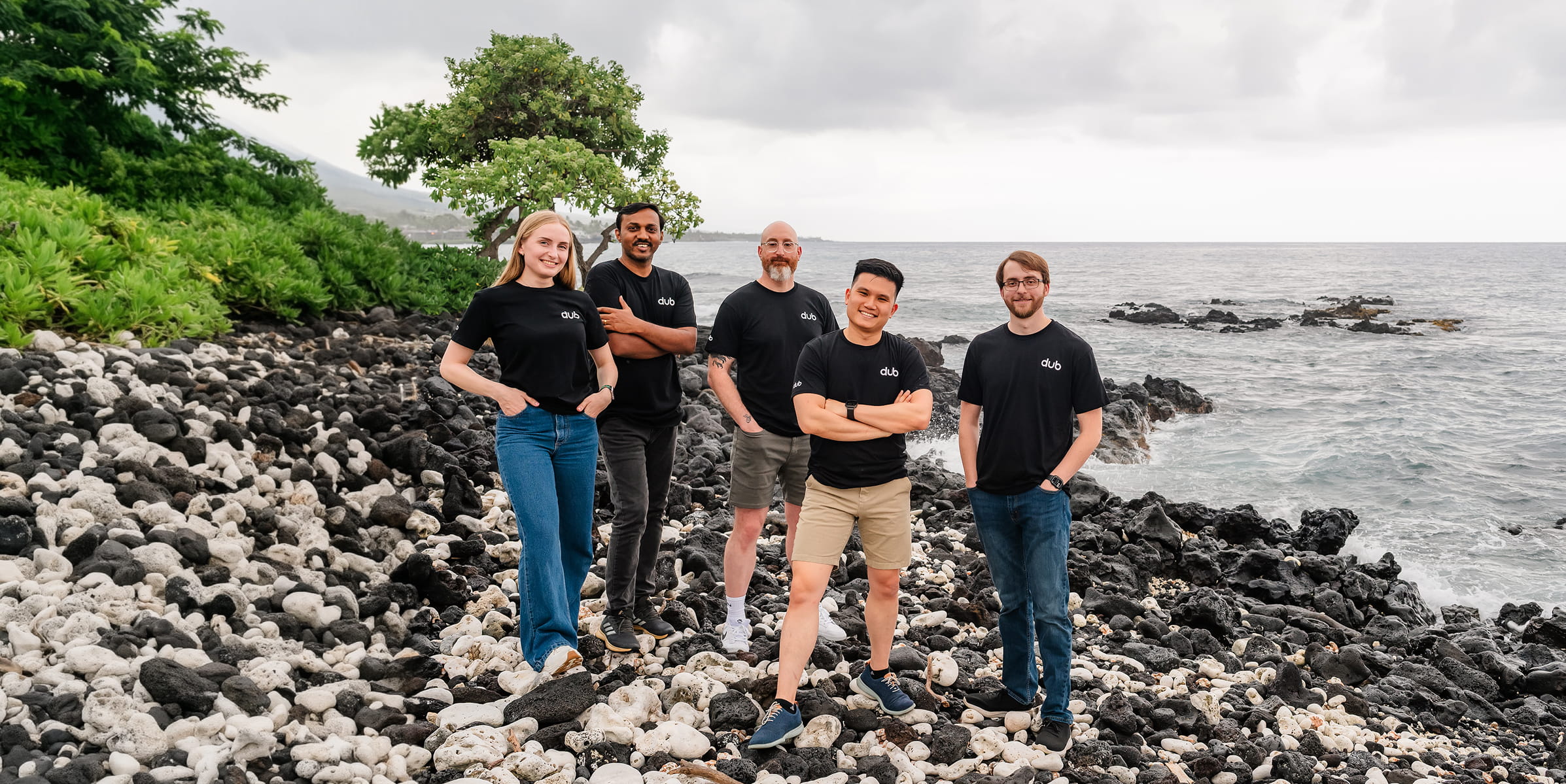
Tey now runs a remote company whose team photographs include a Hawaiian shore, kayaking, and time spent working together at an offsite. The images supply a welcome change of scale. Behind the counts of links and payments are colleagues who sometimes get on the same plane and stand in the same place.
His path offers no need for an invented childhood prophecy. There is plenty in the sequence itself: a novel taken to bookstores, a naming tool built on a deadline, examples written for developers, and a side project that kept attracting users. The common activity is visible. He makes things other people can pick up.
For Dub, that now means taking responsibility for more of what follows a recommendation. A creator shares a link. A customer buys. A business needs an answer about where the sale came from, and a partner needs a payment. Tey’s work has moved closer to those questions.
The novelist’s name belonged on a cover. The founder’s product lives in a route between pages. Both depend on somebody choosing to follow. For Tey, the next chapter is being written in those choices, one small link at a time.