The asset hiding in the basement
There are roughly 185 gigawatts of backup generators bolted into commercial buildings, factories, hospitals, and data centers across the United States. Most of them sit dark, waiting for an outage that may never come. Stephanie Hendricks looked at that pile of expensive, idle steel and saw the largest power plant nobody was using.
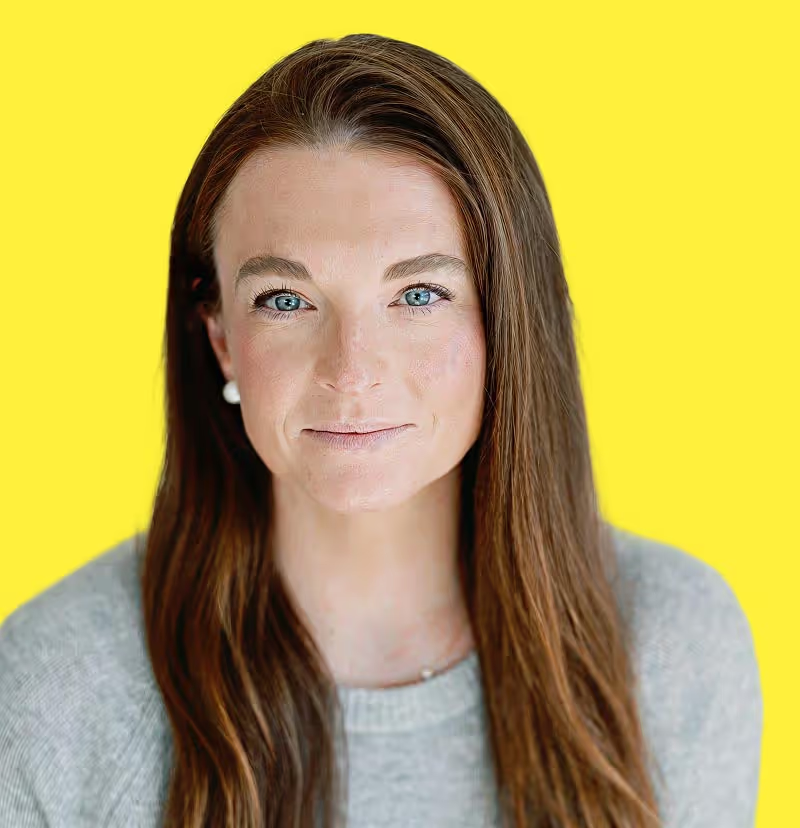
Hendricks is the co-founder and CEO of AGent Energy, a Houston company building AI software that aggregates, orchestrates, and monetizes distributed generation. In plain terms: it lets a building owner's backup generator earn money by feeding the grid during moments of stress, without anyone pouring concrete for a new power plant. The company recently rebranded from AiGent to AGent Energy, but the thesis has not moved an inch.
The pitch is almost annoyingly logical. Electricity demand is climbing, supply margins are thinning, and new generation takes years to permit and build. Meanwhile, the capacity already exists - it is just parked in surge-protected closets running a few hours a year for fire drills. AGent's platform turns those closets into a dispatchable resource that shows up when the grid buckles.
"Backup generators are an untapped reliability resource sitting idle across the grid. AGent turns liabilities into assets, at scale, to improve grid reliability and reduce consumer costs."
— Stephanie Hendricks, on AGent's $6M raiseThe operator, not the theorist
Plenty of people can sketch a clever energy startup on a whiteboard. Far fewer have actually dispatched power across a continent at 3 a.m. Hendricks has. Before AGent, she was Chief Operating Officer at Voltus, one of the recognized leaders in demand response and distributed energy. She built the company's global, 24/7 field operations, dispatch operations, and customer success teams - the unglamorous machinery that makes a distributed power plant actually deliver.
The scoreboard from that run is hard to argue with. Under her operations, Voltus oversaw thousands of distributed power plant dispatches that helped lower energy bills by billions of dollars while helping avert brownouts and blackouts across nine wholesale power markets. That is the difference between a slide deck and a track record.
Before Voltus, she led AI platform growth at NDimensional, where the work was monitoring, diagnosing, predicting, and optimizing industrial IoT assets in real time. It is a straight line from there to AGent: take messy real-world hardware, wrap it in intelligent software, and make it behave.
From top-secret clearance to the power grid
Here is the detail that reframes everything else: before any of the energy work, Hendricks was a Naval Warfare Intelligence Officer with top-secret federal credentials. She earned a bachelor's degree from Harvard and completed ROTC Naval Operations training at MIT - a Cambridge two-step that is rarer than it sounds.
That background is not just a colorful line on a bio. Mission-critical facilities - hospitals, data centers, defense-adjacent sites - do not hand control of their backup power to just anyone. A founder who carried real clearance and a safety-first operational discipline is exactly the kind of person those customers trust to touch the generator they are betting their continuity on.
"These resources are the highest quality power resource available when the grid is stressed."
— Stephanie Hendricks, on backup generators as grid assetsThe rule change that doubled the map
Timing matters, and Hendricks caught a wave. Regulatory clarity from the EPA on using emergency generators for grid services effectively doubled the addressable market for distributed power plants. Demand is rising, supply is tight, and suddenly a huge fleet of generators is allowed to play a bigger role. AGent raised its $6M seed in August 2025 - led by Zero Infinity Partners (ZIP) and CIV - to move while that window is open.
The raise also brought experienced hands to the board, including energy and technology veteran Dan Leff and ZIP managing director Alex Demeulenaere. Hendricks co-founded the company alongside President Francoise Parker and Chief Development Officer Todd Krause.
What she is actually building
Strip away the jargon and AGent is connective tissue. It sits between three things that rarely talk to each other: distributed backup generators, large flexible loads, and the wholesale power markets that pay for reliability. The AI platform decides when an asset should run, handles the market participation, manages fuel and dispatch, and hands the asset owner a new revenue stream for hardware that used to be pure cost.
The environmental angle is real too. Using existing, increasingly clean backup assets - rather than firing up new peaker plants or delaying retirements - is framed by the company as an environmentally preferable way to keep the lights on during stress events. No construction delays. No new land. No waiting.
The workaholic
She describes herself, plainly, as a self-professed workaholic - and a fitness enthusiast who builds intense workouts into the schedule.
Winnie's office
Her dog, Winnie, is a regular fixture at work. The startup grind comes with a four-legged co-worker.
Cambridge two-step
Harvard for the degree, MIT for Naval ROTC. Two of the hardest campuses in the country, back to back.
Why it sticks
The most interesting founders tend to sell the thing everyone else overlooked. Hendricks is not promising a moonshot battery chemistry or a fusion miracle. She is pointing at hardware that already exists, in buildings that already have it, governed by rules that just changed in her favor - and arguing that the smartest grid upgrade is the one you do not have to build. It is a contrarian's bet dressed as common sense, run by someone who has already done the hard operational version once before.
Whether AGent becomes the default layer for distributed generation or one of several players, the underlying idea is sticky: the grid's next great power plant may already be installed, idle, and waiting for someone with the operational nerve to switch it on. Hendricks is making the case that she is that someone.