Stephanie Broyles once walked into a meeting with regional sales leaders carrying the respectable furniture of modern marketing: a pipeline report, performance metrics and a view of where the business stood. She finished the presentation. The first response was not about conversion, coverage or growth. It was a more urgent corporate matter: “We're out of shirts.”
The line has survived because it is funny, and because it is an entire theory of marketing compressed into four words. Inside many companies, marketing is still the department of booths, brochures and boxes of apparel. Broyles has spent her career pushing the job back toward the balance sheet. Her objection is not to a useful event or a decent shirt. It is to mistaking the artifact for the work.
“I don't want anyone to think marketing and shirts, and I don't want to think marketing is putting on an event. We are so much more than that.”Stephanie Broyles, speaking as CMO of Fidelis Cybersecurity
What is the “more”? In her case, it has meant building go-to-market programs, aligning partner objectives, integrating acquired products, sharpening a company's category language and assembling teams across demand generation, product marketing, field, operations and content. The itinerary runs through a surprising amount of modern cybersecurity history: CA Technologies, FireEye/Mandiant, Palo Alto Networks, Orca Security, Fidelis Cybersecurity, Adlumin, CompassMSP, Elastio and now Mend.io.
The engineer enters marketing
Broyles did not begin with the conventional advertising pedigree. She earned a Bachelor of Science at California Polytechnic State University, San Luis Obispo, and has described her journey as a transition from engineering into marketing. She later completed the University of Virginia's Cybersecurity for Business Leaders program with distinction. The combination matters. Security products are crowded with claims that become mush when separated from the underlying technology. An engineering habit asks what the system actually does. A marketing habit asks why anyone should care.
In a 2023 interview, she returned repeatedly to curiosity, constant learning and the need to become comfortable with discomfort. That is unusually practical advice for a business where the category changes its vocabulary every few years. Endpoint gives way to cloud. Cloud acquires XDR. Software supply chains become boardroom material. AI begins writing code while also becoming part of the application that code creates. The nouns keep moving; the executive still has to produce a comprehensible sentence.
Her early senior work included global government pipeline programs at FireEye. At Palo Alto Networks, she moved from Americas marketing across the eastern United States, government and Latin America into a managing director role for global cloud security provider marketing. She says she was selected to build the company's first go-to-market plans for cloud service providers. Those programs were credited with 65 percent year-over-year revenue growth for the clients they served.
A specialist in the inflection point
The logos change, but the assignment keeps returning. At Orca Security, Broyles worked on the early differentiated message for a cloud-security company finding its market identity. At Fidelis, she arrived after its CloudPassage acquisition, with a mandate to broaden the global reach of a portfolio stretching across endpoint, network and cloud. A colleague later credited her first six months with an omnichannel campaign, a redesigned website, stronger lead generation, a healthier pipeline and record web traffic.
At Adlumin, she led marketing from its Series A period, building a data-informed demand engine around managed detection and response and new OEM channels. The company was acquired by N-able in November 2024. Broyles's own description of that chapter is revealing: she talks about demand and channels in the same breath as brand. For her, positioning is not a decorative paragraph. It is the shared set of words that lets sales, partners and customers recognize the same company.
That shared set is especially important in partner marketing, where each side has its own calendar, incentives and attention span. On a 2020 panel, Broyles argued for a shared-responsibility model: agree on the objectives, understand what each party must do, then make accountability visible. It lacks the glamour of a campaign launch. It has the considerable virtue of being operable.
Activity is visible. Accountability is useful.
There is a word for this kind of marketer, and “storyteller” is only half of it. Broyles is an operator. She has repeatedly taken the soft-looking materials of marketing - language, attention, belief - and connected them to hard systems: segmentation, partner motions, pipeline, adoption and retention. The story exists so that the machine knows where to go.
Now the nouns are code, models and agents
Broyles joined Mend.io as CMO during another category turn. The company had long worked in application security and open-source software risk. Its newer pitch extends across human-written code, AI-generated code and the models, prompts and agents embedded in modern products. This is a technical expansion and a linguistic problem. Buyers are being asked to understand two related objects at once: the software AI helps produce, and the AI systems companies are now building into that software.
At Mend.io, her remit covers global marketing strategy, brand and go-to-market execution. The company describes her particular focus as translating complicated AppSec challenges into narratives that connect technical innovation with customer value. In plainer English: explain the machinery without losing the consequence.
Her public work there offers a glimpse of the method. A February article on Claude Code Security moved quickly from an interesting tool announcement to the enterprise questions around governance. A March note about a new cloud region in India framed infrastructure as a response to data-residency requirements, especially in regulated industries. The object changes, but the move is consistent: identify the feature, then locate the business obligation hidden inside it.
Technical feature → operational consequence → customer value → a go-to-market motion someone can measure.
That approach helps explain why fear is largely absent from her visible style. Cybersecurity marketing is always tempted by the siren song of catastrophe. Broyles tends toward the practical question: what must a team understand, and what can it do next? Even in AI security, where the threats include prompt injection, jailbreaks and autonomous agents behaving badly, the useful narrative is a framework rather than a fright.
A booth game and a serious question
At Black Hat USA in August 2026, Mend.io paired its thesis about independent AI-security verification with something rather less solemn: a booth game called Catch the Vulnerabilities. More than 1,000 sessions were played. Fast reflexes filled a leaderboard; conversations followed. The juxtaposition is a neat portrait of Broyles's trade. The underlying question - who verifies AI systems when AI systems can manipulate the test? - is difficult. The invitation to begin talking about it need not be.
Her recap of the event ranged from a keynote and podcast recordings to a video interview and the game. It treated each as part of one communication system. This is where the old T-shirt story acquires its second act. Events are not beneath marketing. They become marketing when the experience, idea and commercial purpose are connected. A booth can entertain people. It can also make an abstract vulnerability tangible enough to discuss.
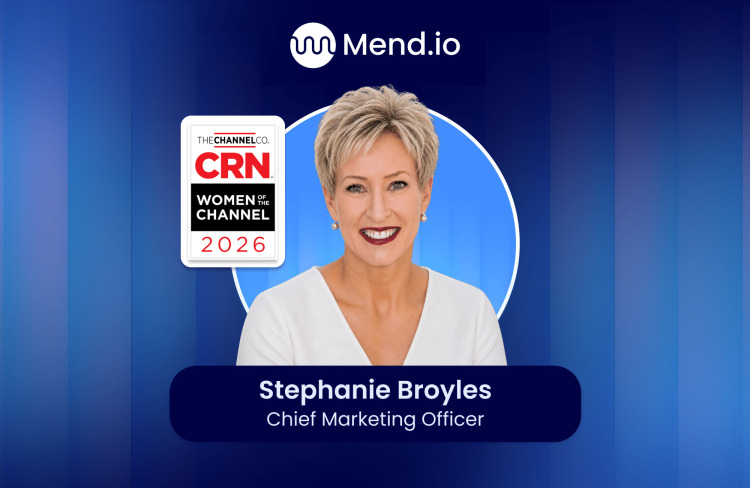
The same instinct appears in her recognition as a CRN Woman of the Channel in 2023, 2024 and 2026. Channel work rewards people who can persuade organizations with different priorities to act as one route to market. It is translation again, only the language includes incentives, enablement and trust.
Curiosity with a dashboard
Colleagues describe Broyles as persistent, forward-looking and able to work across internal and external teams. A former colleague wrote that her mentorship supplied confidence through roadblocks. Broyles herself has said she wants more women to pursue leadership in technology. She became a founding member of Chief's Washington, DC chapter and has advised expert networks including AlphaSights, Guidepoint and Coleman Research.
The personality suggested by the record is an appealing contradiction: curious enough to keep learning, impatient enough to insist the learning produce a result. She can talk about words because words shape categories; she can talk about pipeline because categories eventually have to pay rent. Her 2020 essay title, “Why Words Matter,” now reads like a small signpost placed early in the journey.
Mend.io presents a fresh version of her recurring assignment. The product is technical. The market is noisy. The threat model is changing while buyers are still naming it. Somewhere between code scanning and the boardroom sits a sentence that can align product, sales, partners and customers. Finding that sentence is not the whole job. For Stephanie Broyles, it is where the measurable work begins.