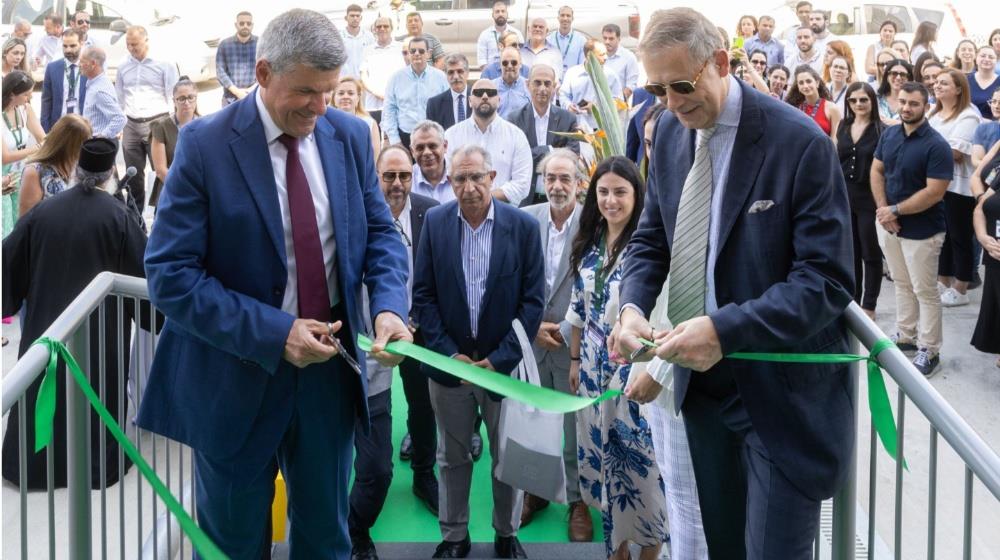
Stefan Linn is holding scissors. Beside him, a green ribbon stretches across the entrance to a new logistics centre in Limassol. He wears a dark suit and sunglasses; people crowd the steps behind him. The photograph catches one of business life’s dependable rituals: a building becomes an occasion, and two adults briefly concentrate on a piece of ribbon.
The occasion, in July 2024, was Remedica’s opening ceremony. Linn, its executive chair, spoke alongside George Papanastasiou, Cyprus’s minister of energy, commerce and industry. There was a tour afterwards. The centre was intended to accommodate more inventory and support the company’s international growth. A ribbon takes seconds to cut. Making the building useful is a longer assignment.
That distinction offers a way into Linn’s career. He has worked in consulting, corporate management and private investment. His responsibilities have ranged from franchise development to acquisitions and global operations. Since 2020, he has been managing partner and CEO of L1 Health, part of LetterOne. Read the sequence of jobs closely and a recurring subject appears: the work required to make a business plan function.
A franchise rebuilt in public
Years before that ceremony, Linn was president of Health Mart, McKesson’s franchise business. In July 2006, it relaunched at a trade show in Las Vegas. By April 2007, the network counted 1,280 stores. The contemporary account described expansion at roughly 100 stores a month following the relaunch. McKesson had brought in Interbrand to rethink the identity and Design Forum to redesign the prototype store.
“We redesigned this franchise from the ground up,” Linn said. The statement was unusually concrete for executive language. There was a brand, a store format and a network of owners to persuade. A franchise has to make a proposition useful to someone who runs an actual location. The central organisation can propose consistency; the owner has to decide whether that consistency earns its place.
A changed identity also has to survive contact with a customer. A logo may be approved in a meeting, but its working life begins elsewhere: above a door, on a sign, in the ordinary business of recognising a place. That makes the franchise chapter a useful early episode. It puts Linn’s corporate responsibilities beside a visible test of execution.
“We redesigned this franchise from the ground up.”
Stefan Linn, 2007
In another discussion that year, he offered a less sweeping thought: “Various formats can work.” He was considering different retail models and the markets in which they made sense. It is a small sentence with room inside it. It allows a business to be judged by the match between its design and its circumstances, rather than by whether it resembles the fashionable example down the road.
The two remarks sit comfortably together. Rebuilding a franchise calls for decisions about what should be shared. Accepting several viable formats calls for judgement about what should differ. A business can need both. The interesting part lies in the decisions between them, where an appealing central idea has to become something a local owner can use.
Changing seats at the same table
Linn’s earlier appointments establish a longer commercial background. He was vice president of marketing at Merck-Medco from 1996 to 2001, then a senior vice president at McKesson from 2001 to 2007. His consulting experience included McKinsey in London. He studied economics at the University of Dallas and earned an MBA at the University of California, Berkeley. Dallas, Berkeley and London make an international route before the investment titles appear.
He became a director at TPG in March 2008 and stayed until October 2010. There, his work involved assessing operating potential and helping portfolio companies improve their operations. The shift placed company experience inside an investment organisation. Evaluating an opportunity and being responsible for a business are different assignments, even when they concern the same machinery, customers and people.
One begins with a decision about what might be possible. The other continues with a calendar. Both require a view of the company; only the calendar insists that the next meeting, the next order and the next problem will arrive whether the original thesis was elegant or not. Linn’s movement between those assignments is the connective tissue of his career.
- 2008TPG
Investment and portfolio operations - 2010IMS
Strategy and business development - 2017Oxford Immunotec
Chief operating officer - 2020L1 Health
Managing partner and CEO
At IMS, the titles became a short record of changing scope. In October 2010, he took responsibility for strategy and business development. In January 2011, the title included innovation and development. In September 2012, it became strategy and global pharma solutions. These appointments placed him within the company’s senior leadership during the period following its acquisition by private equity owners.
There is a temptation to treat successive titles as steps on a ceremonial staircase. Here, the nouns are more interesting than the steps. Strategy, development and global solutions describe related work from different angles. They connect a proposed direction to the products and commercial organisation needed to pursue it. The sequence makes the career legible without requiring an invented moment of revelation.
A signature at the other end of the supply chain
Oxford Immunotec appointed Linn chief operating officer in August 2017. The announcement emphasised his experience with growth, operational improvements and acquisitions. At IMS, he had worked on strategic planning, commercial operations, expanding the offering, and identifying and integrating acquisitions. Those last two activities deserve to remain beside one another. Finding a company to buy and making the acquisition work are separate jobs.
His Oxford responsibilities covered global commercial operations, manufacturing, supply chain and product development. Together, they describe a business from several sides: what it offers, how it makes that offering, how it moves it and how it sells it. They also explain why the logistics-centre photograph belongs in this story. Distribution was already part of his professional vocabulary.
In November 2019, he signed a cooperation agreement with Shanghai Pharmaceuticals Holdings. The arrangement covered an integrated supply chain from collection at a British factory through distribution in China. Around 30 executives and project participants attended the signing. The published account records a business relationship built around the journey between production and the destination market.
International work is sometimes compressed into a list of countries. A supply-chain agreement gives the geography a task. There is an origin, a destination and responsibility for the distance between them. The practical question is whether each part of the arrangement joins the next. A map can show the route beautifully while leaving that question entirely unanswered.
Linn left Oxford Immunotec effective April 15, 2020. That year, he became managing partner and CEO of L1 Health. The move returned him to investment leadership after a period with direct operating responsibility. By then, his career contained both portfolio-company work and the executive obligation to manage several parts of an operating business.
Ownership has a working day
LetterOne describes itself as a long-term investment business. Its L1 Health unit works with entrepreneurs and executives, and its investment approach allows for both minority positions and majority ownership. The stated model uses evergreen capital, giving the organisation flexibility over the time it spends building businesses. That is the institutional setting for Linn’s present role.
Time, however, still needs decisions to occupy it. A longer ownership horizon provides room for work; the work has to be chosen and carried out. In Linn’s earlier roles, the responsibilities were identifiable: a franchise, a commercial organisation, acquisitions, manufacturing and distribution. His investment career becomes more intelligible when those responsibilities stay in the picture.
Capital committed to Remedica upgrades, a new development centre and investment in people.
Commitment reported by Linn in September 2024. Not a measure of completed expenditure or investment returns.In September 2024, Linn described more than €60 million committed to Remedica’s equipment, facilities, development capacity and people. He also discussed employee training, individual development plans and support for further qualifications. These were business priorities he presented publicly, rather than a completed scorecard. A commitment names intended work; its value ultimately depends on what that work produces.
“At the end of the day, our people’s success is our success,” he said. It is an uncomplicated statement. The surrounding detail gives it substance: onboarding, continued learning and conversations about new responsibilities. A company’s capacity includes the people who know how to operate it. Equipment arrives with specifications. Experience takes rather more patient assembly.
Read back through the career and the settings change: a franchise relaunch, an investment firm, a strategy team, a global operating role, a logistics centre. The connection is the movement between a decision and the organisation expected to deliver it. That is an interpretation of the work in his record, rather than a claim to know his private motivations.
There is a useful restraint in reading the career this way. A job title establishes responsibility; a company’s subsequent result belongs to more people than the person named in its announcement. The franchise story includes designers and owners. The Shanghai agreement includes a distribution partner. The Limassol opening includes the people who will use the facility. Keeping those people visible makes the portrait more precise. Linn’s place in these episodes is substantial enough to examine without handing him sole authorship of every business around him. Ownership and management are crowded occupations, even when the photograph has one person in focus.
The photograph in Limassol provides a fitting final image. Linn stands at an entrance with the people gathered around a new piece of business infrastructure. The ribbon marks the opening neatly. Beyond it lies the less photogenic part of the story: a working building, a working organisation, and the next day’s obligations. His career gives that part of business a place in the frame.