Imagine two institutions looking at the same currency market. One wants to buy an option; the other wants to sell. They agree on the price. A trade ought to be the easy part. In over-the-counter finance, however, willingness has company: credit arrangements, legal documentation and the question of who may face whom. The screen can introduce two strangers. It cannot, by itself, make them acceptable counterparties.
- SpectrAxe connects institutional buyers and sellers through an anonymous FX options order book.
- Its credit framework reaches beyond direct bilateral relationships.
- Disclosed trading and post-trade automation give users more than one execution route.
SpectrAxe’s proposition lives in that gap. By May 2024, its central limit order book was live for OTC foreign-exchange options. Hedge funds could interact anonymously with other hedge funds, proprietary trading firms, regional banks and market makers through FX prime-broker relationships. The interesting innovation was the invitation list. More participants could meet on one lit marketplace, rather than remain confined to separate circles of approved trading relationships.
The price is visible. The stranger stays a stranger.
A central limit order book, or CLOB, gathers firm bids and offers in a shared place. An RFQ, a request for quote, asks a selected counterparty or group for a price. Both belong to electronic trading. But they arrange the conversation differently: one displays executable interest; the other begins with a request.
SpectrAxe’s CLOB combines price visibility with anonymity. Those qualities are compatible because they concern different information. Participants can see trading interest without seeing the institution behind it. In a market where revealing an intended trade can affect the response it receives, that separation has practical value. Anonymity is part of the execution design.
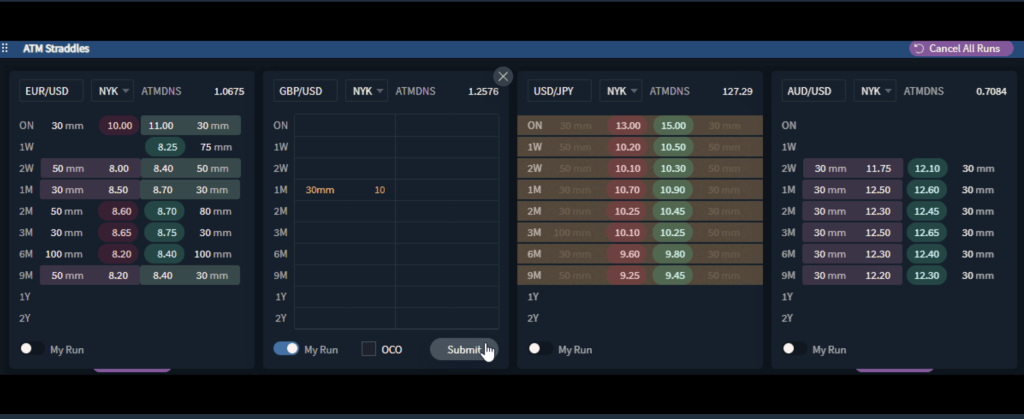
The comparison deserves care. Digital Vega’s Medusa already offers multi-dealer RFQ, streaming prices, custom option structures and post-trade integration. SpectrAxe’s distinction is its all-to-all order book and credit arrangement, rather than the mere presence of software. A dealer platform and a shared marketplace can serve the same desk while doing different jobs.
The boring part that makes the interesting part possible
Behind the order book sits the participating financial institution, or PFI. SpectrAxe’s rules define the documentation connecting a participant to that institution. The PFI establishes trading limits; it can also limit its aggregate exposure to another PFI. Breaching those limits can prevent a trade. “All-to-all” describes the marketplace’s ambition for interaction. Credit still has a vote.
Conceptual view of access, not a settlement diagram.
This is also an institutional venue with regulatory history. The CFTC granted SpectrAxe SEF registration on December 5, 2022, describing it as an affiliate of introducing broker Spectra FX Solutions. Registration continued when the LLC converted to SpectrAxe, Inc. in April 2025. Exchange-style execution here sits inside an OTC framework with defined responsibilities and access requirements.
A trade needs somewhere to go afterwards
Execution produces work. A completed transaction must reach the systems that book it and measure its risk. In July 2024, SpectrAxe partnered with OSTTRA to connect its price-discovery and execution capabilities to a post-trade network. Real-time trade notifications could flow into participants’ risk systems. The connection used FIX, the messaging protocol familiar to institutional trading teams.

Chopra explained the choice in terms of overlapping clients. The service was live for participants with relationships with both firms. That qualification matters: a useful integration depends on the connections a customer actually has.
“Partnering with them to create a seamless end-to-end experience for our mutual clients was an easy decision.”Alvin Chopra / September 2024
The business model, in six dollars
The venue earns execution fees. Its standard schedule effective January 26, 2026 listed CLOB single-leg options at $6 per $1 million of dollar-equivalent notional. A $10 million trade therefore implies a $60 standard venue fee before applicable discounts. Notional is the contract’s reference amount, not its premium. The number describes an execution charge, rather than the whole economic cost of trading.
January 26, 2026 schedule; before discounts
The same dated schedule charged Direct Trade makers $5 per million for single-leg options and no taker fee. Participant classifications and product structures change the calculation. These details show a business shaped around completed transactions, with different prices for different routes through the venue.
In April 2025, Susquehanna Private Equity Investments led SpectrAxe’s Series A, joined by IMC and CTC. The announced plans included broader geographic reach and additional functionality. These were investors from the trading industry backing a proposed change to its plumbing. Their participation gives the proposition weight; it does not establish how much liquidity every contract will attract.
For a trading desk, the sensible comparison is between complete workflows. A lower venue fee may be attractive, but the useful questions concern executable size, available counterparties and what happens once the order fills. For the venue, charging on execution ties the business to participation. A beautifully organised book still needs orders that other institutions want to trade.
Even an open marketplace needs more than one door
The evolution is revealing. A July 2025 filing prepared Direct Trade, an RFQ and block-trading module. SpectrAxe now advertises both anonymous and disclosed pathways. Institutions can choose a shared order book or a relationship-based conversation using its credit framework. That gives desks room to adopt the infrastructure without putting every transaction into the same format.
There is one documented adjustment to the rules: following feedback, SpectrAxe lowered block-trade minimums to mirror the required CFTC sizes. It is a small, concrete example of listening to participants. The broader product catalogue has also expanded, with 2026 filings covering FX swaps and metal-product fees. Switch, meanwhile, addresses position transfers across prime brokers, extending beyond spot to forwards and NDFs.
The lesson for other marketplace builders is an inference, but a useful one. Ask what stops willing users from completing a transaction. Then follow the transaction into the machinery downstream. SpectrAxe’s approach suits institutions that can satisfy onboarding, documentation and credit requirements, and find matching liquidity. The order book can widen a conversation. Someone must still be willing, and permitted, to take the other side.