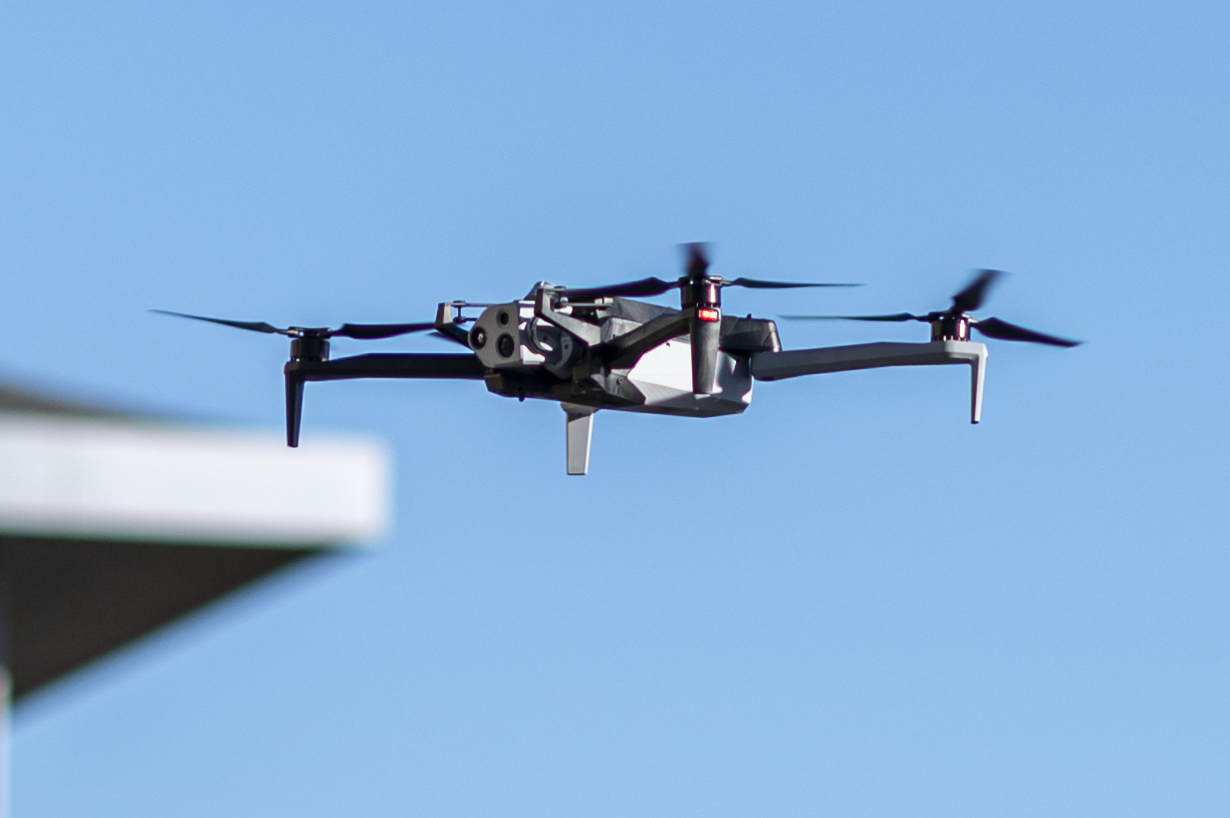
It's a Tuesday afternoon in a midsize American city. A 911 call drops - alarm tripped at a warehouse. Before the patrol car peels off, a small black aircraft lifts out of a metal box on a rooftop two blocks away. No pilot. No throttle. It climbs to about 200 feet, threads a parking lot, finds the warehouse, and is sending live video to a dispatcher before the cruiser hits the on-ramp. The drone is a Skydio X10. The box is a Skydio Dock. Nobody touched a joystick.
This is what Skydio sells now. Not toys. Not selfie cameras. Not even, strictly speaking, drones - the company prefers "autonomous aerial robotics," which sounds more like a phrase you'd put on an invoice. The pitch is simple: the next decade of robotics happens in the air, and somebody on this side of the Pacific had better build it.
A market the U.S. forgot to win.
For most of the 2010s, the global drone industry had one address: Shenzhen. DJI made the cameras, the airframes, the radios, the apps. American hobbyists bought DJI. American police bought DJI. American utility crews bought DJI. The Pentagon, eventually, decided this was a problem.
Three MIT roboticists noticed earlier. Adam Bry and Abe Bachrach had built drone autonomy at MIT's Robust Robotics Group, then helped start what became Google's Project Wing. Matt Donahoe joined from Apple's design org. The thesis: the aircraft itself was the easy part. The hard part - the part that would matter when computers started making decisions in three dimensions - was teaching a drone to see.
Six cameras and a hunch.
Skydio was founded in 2014. Its first product, the R1, arrived in 2018 with six fisheye cameras strapped to a frame and an onboard computer that did all the work. You could chase a mountain biker through trees by tapping "follow." There was no joystick at all on the controller, because Skydio decided the joystick was the problem.
The R1 was beautiful and expensive and a commercial curiosity. The follow-up, the Skydio 2, was a hit. For a brief period in the late 2010s, Skydio looked like it might become the American consumer drone brand - the Tesla of small things that hover.
Then, in August 2023, the company quit. Skydio announced it was leaving the consumer market entirely to focus on enterprise, public safety, and defense. The decision drew the predictable obituaries. The decision, it turns out, was probably the best one the company ever made.
Why exit consumer?
Selling $1,000 drones to hobbyists is a margin-thin, support-heavy business that competes head-on with a Chinese giant that subsidizes hardware to win software loyalty. Selling $20,000 drones to police departments and the U.S. Army is a different game with a different game's economics. Skydio noticed.
A short, opinionated timeline
Founded in Redwood City by three roboticists, two from MIT.
R1 ships. The first drone with no joystick.
Skydio 2 launches. Smaller, cheaper, much smarter.
U.S. Army adopts Skydio for short-range reconnaissance.
Exits consumer. Launches X10 and X10D for enterprise and defense.
China sanctions Skydio. Battery supply chain pivots stateside.
$52M U.S. Army order for X10D - largest single-vendor in Army history.
$110M Series F at $4.4B; $3.5B Skyforge manufacturing pledge.
The X10 is mostly software.
From the outside the X10 looks like the drone you'd expect: black, angular, a little menacing in the way that anything modular and military-adjacent tends to be. The interesting parts are inside. Six navigation cameras for 360-degree obstacle avoidance. A swappable payload bay for thermal, low-light, or telephoto sensors. An NVIDIA Jetson under the hood doing the math.
The trick - the part that distinguishes Skydio from a thousand quadcopter startups - is that the drone navigates on the strength of what it sees, not where GPS says it is. That matters in tunnels, under bridges, inside warehouses, behind buildings, and in any environment where the satellite signal is jammed, spoofed, or just not there. Which is increasingly the kind of environment people pay drones to enter.
The drone dock
The Dock for X10 is the part of the system that gets less press and probably matters more. It's a weather-sealed enclosure that lives on a roof, a substation fence, or a depot wall. The drone sleeps inside, charges itself, and launches on command - from a dispatcher 50 miles away, from an alarm trigger, from a calendar.
This is the unsexy infrastructure that makes the "drone as first responder" model work. A patrol officer doesn't take off and land a drone. A dock does. The officer just watches the feed.
Approximate funding raised, by round
Total raised to date: ~$851M. Series F at $4.4B post-money.
Who actually buys this stuff.
Three customer groups, in roughly equal weight. Public safety: hundreds of police and fire departments now run Skydio drone-as-first-responder programs, including major U.S. cities. Defense: the U.S. Army, allied militaries, and most visibly the Ukrainian Armed Forces, which have received over a thousand X10 platforms and use them for reconnaissance, evidence collection, and the kind of small-team missions where a $20,000 drone is cheaper than a $20 million helicopter.
Infrastructure: utilities like Axpo and Duke Energy use Skydio to inspect power lines and substations. Departments of transportation use it for bridges. Energy companies use it for flare stacks they'd rather not put a human on.
The China problem, briefly.
In October 2024, China sanctioned Skydio - an unusually direct move against a U.S. drone maker. The immediate effect was a battery shortage. Skydio had to ration packs to customers while it found new suppliers outside China. The longer effect was free advertising. Every American agency that worried about depending on Shenzhen now had a worked example.
"More productive, creative, and safe."
The official line is that Skydio exists to make the world more productive, creative, and safe with autonomous flight. The unofficial line is more pointed: the company believes that a U.S.-built, software-defined, fully autonomous drone platform is a piece of national infrastructure, and that whichever country gets there first will set the rules for everyone else.
That is, you'll notice, an argument about more than aircraft.
Skyforge, and the bet on Hayward.
In April 2026, alongside the Series F, Skydio announced something it called Skyforge - a five-year, $3.5 billion plan to scale U.S. manufacturing. The pledge includes 2,000 new Skydio jobs, 3,000 additional roles inside its U.S. supply chain, and more than $1 billion routed to domestic suppliers. The bet is that the next decade of robotics, like the last decade of semiconductors, is going to be relitigated on the basis of geography.
This is the part that's harder to write a punchline for. You can roll your eyes at "made in America" as a slogan. It's harder to roll your eyes at a $52 million Army contract delivered, on schedule, from a building in Hayward.
Back on the rooftop. The X10 finishes its loop of the warehouse, sees nothing moving, and posts back to the dock. The dispatcher cancels the patrol response - false alarm, raccoon, again. The aircraft folds itself into its enclosure. Total flight time: about four minutes. Officers in the area: zero. Drones in the air, somewhere in the United States right now, doing some version of this exact thing: a number that goes up every quarter.
The joystick is still gone. The market that the joystick implied - the hobbyist, the videographer, the consumer - Skydio happily handed back to DJI. What it kept is the more interesting market: every flying job that, until recently, was either too dangerous, too expensive, or too boring for a human to do. There are a lot of those.
The drone hears another alert ping. The dock opens. The next four minutes start.