A LinkedIn message is an unpromising place to look for a company’s next chapter. Daniel Juárez, who built the Latin American recruiting business Interfell, had seen plenty of pitches. Then Sofia Castillo, a Simera co-founder, wrote about a shared mission and suggested a call. He answered. In September 2025, Interfell joined Simera. A conversation about partnership had become a bet on how hiring should work.
The short version
- AI narrows the search; people review the candidates.
- Profiles carry interview evidence and work samples.
- Onboarding and international payments follow the match.
The interesting part of that bet is the distance between finding somebody and employing them. A manager can love a candidate and still face a queue of questions: Who checked the skills? What does the contract cover? How does the money arrive? Simera sells a route through that queue. Its market is the growing collection of employers willing to hire abroad, provided somebody makes the process manageable.
The résumé gets a second job
Simera calls its candidate dossier the Simera Professional Key, or SPK. Interfell’s explanation makes the idea concrete: a summary, a scorecard, interview clips, tests, work samples and logistics. English proficiency, availability and time zone belong beside technical ability. A brilliant applicant who cannot overlap with the team’s working day presents a different hiring proposition from one who can.
That packaging matters. The ordinary résumé is an argument written by the person who wants the job. The SPK is meant to put evidence beside the argument. Candidates complete validations that can serve several openings, reducing repetition. Hiring managers get more material to question. A score still needs interpretation: the useful conversation begins when someone asks which task, answer or work sample produced it.
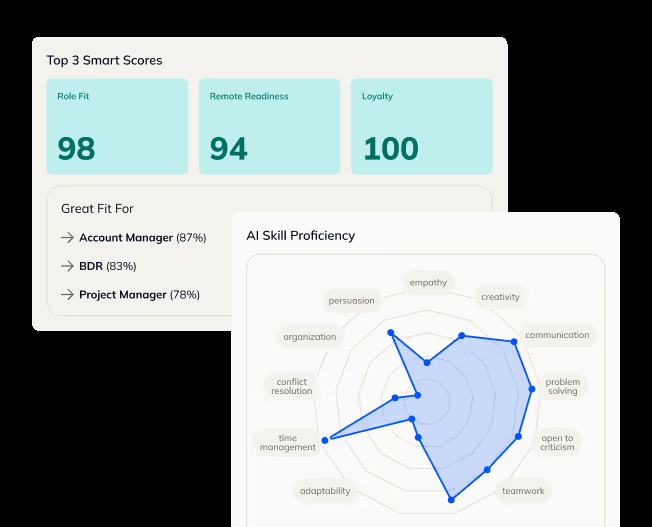
Agent David, Simera’s hiring assistant, searches and ranks candidates using structured signals. The company describes human vetting before candidates reach the employer, and employers can conduct their own interviews. For job seekers, the proposition is access to international opportunities through one developed profile. For employers, it is less time assembling the basic facts before a serious conversation can begin.
David needs a better answer
A May 2026 account from technology provider Manufact describes a wonderfully ordinary obstacle. Simera had candidate data, but staff still searched it manually and sent shortlists back to customers. Agent David made searching conversational. Then another limitation appeared: paragraphs about applicants were awkward to compare. The team moved toward interactive lists that people could sort and filter.
Manufact describes the same application serving customers, the website and internal staff. This is a vendor’s account, rather than an independent speed test, but the design lesson travels well. Automating retrieval helps only if the answer arrives in a form somebody can use. A hiring manager needs to compare people, inspect evidence and decide whom to meet. More text can simply move the waiting room onto the screen.
From request to working relationship
- 01Specify
the role - 02Compare
the evidence - 03Interview
and select - 04Onboard
and pay
A simplified workflow. The employer’s judgment remains part of the sequence.
The bill arrives after the match
Simera’s public FAQs say reviewing candidate information is free. Payment begins after a contract is signed; the monthly invoice includes data and administration fees. That makes it a recurring service relationship. A buyer is paying for access and administration over time, so the agreement deserves the same attention as the shortlist.
The company advertises savings of up to 70%. Treat that as a claimed upper bound. Its October 2026 LATAM salary guide supplies the useful complication: geography, specialization, experience and English proficiency affect compensation. The guide puts mid-level software engineers around $3,500 to $6,000 a month and senior engineers at $6,000 to $8,500 or more. These are Simera’s benchmarks, not an individual quote. Service charges and the employment arrangement also belong in the calculation.
Compensation + service fees + applicable employment costs
Compare the total for the same role, hours and level of experience.Buying the people behind the platform
Simera’s breadth runs beyond engineering into sales, marketing, support and operations. Customer examples include Back to the Roots, New Level Work and NoPlex. On Simera’s site, Back to the Roots describes hiring across several Latin American countries. Those examples make the customer proposition tangible: an operating company needs particular work done, with recruiting and administration fitted around it.
A buyer can also assemble this process from separate suppliers: an agency for sourcing, a specialist for assessments, and a service for payroll. Simera competes on putting those stages together. That is a useful distinction from a job board that primarily collects applications. The breadth of the offer also raises a practical question: which responsibilities does the agreement actually assign to Simera, and which stay with the employer?
The acquisitions extend that idea. Interfell brought regional recruiting experience. In May 2026, Simera announced the acquisition of Talent Sam, whose South African operation combined recruiting with employment, HR, equipment and IT support. Talent Sam’s three founders joined leadership roles. The strategic logic is straightforward: finding people and running the surrounding operation require different kinds of knowledge.

That combination carries its own work. Juárez’s later reflection on the deal was unusually practical: integration and changing a technology stack were difficult. His original account says previous acquisition approaches had fallen away or failed to align; Simera offered a technological and cultural fit. That is a useful corrective to the frictionless language of hiring platforms. The organizations removing handoffs for customers must manage their own.
“Integration is tricky. Changing a tech stack is challenging.”
Daniel Juárez · reflecting publicly on Interfell joining Simera
Borrow the discipline, then widen the map
The copyable part starts before opening the talent pool. Define the output, required working hours and evidence a good applicant should provide. Ask to see the work behind a score. Interview against the actual assignment. Then price the whole arrangement and name the person responsible for each step between acceptance and the first working day.
This approach depends on work that can travel, communication that holds up and arrangements suited to the country and role. A local presence requirement or an ill-defined brief can defeat a broad search. Simera sits between recruiting, talent marketplaces and workforce administration. Its case rests on making those pieces work together. The useful test is whether the person you selected can begin doing the work you needed.
Open another window
Explore Simera’s platform, meet its hiring assistant, or hear the conversation behind the product.