The Sierra Star once gave Oakhurst an address for more than the news. During the Detwiler Fire response in July 2017, the American Red Cross directed people with goods to donate to the newspaper’s office on Crane Valley Road. The drop-off, operated by VOAD, was listed as open from seven in the morning until dusk. A newspaper building had become part of the community’s emergency logistics.
That is a useful place to begin with this company. Before asking how many readers a local publication can reach, ask what people expect it to do. Report a school decision. Introduce a business. Carry a public notice. Sometimes, provide a recognizable place to bring things when neighbors have been forced from home.
The Star’s physical presence has since receded. Its Oakhurst office closed in 2018; its weekly print edition was scheduled to end in March 2024. Readers were directed to a digital section hosted by The Fresno Bee. The name survived the changes in how the product was made available. The more interesting question is how much of its local usefulness can travel with it.
A Thursday habit, priced at $3.50
The early business fits into a few lines of a newspaper directory. In 1962, N. W. Ayer & Son listed the Sierra Star as an independent Thursday publication, established in 1957, with circulation of 1,200 and a subscription price of $3.50. Jack L. Gyer was publisher; Clarence R. Ragland was editor. The entry describes an offset-printed newspaper serving a mountain resort community.
Those numbers are a period snapshot, not a claim about today’s audience or prices. They also describe a deliberate scale. The Star organized attention around a place small enough for an individual publisher and editor to become part of its public life. A later federal trademark filing recorded November 1, 1957, as the name’s first use for newspapers.
The product accumulated another kind of value as it aged: a record of the area. Fresno County Public Library lists ten microfilm reels of the Star covering July 1977 through December 1985. GenealogyBank announced the addition of Sierra Star web-edition articles in its November 2017 collection update. Yesterday’s routine coverage can become tomorrow’s family-history clue, or the surviving account of a business, argument or celebration.
There is a practical distinction here. A live feed helps someone decide what deserves attention now. An archive lets someone check what happened before. A newspaper brand can serve both purposes, but keeping current coverage available and keeping historical reporting discoverable are separate jobs.
The customers were also the neighbors
The Star’s readers historically included people in Oakhurst, eastern Madera County and the Yosemite area. Its commercial offering joined subscriptions with advertising, while public notices gave institutions a way to put information before local residents. That mix is more revealing than a broad label such as media company: the publication sold attention within a particular geography.
Public records make the arrangement concrete. Madera County transportation planning materials list paid notices in the Sierra Star among the methods used to promote community engagement. A workforce-development plan includes an affidavit for a notice published in the Star on January 31, 2019. Oak Creek Intermediate School’s accountability report named the newspaper among its channels for communicating with families.
These are different uses of the same distribution business. A public agency wants participation. A school wants parents informed. A merchant wants a customer to remember an offer. Readers, meanwhile, need enough useful reporting to make opening the publication a habit. The editorial and advertising sides meet around that habit, even though buying advertising and earning news coverage are different transactions.
A 2017 promotion supplied a sunnier example. Bass Lake Water Sports offered a full-day patio-boat rental and lunch for six through a Sierra Star Facebook giveaway. Entrants were asked to like the post and share a favorite Bass Lake summer memory. The prize was tied to a place the audience already knew, and the entry invited a story rather than a bare click.
Historical advertising directories list page fractions and column inches alongside digital display formats. One third-party guide estimates $16 for a column inch of black-and-white advertising, explicitly warning that its figure may be outdated or incorrect. It belongs in the history of the offer, not in a present-day media budget. Current buying links on the Bee’s site lead to McClatchy’s advertising services.
A front office with another job
Local competence is sometimes visible in a single photograph. In the 2016 California News Publishers Association Better Newspapers Contest, with results announced in May 2017, Michael Costa’s “A Proud Tradition” earned the Sierra Star a first-place Artistic Photo result. The judges singled out the dancer’s dedication. Coverage of a small place still demands the craft of looking closely.
That craft shared a home with the ordinary work of a newspaper office. The Star had moved into a former Bank of America building in 1983. Former publisher Betty Linn, who retired in 2017 after more than 23 years in that role, later recalled that “serving the community has been so rewarding.” The fire-relief drop-off gives that sentiment a specific physical setting.
“serving the community has been so rewarding.”
Betty Linn · former publisher · 2018
The Red Cross notice carefully distinguished the newspaper drop-off from evacuation shelters. People donating goods were being sent to a collection point, while displaced residents were directed to separate shelter locations. The Star was part of a wider local response. Its contribution depended on a usable address and other organizations doing their own jobs.
There is a striking coda to the building’s newspaper years. In December 2019, local reporting described the opening of Camarena Health’s Oakhurst urgent care clinic in the remodeled former Sierra Star building. The space found another public-facing purpose. For the newspaper, the challenge was to keep serving people without the same invitation to walk through its door.
First the office. Then the presses.
The 2018 office decision came with a stated reason: foot traffic had fallen, and more business could be handled online or by phone. Management said weekly print production would continue. Read that chronology carefully. Closing a public office and ending a printed product were separate decisions, made years apart.
The wider corporate setting was also changing. McClatchy, which owned the Star through the Fresno Bee operation, filed for bankruptcy in February 2020. Its own corporate history records a transition to private ownership under Chatham Asset Management that year. Those are parent-company events; they should not be confused with a standalone Sierra Star funding round or a financial measure of its newsroom.
In January 2024, Christopher Kirkpatrick announced the Star’s move to an all-digital format. The last print edition was scheduled for Thursday, March 7. Existing subscribers would receive a letter explaining their options, and coverage would be available at the Fresno Bee’s Sierra Star address. The announcement promised continuity in news coverage while changing the means of delivery.
The first documented pressure in this sequence was reduced use of the office. It would be a leap to label that evidence a collapse in demand for local reporting. Equally, keeping a web destination does not establish that every reader followed. The observable change is narrower: the business stopped maintaining two familiar physical ways of meeting its audience.
A local name inside a regional feed
Today, the original Sierra Star web address redirects to The Fresno Bee’s Sierra Star section. A September 2026 check found a mix of regional government, public-safety and opinion stories, including listings dated April 2026. That visible mix places the title within a broader Central Valley news operation. A reader looking for it should expect a section of the Bee rather than the old standalone newspaper office online.
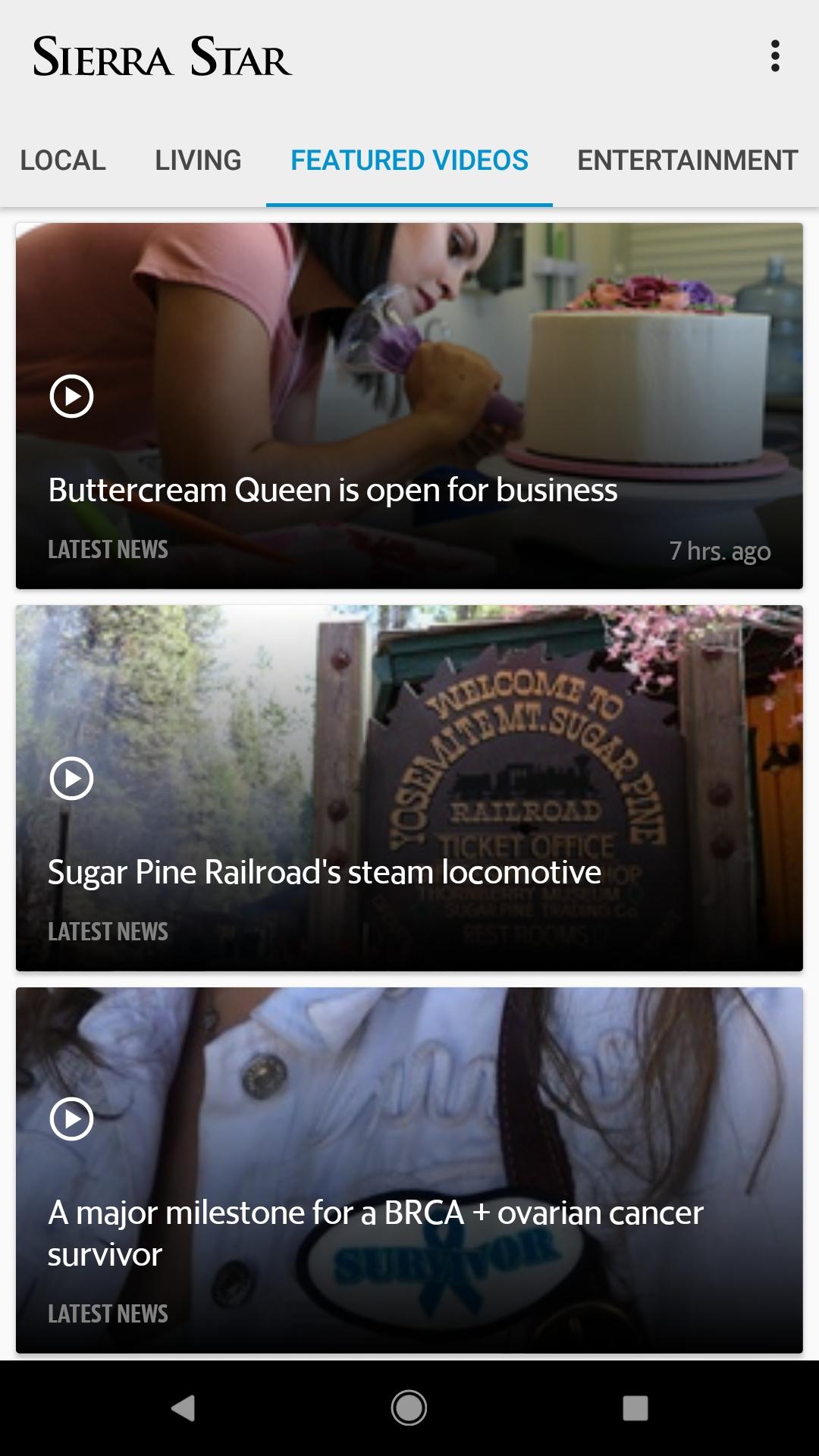
Familiar places.
A bakery and a steam railway share the video menu.
Mobile publishing preceded the end of print. Archived Android and iOS listings describe Sierra Star apps carrying news, sports and community events. The Android listing preserves a video interface with stories about a bakery and the Yosemite Mountain Sugar Pine Railroad. It is a useful artifact of the transition: locally recognizable subjects, presented through software.
The Star also operated in a market with other voices. Sierra News Online explicitly identifies itself as a separate outlet and described its relationship with the Star as a friendly rivalry. For readers, the distinction matters. Similar names do not mean the same newsroom, ownership or coverage priorities.
The useful part to copy
The transferable lesson is visible in the specifics: make the audience’s place do some of the work. A Bass Lake prize gave a promotion local relevance. A planning notice reached residents with a reason to participate. A searchable archive made old coverage useful again. Each connected the publication to a recognizable need, rather than asking readers to value news in the abstract.
There are conditions attached. A web-only offering depends on readers being able and willing to use it. A broader regional feed needs enough relevant material to reward a mountain reader’s return visit. And the civic usefulness of an office cannot be reproduced simply by redirecting a domain. Digital distribution changes access; somebody still has to maintain the local relationships.
Sierra Star’s history supplies a grounded standard for judging its next chapter. Can a resident learn something useful, an institution reach the people it serves, and a local event receive careful attention? Those were meaningful jobs when the subscription cost $3.50. They remain meaningful after the paper stops arriving.