Once a month, Jasmyn Rowley used to enter a Sault Ste. Marie grocery store carrying a peculiar kind of suspense. Regular shoppers recognized her. A camera might be nearby. Someone could be about to have a bill paid, receive flowers or discover that neighbours had quietly nominated them for a surprise. Sometimes, of course, Rowley was simply buying groceries with her son. But by 2019, after seven years and 154 filmed acts of kindness, her presence had become a local tell: something generous might happen here.
It is an unusual form of brand recognition for a marketing executive. Most campaigns try to make a logo trigger recall. Rowley's work made a person trigger possibility. The distinction helps explain her career at Village Media, where she moved from video journalism and communications into the Chief Marketing Officer role. Her work links the measurable machinery of digital publishing - email acquisition, contribution funnels, social distribution - with something less tidy and more durable: the feeling that a local newsroom is part of the place it covers.
That connection did not arrive as a finished strategy. It grew from a question Rowley and her colleagues asked while she was reporting for Local2: how could they surprise deserving people in their community? The answer did not require a celebrity donor or a national production budget. It required nominations, local businesses willing to help, a camera and enough care to make the recipient the centre of the scene.
“All you really need to run it are generous community members who want to be on board and want to help others.”Jasmyn Rowley, on Random Acts of Kindness
The route back home
Rowley's route to that question ran through several corners of the media business. She studied media and journalism at Western University and Fanshawe College, then entertainment business management at Vancouver Film School. Her early work included television at TVtropolis, on-air reporting with Shaw Communications and publicity work that took her to Toronto red carpets and press junkets, including events connected to Universal Studios. She also taught public relations and event management at Sault College.
Then she returned to her roots in Sault Ste. Marie. The move placed her near the ground floor of what became Village Media, a company built from the SooToday model of free, digital, community-specific news. Rowley connected with CEO Jeff Elgie and joined the business in 2013 as Director of Marketing & Communications. The company was young enough that job boundaries were porous. Reporting, promotion, sponsorship and audience development could sit at the same table because the larger problem was shared: how do you make local news useful enough, and sustainable enough, to keep showing up?
Random Acts of Kindness became the most visible expression of that work. Early surprises included arranging for a woman to see a horse again, installing a wheelchair ramp for someone who needed one, helping a young girl walk alongside her twin sister with a new device, and arriving with smaller gifts such as pizzas, coffee, flowers or grocery money. The scale varied. The structure stayed recognizable: listen for a need, find a local partner, show up, record the moment and let the community see what its own generosity could do.
A format that travelled
The holiday version became a ritual. By 2022, the 12 Days of Christmas program had run for ten consecutive years. Rowley recalled people telling her that Christmas in their household did not begin until her first video appeared. What began as a grassroots Sault Ste. Marie initiative spread to more than a dozen communities across Ontario. The repeatability mattered. Each market could preserve the premise while supplying its own nominators, sponsors, recipients and local texture.
In Toronto, the format grew physically larger. In August 2025, the Village Media Cares team joined GFL, Canadian Tire Jumpstart and Toronto Community Housing at a neighbourhood barbecue in Blake-Boultbee. More than 250 gifts went to families and children, including bikes, scooters, backpacks and shoes. The scene did not resemble a conventional newsroom activation. That was the point. The news company was not only describing a community. Its staff and partners were participating in one.
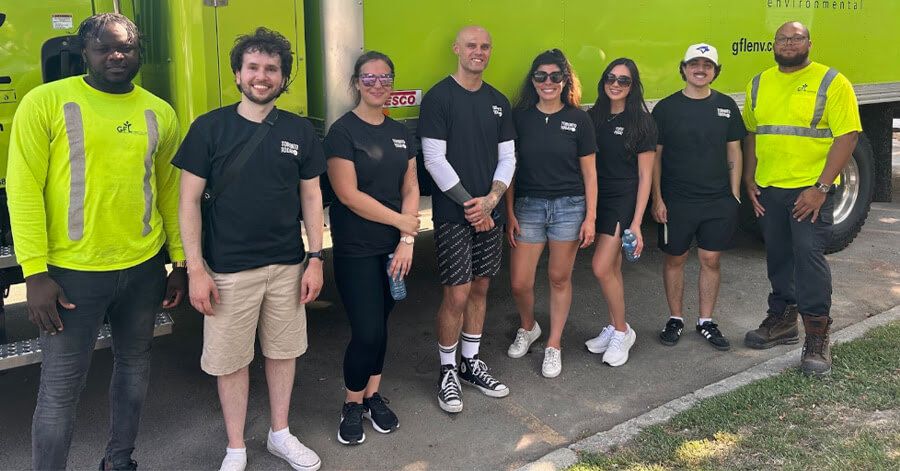
Rowley's community portfolio widened alongside the video series. Community Builders Awards recognize people doing sustained local work. GoodWorks grants and charity-match initiatives channel support to organizations. GoodMakers gives individuals a way to amplify their contributions across local programs. These projects turn a publisher's reach into a coordinating asset. A newsroom already knows the businesses, volunteers, institutions and stories in a town. Rowley's work asks what happens when those connections are arranged around action.
The numbers behind belonging
There is a hard-edged growth operator inside this community story. In 2020, Village Media worked with Social News Desk to turn its strongest live stories into automatically updated Facebook lead-generation ads. The content changed as news and audience response changed. From September onward, the campaign produced 76,426 new email signups at an average cost of $0.81 each. Rowley described the approach as deliberately balanced: onsite acquisition paired with offsite email and social campaigns.
A second experiment addressed reader revenue when advertising looked uncertain. Village Media simplified its contribution flow, clarified the available tiers, rewrote verification emails and tested subject lines. The newsroom promised to keep access free while asking readers who valued the coverage to help subsidize it. Email generated more than 80 percent of total contributions across its markets, outperforming header prompts, in-article messages, display placements and Facebook ads.
The tactic is useful, but the sequence is the real lesson. Local reporting earns attention. A newsletter turns attention into a habit. Repeated usefulness creates enough trust for a voluntary contribution. Community programs return some of the publisher's reach to the place that produced it. Each step makes the next one more plausible.
The local attention loop
This is where Rowley's two public roles converge. The former reporter knows how to locate the human detail that makes a story worth watching. The marketer knows how to distribute it, test it and create a path for the audience to respond. The community organizer knows the response cannot stop at a metric. It has to land somewhere: a ramp, a bicycle, a grant, a room where quiet local work is finally applauded.
The useful unit is not a pageview. It is a relationship with a next step.
Learning to take the spotlight
For someone whose signature format puts other people at the emotional centre, recognition creates a small inversion. When Rowley received the Sault Ste. Marie Chamber of Commerce's 2023 ATHENA Leadership Award in March 2024, she told the audience she was used to shining the spotlight on other people. Having it aimed at her felt new. Her acceptance traced a path through journalism school, film school, television, publicity and home, then thanked the people who made career and family life feel less impossible.
Her colleagues leaned into the inversion a few months later. Rowley would have preferred her 40th birthday to pass without publicity. Village Media published a celebration anyway, inviting stories and messages for the person normally engineering the surprise. It was affectionate mischief, and evidence that a recurring public format can shape an internal culture too.
The formal milestones continued. Rowley was promoted from Director of Marketing & Communications to Chief Marketing Officer in late 2025. In May 2026, the Chamber gave her its Economic Impact Award for an Individual, pointing to her leadership of the Cares team, Random Acts of Kindness, 12 Days of Christmas, GoodWorks and GoodMakers. Her Random Acts collaborators also earned a silver Canadian Online Publishing Awards recognition for video content.
Awards compress years into a citation. Rowley's record is more instructive when expanded. A television reporter asks a local question. A recurring segment supplies an answer. Sponsors and residents make the answer repeatable. A growing digital publisher carries the format to other towns. Audience experiments make the underlying business stronger. New programs give that audience more ways to participate. The executive title arrives after the operating system is already visible.
What travels, what stays local
The tempting lesson is to copy the series. The more durable lesson is to copy its constraints. Begin with a real local need. Let people in the community identify it. Invite partners whose contribution is tangible. Make the recipient, not the sponsor, the centre of gravity. Show enough of the process that viewers understand they could join it. Then repeat it until the audience recognizes the ritual.
The same constraints improve growth work. Start with useful reporting. Ask for an email address at the moment value is clearest. Make the next step simple. Test the message. Keep the core promise, in Village Media's case free access, easy to understand. Measure the result, but do not confuse the metric with the relationship it represents.
Rowley has written that she wants to continue creating more good in her community. It is a plain aspiration, almost suspiciously modest for a C-suite biography. Yet it matches the work. The programs are built from ordinary components - a nomination form, an email, a willing sponsor, a local story, a surprise at the door. Their power comes from arrangement and repetition.
That may be why the grocery-store anecdote lingers. Recognition usually creates distance between a media figure and an audience. In Rowley's case, recognition creates a question about what might happen to the person standing nearby. A shopper sees her and imagines generosity moving through the aisle. For a local-news marketer, that is an uncommon achievement: the brand is not merely remembered. It leaves people watching for a chance that their town might be kind again.