A repair shop can finish a brake job and still have work left to do. The advisor needs an approval. The technician needs the right part. A customer wants to know whether the car will be ready by five. Someone must turn the estimate into an invoice, take payment and remember what happened when the same vehicle returns six months later. None of this is the repair. All of it determines whether the shop makes money.
In four turns of the wrench
- Shopmonkey sells cloud software for the work around a vehicle repair: booking, quoting, inspections, parts, communication, payment and reporting.
- It is built mainly for independent repair and related service shops in the United States and Canada, with a multi-location product for larger operators.
- The published Basic price is $239 a month, or $215 a month with annual billing. Payments and several growth and finance tools carry separate costs.
- Its practical lesson: follow a job from first call to final receipt, then fix the waits between those steps.
Shopmonkey is the company that decided this invisible job deserved software of its own. Its founder, Ashot Iskandarian, had worked in software for small businesses and liked working on cars. In a 2019 account of the company’s beginnings, he described spending time at a local auto shop and watching owners wrestle with poor software. It cost them time, money and patience. He began building Shopmonkey in 2016, wrote its first line of code in January 2017, and left his technology job that July to pursue it full time.

The customer is waiting for an answer
The first insight was not that garages needed a prettier calendar. A repair order passes through people who have different information. The service advisor hears the complaint. The technician sees the fault. The owner controls the parts budget and labor rate. The customer authorizes the bill. When each handoff lives in a different notebook, phone, inbox or application, the shop spends its day asking what happened to the job.
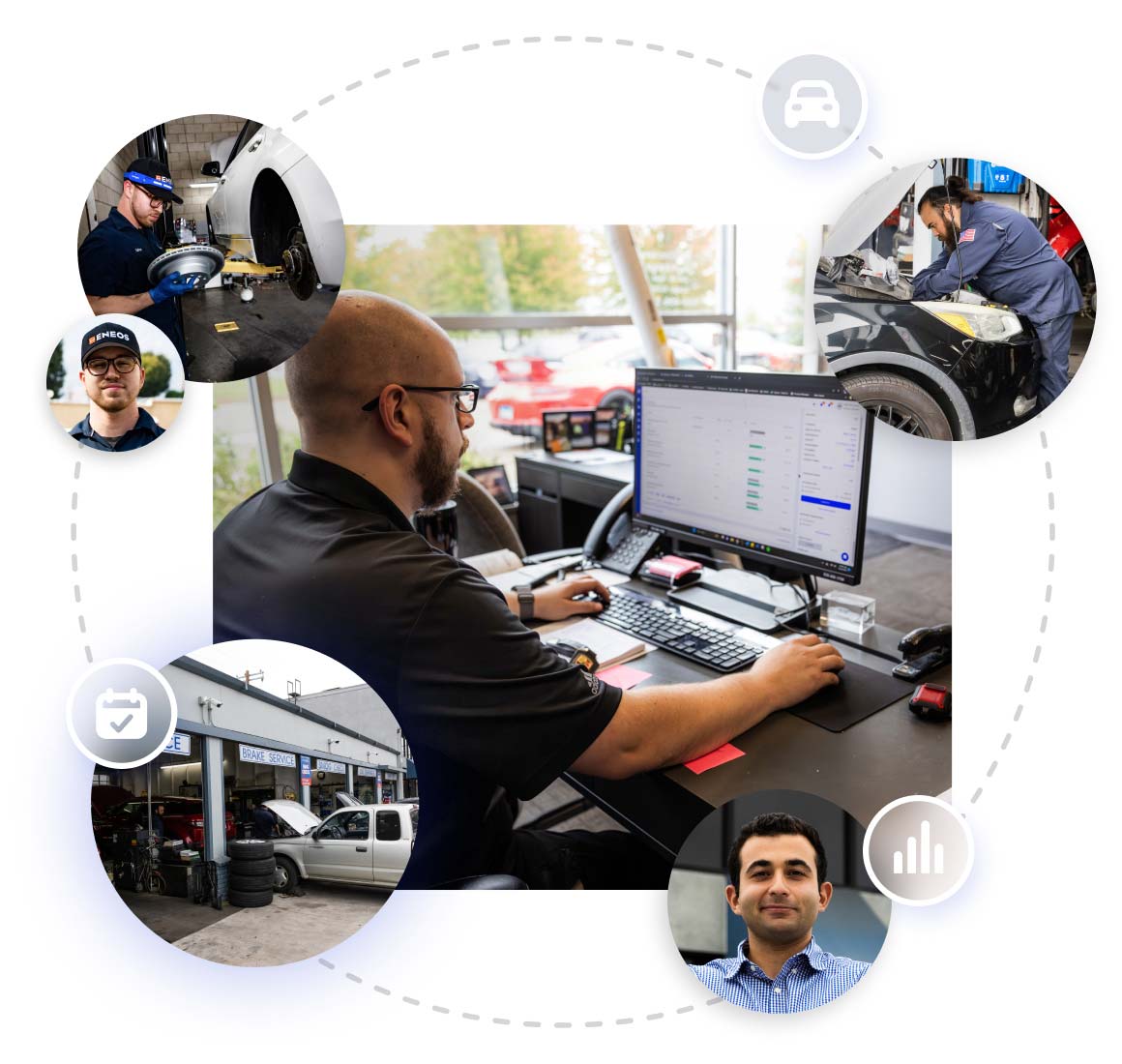
Shopmonkey puts the order at the center. A shop can schedule an appointment, build an estimate, assign work, order parts, track technician time, send a digital vehicle inspection, collect a signature, issue an invoice and accept payment. Two-way text and email connect the customer to that process. The technician app puts vehicle scanning, inspections and work updates in the bay, where a desktop computer is rarely the natural tool.
A repair order’s route
The difficult part is often the gap between boxes. That is where a message, an approval or a missing part can stop the day.
A digital inspection illustrates the method. A customer may distrust the phrase “you need new brakes” from an unseen mechanic. A photo or video of the worn component, with notes attached to the order, gives the recommendation something to stand on. It does not make every repair necessary or every customer eager to spend. It does let both sides discuss the same object. Shopmonkey then lets the customer approve the estimate electronically, leaving a record of the decision.
“We created Shopmonkey to empower every shop to thrive.”Ashot Iskandarian, founder and CEO
The software follows the money
The initial pitch was easier operations. The current product is larger. Inventory, parts lookup, marketing, reporting and multi-shop administration sit beside the repair order. Shopmonkey HQ can standardize roles, pricing rules, payment methods and shared inventory across locations. A chain that once had to ask each branch for a spreadsheet can inspect its business from a central view, while individual shops still do the work.
The integrations are revealing. A 2021 partnership with Epicor brought a parts catalog into the ordering flow, so a selected part could move directly to the repair order. Shopmonkey added access to existing ALLDATA parts and labor accounts in April 2026. Neither partnership replaces the supplier or the repair guide. Each shortens the trip between finding a part, pricing the work and explaining the quote.
Then comes payment. Shopmonkey Payments attaches card, wallet and eligible financing options to the invoice; payment data can flow into reporting and, for QuickBooks Online users, into accounting records. In July 2026 the company introduced its own accounting software and a bookkeeping service with an assigned bookkeeper. This is an expansion from helping a shop finish a job to helping its owner understand whether the job paid.
A subscription with a widening driveway
Shopmonkey’s business model starts with a software subscription. As of September 2026, its published Basic plan costs $239 a month, or $215 a month when billed annually. Clever is $399 monthly and Genius $499; Multi-Shop is quoted individually. Basic includes estimates and invoices, appointment reminders, two-way text and email, digital inspections, e-signatures, parts lookup and the mobile app. Additional user licenses are listed at $20 a month. The entry price is therefore a starting point for a particular shop configuration, not a universal bill.
This breadth is both Shopmonkey’s distinction and the question a buyer should test. Compared with rivals such as Tekmetric, AutoLeap, Shop-Ware and Fullbay, Shopmonkey emphasizes one connected path across front desk, bay and customer. It includes two-way messaging in its entry plan, a detail that matters when every estimate waits on a reply. But a one-person specialty shop, a high-volume tire operator and a hundred-location franchise should not buy from the same feature checklist. They should run one real job through a demo and price the seats, add-ons and transaction fees that job requires.
From one shop to the whole trade
The company’s growth is visible in its own milestones. It said more than 1,200 shops used the platform when it announced a $25 million Series B in 2020. A $75 million Series C followed in 2021, led by Bessemer Venture Partners and Index Ventures. Today its home and pricing pages advertise more than 8,000 shops. The reported scale is substantial, though the company’s own pages use different counts, so a precise active-customer number would imply more certainty than the public material offers.
There is a smaller, more personal thread in this story. Iskandarian has said that seeing a Ferrari F40 as a child helped turn him into a car enthusiast. He and his wife Annie later started Maintenance for Moms, which arranges subsidized repairs for single mothers. The image is useful because it keeps the software in proportion. A missed approval is not merely a bad workflow metric. Sometimes it is a parent waiting to get a vehicle back before school pickup.

What can another business copy? Start where a transaction stalls. Observe who must ask whom for permission, which facts get entered twice, and what customers cannot see. Put those facts beside the decision they inform. Shopmonkey applied that logic to estimates, parts, inspections and payment, then sold the result to a trade with enough repeated complexity to make a monthly subscription worthwhile. The idea travels. The exact product may not: a shop with little repair volume, an existing system its staff already uses well, or a need for specialized workflows should calculate the switching cost before changing the software that runs its day.
The mechanic still fixes the car. Shopmonkey’s ambition is to make the rest of the work move at the same speed.