There are two George Sheas. One spends the working week talking about office leases, engineering firms, property law and the slow, consequential machinery of New York real estate. The other appears each Fourth of July in a straw boater, raising his voice above Coney Island and introducing competitive eaters as if they have arrived from the pages of Homer. Both men run the same play: decide what the audience should notice, make the stakes unmistakable, and give the press a sentence it can carry away.
That is the unusual center of Shea Communications, the independent media-relations firm George founded with his brother Richard in 1997. The company is small - LinkedIn places it in the two-to-ten employee band, while supplied company data lists 11 - and its daily output is practical. It develops positioning, writes press material, pitches trend and feature stories, connects clients with reporters, monitors coverage, stages events, supports social campaigns and handles crises.
The office is serious. The proof is ridiculous.
Shea's client list reads like a compressed map of New York institutional life: JLL, Rose Associates, DeSimone Consulting Engineers, Fosun Property Holdings, Rosenberg & Estis, Luna Park, the Greater New York Councils of the Boy Scouts and the Municipal Art Society. The firm says it serves public, private and nonprofit organizations nationally, but its sharpest subject expertise is local and specific - commercial and residential property, architecture, engineering, law, urban development, arts and events.
For JLL, the assignment has covered media relations across New York City and the surrounding region, plus capital-markets and project-development teams. For Fosun, it included the rebranding and leasing of 28 Liberty and communications around a landmarks approval process. For Rose Associates, a relationship dating to 1997, it has publicized corporate divisions and projects such as the conversion of 70 Pine. These are not mass-market products. The underlying problem is translation: turning a transaction, an approval or a piece of expertise into news that a business editor can use.
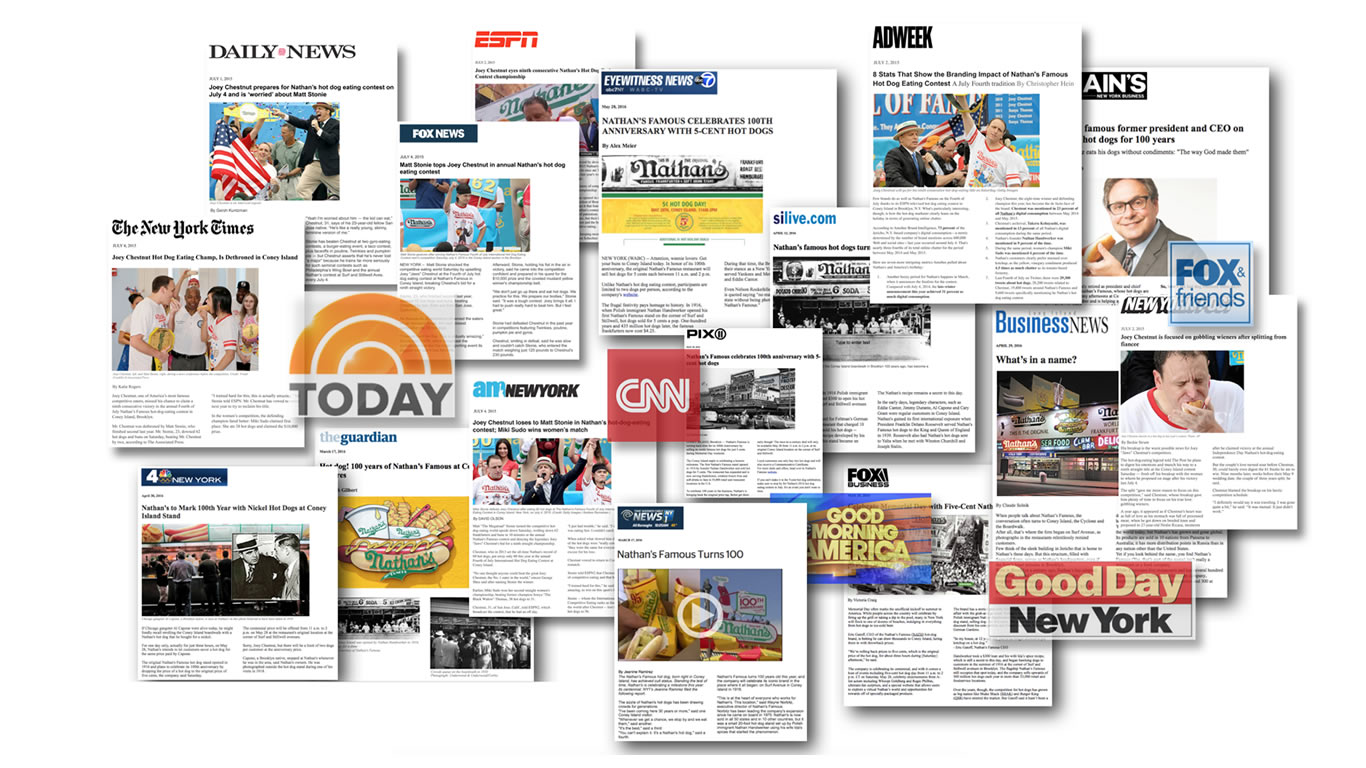
Then there is Nathan's Famous. George began publicizing and hosting the hot-dog-eating contest in 1991, when the event drew only a few dozen spectators. The brothers supplied a mythology: grandiose introductions, rivalries, a mustard-yellow championship belt and the deadpan insistence that eating quickly belonged in the sporting canon. By the firm's account, the event now draws roughly 30,000 spectators, airs live on ESPN and generates billions of media impressions worldwide.
“Everything you say is a lie, yet it all comes true.”An elderly spectator to George Shea, as he later recalled
The line is funny because it captures what changed. Shea once announced a national circuit that did not yet exist. Eventually, there was one. He treated contestants like champions before much of the public considered competitive eating a sport. Eventually, audiences learned the characters, records and rituals. The first thing that failed was the ordinary frame: a small local promotion could not travel very far as merely a small local promotion. The Sheas replaced it with a recurring world, elaborate enough to reward attention and simple enough to explain in one breath.
A publicity machine with only three moving parts
The theatrical work and the property work look unrelated. Operationally, they rhyme. A reporter needs a reason to care now, a credible person or event through which to tell the story, and material that reduces friction. Shea Communications sells the judgment required to assemble those pieces. It is a services business, not a software platform: clients pay for strategy, writing, relationships, execution and quick senior counsel. The firm publishes no standard rate card, so cost is shaped by the engagement.
That model also explains the firm's position in the market. Large agencies can offer international offices, deep production benches and broad paid-media capability. In-house teams live closest to their executives and data. Shea's alternative is narrow fluency and access: a compact team with senior principals who know New York's property press, understand how a crisis accelerates, and can produce an event that gives cameras something to see.
The recent work remains grounded in that niche. Company updates highlight media coverage for real-estate, legal, engineering and insurance clients. A 2025 entry-level job listing described the actual production line without perfume: draft press materials, maintain media lists, research journalists, monitor coverage, compile reports and help with event logistics. Public relations, viewed from inside, is a stack of careful small tasks. The straw hat is optional.
What another company can copy
The Nathan's story tempts people to copy the weirdness. That is the least portable part. The useful pieces are structural.
The approach has limits. Stagecraft cannot rescue a message with no evidence, and a manufactured spectacle can damage trust when the client depends on institutional seriousness. Real-estate media relations also works best when there is an actual deal, trend, public decision or informed point of view. Without one, reporter relationships become a wasting asset. The Shea method requires something true at the center, even when the introduction around it is magnificently overcooked.
This is why the firm's odd dual identity is more coherent than it first appears. Whether the subject is 1.8 million square feet at Hudson Yards or ten minutes on a Coney Island stage, the work begins by answering the same unglamorous question: what, exactly, should another person repeat?
Continue exploring