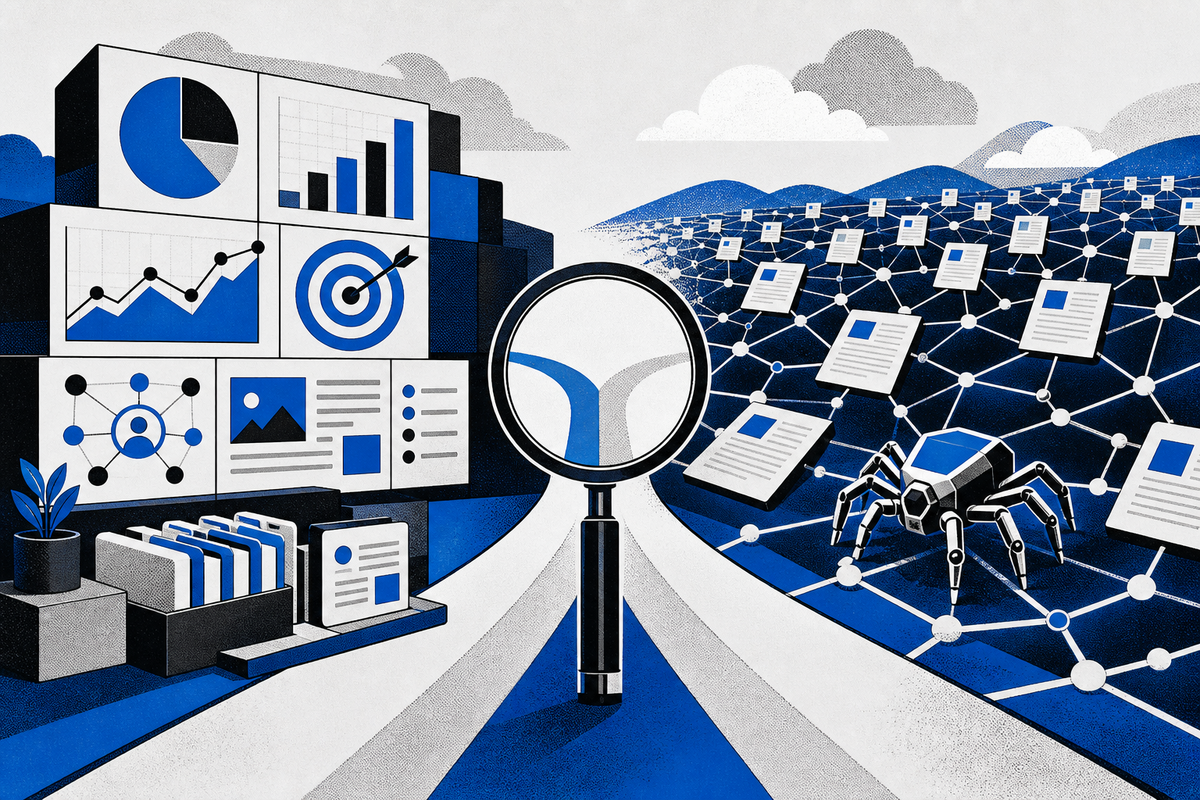
The most revealing moment in a Semrush or Ahrefs trial comes after the impressive demo. A content lead finds a keyword gap. Then what? If the answer passes through a paid-media manager, a social calendar, three clients and a monthly reporting ritual, the problem is coordination. If the answer stays with an SEO specialist who needs to inspect competing pages, lost links and crawl changes before lunch, the problem is resolution. Both people can say they need “an SEO tool.” They are buying very different kinds of work.
This is why the familiar comparison table misleads. It counts keyword tools, audits and rank trackers as if each checkmark carried the same weight. It ignores who opens the software, what that person does next, and how many handoffs stand between an insight and a published change. Semrush and Ahrefs overlap across the standard SEO repertoire. Their more useful difference is organizational.
Semrush presents itself as one platform with specialized toolkits for SEO, content, advertising, social, local marketing, traffic and market analysis, AI visibility and PR. The toolkits can work together or independently. Ahrefs has also expanded beyond backlinks into keywords, site audit, rank tracking, content, web analytics, social management and AI-oriented brand discovery. Yet its center of gravity remains unusually physical: a crawler, a web index, and the link graph built from them.
Breadth is a workflow feature
Consider a six-person agency serving twelve clients. Search performance is only one line in the report. A client also asks what competitors spend on ads, whether social output is consistent, which local listings need attention and how the brand appears in AI answers. A platform that keeps those questions near one account can reduce exports, duplicated projects and the small tax of relearning where everything lives.
That is Semrush’s strongest practical argument. Its SEO Toolkit handles competitor research, keyword analysis, position tracking, backlink analysis and technical audits. Its neighboring toolkits extend the surface: the Advertising Toolkit covers campaign research and planning; the Social Toolkit supports scheduling, analytics, competitor monitoring, influencer work and listening; the Content Toolkit develops ideas, briefs and drafts; My Reports pulls data into stakeholder-facing outputs. The value is not that every team needs every module. It is that a generalist can widen the job without replacing the operating console.
There is a catch worth putting in red ink. The Agency Growth Kit, long cited in comparisons as Semrush’s multi-client advantage, has been discontinued. Semrush says Client Portal and CRM were sunset as part of the restructuring. My Reports now stands alone for cross-toolkit reporting, while the Agency Partners Platform and lead-generation functions live outside the old bundle. Existing users retain access to certain reports and preserved assets.
That change does not erase Semrush’s agency appeal, but it changes the buying exercise. A team should price the current combination it needs, not the neat bundle remembered from an old review. This is also a useful lesson about comparison content: software packaging ages faster than the screenshots.
Where each approach earns its keep
Semrush gains leverage when one person moves between SEO, content, ads, social and reporting.
Ahrefs gains leverage when the work begins with links, pages, competitors and crawl-derived evidence.
Favor the system that produces repeatable, legible reporting with fewer exports and reconciliations.
Favor the system that makes investigation fast and lets specialists follow an anomaly without changing tools.
Depth starts with the crawler
Ahrefs’ case becomes clearest when the web itself is the raw material. The company says its backlink index is built from its own crawlers, not borrowed from Google or Bing. Its public data page reports 35 trillion historical external backlink records, 493.9 billion pages in the index and a crawl rate around five million pages per minute. Content Explorer reports roughly 20.9 billion indexed pages, with ten million new pages discovered and hundreds of millions updated in a day.
Ahrefs’ public index snapshot
Bars are illustrative, not on one shared scale. Figures are company-reported; the backlink and web-index page labels its underlying data as supplied in May 2024, while live counters may change.
Those figures sound decisive until one asks the adult question: decisive for what? Index size matters when a marginal discovery changes a link-building campaign, reveals a competitor’s distribution pattern or explains why a page moved. Crawl freshness matters when the team must distinguish a current signal from a fossil. But no index sees every page at every moment, and a large count alone does not guarantee that the specific sites in your market are covered in the way you need.
Ahrefs makes an important distinction in its own documentation. New and lost links can flow into its live index every fifteen to thirty minutes, but that is processing frequency, not a promise to recrawl every page in that window. A high-authority page may be revisited often; a quiet page can wait days or weeks. Content Explorer can also show cached values until a result loads and refreshes against live Site Explorer data. Freshness is a pipeline, not a magic timestamp.
For an in-house SEO group, that pipeline can become a common language. A lead investigates a traffic fall, moves from a domain overview to a lost-link pattern, checks competing pages, and turns the result into a content brief. There may be no client portal, paid-media calendar or local-listing workflow to coordinate. The narrower route is not necessarily less ambitious. It can simply have fewer passengers.
Run the trial like a workweek
The right test is not a scavenger hunt for features. Take one decision your team makes every week and run it end to end. Use the same domain, country, keyword set and date range. Ask both platforms to explain one traffic loss, identify one content opportunity, surface one link prospect and produce one update a stakeholder can understand.
A trial that exposes the fit
Trace the owner. Record who starts the task, who interprets the result and who acts on it.
Count the handoffs. Note exports, pasted screenshots, duplicate projects and requests for another login.
Challenge the data. Inspect several known links and pages, and compare gaps instead of admiring aggregate counts.
Price the real stack. Include seats, limits, reporting, adjacent toolkits and the software you can actually retire.
Measure time to a confident decision, not time to the first chart. Note where a novice needs help and where an expert feels slowed down. Ask whether the reporting layer preserves the caveats that mattered during analysis. A dashboard that makes uncertain data look certain creates a new problem while appearing to solve the old one.
Also test absence. If Semrush became the center, which existing social, content or reporting subscriptions could go away? If Ahrefs became the research core, which specialist workflows would become clearer, and which other systems would remain? Consolidation saves money only when the consolidated functions are good enough to be used. Depth pays only when someone has the skill and mandate to exploit it.
The verdict is a map, not a trophy
Semrush is the more natural starting point when SEO sits inside a broad marketing operation, particularly when generalists or agencies must coordinate several channels and explain the result to clients or executives. Its modular structure lets a buyer assemble that breadth, though the discontinued Agency Growth Kit means agencies should verify the current packaging carefully.
Ahrefs is the more natural starting point when a team’s edge comes from close reading of the web: backlinks, competing pages, technical conditions and content performance. Its crawler and index are not merely a feature in the menu; they shape the product’s point of view. Ahrefs now covers more of the marketing stack than its old “backlink tool” reputation suggests, but its data infrastructure remains the reason specialists lean forward.
The practical answer: choose Semrush when your expensive problem is coordination across marketing work. Choose Ahrefs when your expensive problem is uncertainty inside SEO research. If both problems are costly, test both against one real workflow and budget for overlap only after each platform proves a distinct job.
No verdict survives a reorganization forever. A startup can move from one SEO generalist to a content team, a paid lead and an outside agency in a year. An agency can narrow into technical consulting. The software should be reviewed when the handoffs change, not only when renewal arrives. Your org chart has already written most of the requirements. The useful move is to read it.
Questions buyers actually ask
Is Semrush better than Ahrefs?
Neither is universally better. Semrush often fits teams coordinating SEO with content, paid, social, local and reporting workflows. Ahrefs often fits specialists who prioritize backlink research, crawl-derived data and competitive SEO investigation.
Does Semrush still offer the Agency Growth Kit?
No. Semrush says the Agency Growth Kit has been discontinued. My Reports is available separately, while agency directory and lead-generation functions are offered outside the former bundle.
How fresh is Ahrefs backlink data?
Ahrefs says new and lost links flow into its live index every fifteen to thirty minutes. That is index processing frequency, not a promise that every page is recrawled within that window.
Which platform suits an in-house SEO team?
A team concentrated on technical SEO, content gaps and link analysis may value Ahrefs’ crawler-led workflows. A team that also owns advertising, social, local or executive reporting may get more leverage from Semrush’s wider toolkit surface.
How should a team compare the products?
Run the same real task in both products. Compare time to decision, confidence in the relevant data, collaboration friction, reporting quality and the need for extra software.