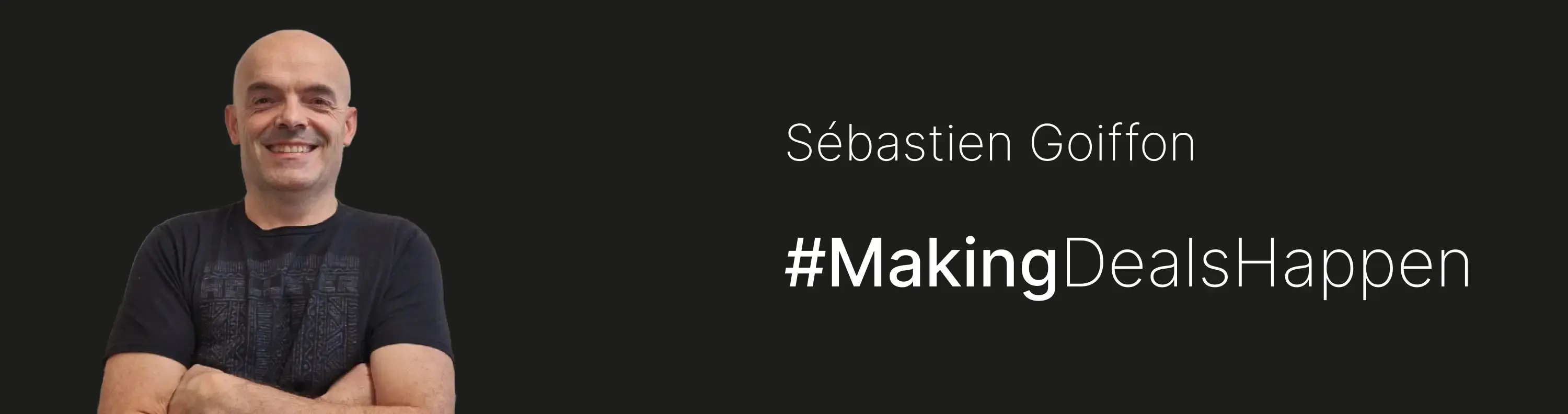
Sébastien Goiffon once wanted to take his company to Nasdaq. The stock exchange eventually entered the story through a different door: it became a customer. For a founder whose business concerns the difference between appearances and reality, this is a pleasingly awkward result. He had imagined seeing his company on the exchange. He ended up helping the exchange with its own work.
He tells the story with room for the joke. He also uses it to describe a change in ambition. The original destination was a listing. Today, the co-founder and CEO of Wiiisdom wants to lead the category his company works in: analytics governance. A stock ticker would have supplied a very visible form of recognition. Making the numbers behind other people’s decisions dependable is a quieter occupation.
Quiet occupations can have demanding customers. Wiiisdom’s work sits around the reports and dashboards that organizations consult before they act. A persuasive chart is an excellent way to communicate information. It can also give an error a handsome suit.
The software that needed watching
Goiffon’s route into this work began in consulting. He specialized in Business Objects, including the permissions that determined who could see sensitive information. A client wanted to examine the analytics system itself: its contents, its access arrangements, its workings. The software used to inspect the business needed some inspection of its own.
He made a tool. In 2007, he joined forces with Alexandre Biegala to establish GB&SMITH, the company that would become Wiiisdom. Their partnership brought together knowledge of customers’ problems and the ability to turn that knowledge into software. Understanding a complaint and writing a durable solution are related talents. They are useful talents to have in the same business.
One early name suggests that enterprise software briefly entertained a more theatrical future. Goiffon has recalled that his first solution was called Musclor, the French name for He-Man. It became 360View. Somewhere between those names, a muscular cartoon hero made way for a product that could be discussed with a procurement department. The underlying attraction was practical: give administrators a clearer view of what they were responsible for.
There were outward signs of progress. GB&SMITH won Deloitte’s Northern France Technology Fast 50 in 2013, with reported revenue growth of 761% over 2008-2012. The figure describes a particular five-year period. It also marks the distance between an improvised solution and a business with a record to show.
Reported revenue growth behind GB&SMITH’s 2013 Northern France Technology Fast 50 award.
Boston was a business decision with a moving van
The American market supplied a reason to change his address. In 2014, GB&SMITH missed a sale to U.S. Bank because it needed a local subsidiary. For a software company, a product can cross the Atlantic more easily than the commercial arrangements required to sell it. A promising conversation still needs somewhere to land.
Goiffon moved to Boston in 2015. His account of the decision gives the chief executive’s presence a specific purpose. Customers could see that someone with authority had committed to the market. The move put him closer to the people buying the software, and closer to the habits that shaped their decisions.
International expansion sounds tidy when written beneath an arrow on a slide. His relocation involved his wife and their two children. It also involved learning how a familiar business conversation could mean something different in another country. A founder can bring a product across an ocean without bringing an accurate understanding of every customer on the other side.
Boston became his base while Lille remained part of the company’s geography. In 2016, another connection to the earlier generation of French enterprise software became formal: Business Objects co-founder Denis Payre joined the board. Goiffon had built a business around a technology Payre helped bring into the world. Now that experience was available inside his own company.
A bigger company needs different habits
Growth changes who needs to understand the business. In October 2019, Goiffon announced an employee stock option plan that included everyone, from longstanding developers to new recruits. He had waited twelve years. His explanation linked the timing to the transition from starting a company to scaling one, when employees would face fresh demands and should share in the result.
The decision offers a concrete view of how he wanted the company to work. A founder’s enthusiasm can get a product moving. Keeping a growing organization together involves the people answering support requests, writing the next release and explaining it to customers. Ownership gave that shared effort a financial expression.
He also sought help with the commercial machinery. Working with elaya, Wiiisdom introduced more structured sales practices: regular reviews, shared methods, formal onboarding and collaborative work on major opportunities. The details are ordinary enough to disappear from a founder’s legend. They belong in the story because they describe how experience can become available to a team.
A sale that depends on one person’s memory is difficult to reproduce. A method can be taught, questioned and improved. For a company selling confidence in analytical processes, the internal lesson has a familiar shape: make the important work visible, and make it possible for someone else to check it.
“Starting is hard. Scaling is harder.”
Sébastien Goiffon
Buying a bridge to Tableau
The customers’ technology was changing too. Organizations could run several analytics platforms, each serving different teams or purposes. Expertise in BusinessObjects gave GB&SMITH a starting point. Customers wanted help across more of the software they actually used.
In October 2020, the company announced its acquisition of Kinesis-CI, which supplied automated testing for Tableau. Its capabilities included checking whether changes broke existing work, whether functions behaved as expected and whether performance held up. The purchase gave Goiffon a route into another analytics environment without beginning every piece of the technology from scratch.
There was a personal attraction alongside the technical fit. He had met the founders at a Tableau Conference and recognized something of his own company’s beginnings: people with practical experience who enjoyed solving difficult technical problems. Acquisitions are often described as transactions between portfolios. In this account, recognition between builders helped make the transaction intelligible.
The company changed its name to Wiiisdom in 2021. The broader name suited a broader assignment. By October 2023, Goiffon was announcing automated testing for Microsoft Power BI as well. BusinessObjects, Tableau and Power BI could differ in their tools and interfaces; the person relying on a report still needed a reason to believe it.
Fifteen years before the first cheque
In October 2022, Wiiisdom announced €6 million from Isatis Capital, its first fundraising after fifteen years of bootstrapping. The sequence matters. Customers, a product business and international operations preceded the investment. The money arrived to help an existing company move faster.
The announcement tied the funding to quicker innovation and support for additional technologies. That is a specific use for capital: give the team more capacity to serve the changing analytics environments around its customers. It also made competition part of the calculation. Being early in a market leaves another job to do when rivals arrive with resources of their own.
Goiffon has been candid about the difference between creating a company and growing one. In May 2026, he described them as requiring different skills. He acknowledged that the founder suited to one stage might be less suited to another. That is an unusually useful admission in a genre that prefers its founders permanently qualified for everything.
It also gives his revised ambition some texture. Category leadership requires more than seeing a problem first. People must understand the problem, assign responsibility for it and decide to pay for a solution. A company can have convincing engineering and still need to learn how to make that case repeatedly.
- 2020Kinesis-CI acquisition
A route into Tableau testing - 2021GB&SMITH becomes Wiiisdom
A name for the broader mission - 2022First fundraising: €6 million
Investment from Isatis Capital - 2023Wiiisdom for Power BI announced
Another analytics environment
The next customer might be an agent
By August 2026, Goiffon was making a further argument: companies pursuing AI analytics should first govern the business intelligence they already have. In his view, existing reports and metric definitions contain knowledge that new systems should be able to reuse. He favors checking and controlling that foundation before asking an AI system to rely on it.
His proposed next step is governance that can operate through agents: watching the analytics environment, recommending corrections and taking permitted actions, with sensitive decisions under human control and actions recorded. This is his direction for the business, and his claim about where the work needs to go.
The personal thread reaches back further than the latest technology. He once imagined teaching mathematics in French preparatory classes, then became a generalist engineer. Today, the question running through his work still concerns whether an answer can withstand examination. He also says he repaints his own house exterior. A founder who delegates across an international business apparently retains a few reservations about outsourcing the brushwork.
The Nasdaq dream supplied one possible ending. His present work keeps producing another question. When a number reaches someone who can act on it, what has earned their confidence? Goiffon has spent years building a company around that moment. AI is bringing more visitors to it.