Imagine selling a domain name for $5,000. At Sav.com’s advertised 4% marketplace commission, the platform’s share would be $200. The seller would retain $4,800 before any other applicable costs. It is a modest calculation with an immodest implication: in a business built around a few letters, the percentage between buyer and seller can be worth more than another year of registration.
That is one useful way into Sav. Another is to imagine the buyer. A small business has settled on a name, printed nothing, promised nothing, and finally types it into a domain search. Someone else owns the address. The business has encountered a marketplace before it has opened its own.
- Register or acquire: search new domains and names already owned by someone else.
- Keep the tools together: privacy for eligible domains, DNS and related services accompany registration.
- Sell at 4%: Sav’s advertised marketplace fee leaves 96% before other applicable costs.
- Build the next step: templates, commerce tools and the Savannah AI beta extend the offer beyond the name.
Sav sits between these two people: the entrepreneur who needs an address and the investor who regards that address as inventory. Its products make more sense once you notice that they are shopping for the same object with quite different intentions. One wants to stop thinking about domains. The other wants to keep thinking about them, preferably at a profit.
Four percent, in actual dollars
Sav’s marketplace offers auctions, fixed-price selling and free for-sale landing pages. A lander gives an unused address a useful task: tell the arriving visitor that the name is available to buy. Instead of sending somebody to a blank page, the owner sends them to a proposition.
The commission is the clearest part of that proposition. Consider a hypothetical $5,000 sale at 10%, 15% or 20%. Those fees would be $500, $750 or $1,000. Sav’s advertised 4% would be $200. These are arithmetic comparisons, not a claim that every rival charges the same rate or provides the same service. Referral routes, distribution networks and transaction terms can change the bill.
How much leaves the seller’s pocket?
Commission only. Illustrative rates are not named competitor quotes. External network fees may differ.
A lower fee improves the proceeds of a sale that happens. It does not make the sale happen. That distinction is the mildly inconvenient guest at every marketplace celebration. Sellers also need buyer traffic, workable payments and dependable delivery. Sav advertises Afternic and Sedo Fast Transfer integrations, putting outside distribution beside its own selling tools. A domain investor must evaluate the route to the customer as well as the percentage at the end.
The registration offer uses a related idea. Sav includes WHOIS privacy for eligible domains and advertises DNS, SSL, CDN, email forwarding and domain forwarding. Eligibility matters because domain extensions have different rules. The attraction is fewer separate purchasing decisions around the address. For someone managing many names, a small recurring extra can become a substantial line in the budget.
The trouble with “unavailable”
Anthos Chrysanthou, Sav’s founder and CEO, previously founded Translate.com. Sav launched in 2019. Its early Sedo integration reveals a practical choice: a domain search could include existing owners’ inventory, rather than only names available for first registration.

“Successful registrars need to be more than just administrators of domains”
Anthos Chrysanthou, in Sedo’s partner case studyIn early 2020, Sav connected with SedoMLS. The partner’s case study says the simpler integration went live in days. Fixed-price purchases received a checkout on Sav; negotiated purchases continued through Sedo. Building an internal bidding system for those deals would have required more work.
The lesson is a choice about effort: own the straightforward checkout, borrow the complicated transaction machinery. It works when partner inventory is relevant and the handoff preserves the customer relationship. A partner that loses the buyer, or brings the wrong stock, would undermine the same arrangement.
For a reader building a marketplace, this is the part worth copying: examine the moment a customer runs out of options. More advertising cannot repair a search that has nothing useful to offer. Additional supply can. The implementation need not begin with owning every part of the transaction.
The shop after the sign
Securing the address leaves a second problem untouched. There still has to be something at the address. Sav offers a conventional website builder with customizable templates, mobile layouts, SEO tools and commerce features. Its published paid tiers run from Basic to Unlimited. The advertised monthly figures assume annual payment.
Annual equivalents calculated from published rates, checked October 2, 2026. Domain purchases and other applicable costs are separate.
The conventional plan comparison lists catalogue capacities of 10, 100, 2,500 and unlimited products. That is a useful distinction for a merchant: the cheapest plan might suit a short menu or a handful of items, while a larger catalogue changes the purchase. The right question is the annual cost of the required features, including the domain, rather than the smallest number on the card.
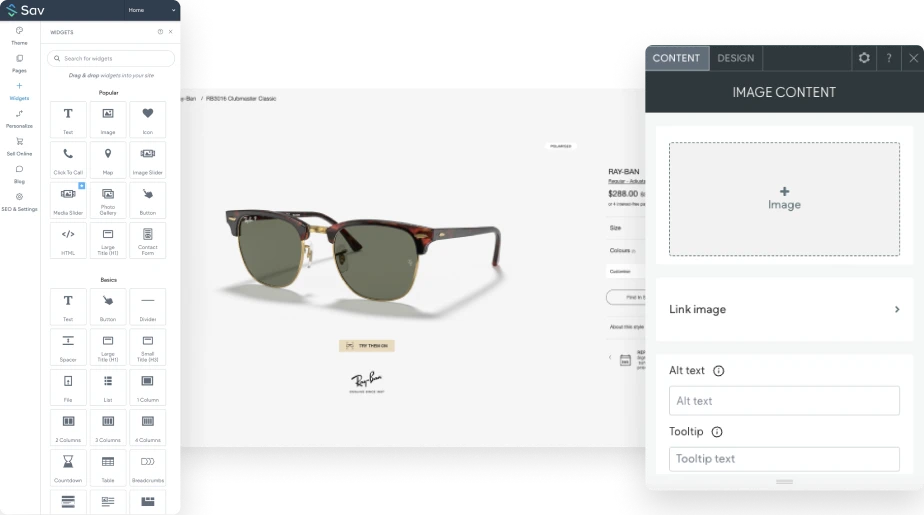
There is also a newer entrance. Sav’s current website promotes Savannah AI, labelled beta in its navigation, as a way to describe a business and generate a website or store. In September 2024, the company announced an AI website-generation patent and a planned Q1 2025 introduction. That announcement explains the intended workflow; it does not establish the actual launch date.
The commercial logic is easy to see. A registrar meets customers when they are naming something. A builder meets them when they are trying to make that something real. Joining those purchases could reduce the time spent connecting separate tools. It also asks Sav to compete on editing, commerce and the quality of generated output, where a low domain fee has limited persuasive power.
A buyer can test that proposition with a small, specific job: one landing page, one product, one payment path. Check the result on a phone. Check the wording. Check whether the plan supports the features the business needs. An attractive first draft is helpful; a working customer journey is the thing being bought.
Cheap is only useful when the account works
Sav’s business model combines recurring registration and renewal payments, domain-sale commissions and website subscriptions. Its advertised free tools make the first purchase easier to justify. The continuing relationship depends on less photogenic work: account access, billing, renewals and support.
Public feedback gives that distinction some teeth. Trustpilot includes customer reports of payment trouble, website bugs and slow support, alongside positive accounts of completed purchases. These are users’ reports, not independently established findings about every transaction. They nevertheless identify what a prospective customer should test before moving a large portfolio.
The sensible trial is small enough to inspect. Register or transfer a non-critical name, check the DNS controls and renewal settings, and see how the account handles the tasks you actually perform. Sav’s transfer page describes keeping existing DNS and receiving a registration extension; transfer eligibility and timing still matter. A low fee loses its charm if a deadline is missed.
This makes Sav a plausible option for price-conscious owners who can evaluate the workflow, and for investors who understand the difference between listing an asset and finding a buyer. A business needing extensive custom development should assess those requirements separately from the domain purchase. Owning the sign does not settle how the building should be constructed.
An old address, a new kind of wrapper
In October 2025, Sav and D3 announced a partnership to integrate Doma Protocol. The proposal is to tokenize conventional domains while preserving their use for websites and email, with possibilities including fractional ownership and blockchain trading. The announcement reported more than a million managed domains and nearly 100,000 customers across over 90 countries. Those are dated company-reported figures.
The idea extends Sav’s investor-facing business. It also introduces a demanding test: a different ownership and trading system must produce benefits people can actually use. Tokenization can change transaction mechanics; demand still comes from buyers. The announcement describes an intended integration, rather than proving universal availability or a successful resale market.
For the ordinary owner, Sav’s immediate proposition remains more tangible. Find an address, understand its recurring price, decide whether to build on it or sell it, and keep track of the account. The business has gathered several ambitions around that short sequence. Its most persuasive number is still four - provided the rest of the transaction earns its keep.