Sarah Segal went away for about ten days. Her communications agency carried on. There was client work, an inbox waiting for her return and even a troublesome social media account. The founder was no longer managing clients day to day. Her colleagues could handle things. For someone whose working life had revolved around finding the story and getting it delivered, the absence was an achievement of its own.
It is a modest opening for a business story. No ribbon, no funding round, no photograph of someone pointing at a rising line. But the ability to leave is a revealing measure of what an owner has built. A company with a founder’s name on the door can become a very elaborate way of keeping that founder permanently on call.
Segal’s career has given her several opportunities to reconsider the job. She worked in banking, moved into broadcast journalism, crossed into public relations and founded the San Francisco agency that bears her name. She sold it, later described taking back ownership, and learned how quickly a client list could change the size of a business. Along the way, the question shifted: which work still needed her, and which work needed her to let somebody else do it?
The reporter changes sides
Her first job after college was at Brown Brothers Harriman in Boston. That beginning is a useful antidote to the biography in which every early decision points toward the eventual company. Segal has described exploring different kinds of work before finding journalism. The later career makes sense in retrospect; it was allowed to develop without a tidy opening argument.
She earned a bachelor’s degree in international relations at Occidental College and a master’s in journalism at Columbia. Her production work included 20th Century with Mike Wallace and NBC News Special Reports in New York. There were years behind the scenes and then years in front of the camera, reporting in New York and San Francisco. She finished her broadcast career at KRON 4.
The move into communications brought corporate and agency experience, including CafePress, The Blueshirt Group and SHIFT Communications. Journalism had supplied a particular starting point: the intended audience gets a vote. A company may have something it wants to announce; a reader still needs a reason to care. Those two interests can meet, but enthusiasm alone does not arrange the introduction.
Her later description of her approach emphasizes internal expertise, distinguishing details and data. Those are materials a reporter can use. They also demand more preparation than a flattering adjective. A useful number can support a question. A knowledgeable employee can answer it. The job is to find those people and facts before asking anyone to pay attention.
A sale, then a fresh set of invoices
Segal Communications’ public launch history dates to 2018. In September 2021, The Messina Group announced its acquisition of the agency. Jim Messina’s consulting firm wanted to expand its consumer technology and lifestyle communications capabilities and its presence on the West Coast. Segal’s team brought experience across media relations, influencers, social channels and events.
The transaction put a small agency inside a broader consulting operation. It also connected a founder with a newsroom background to a firm led by the manager of Barack Obama’s 2012 presidential campaign. The stated business logic concerned complementary services: different kinds of communications experience under a larger roof.
Then the story acquired another beginning. In a 2023 conversation, Segal said the agency had separated from its parent at the end of the previous year. She entered January waiting for new invoices to turn into cash. She put $20,000 of her own money into the company to make payroll while payments arrived.
Personal money Segal said she put into the agency while waiting for invoices after its return to independence.
There is a difference between having work and having money in the account on the right morning. Payroll makes that difference concrete. An acquisition announcement can compress a business into a date and a buyer’s name. Running the business afterward brings back the calendar: who must be paid, when a payment is due, how much the owner can take home.
Segal was willing to ask other owners basic questions about compensation and cash reserves. That willingness gives her public account texture. The experienced communications adviser was also a person figuring out how to pay herself. A title does not remove the need to ask.
The arithmetic behind the client list
Another lesson arrived when two large clients left within six weeks. Segal had to lay off staff. She subsequently broadened the agency’s mix toward smaller and midsize accounts, reducing the dependence on a few large relationships. A client win could be good news and still leave the business exposed.
That is an awkward complication for an industry built around announcements. The impressive new account is easy to describe. The share of revenue it represents is less likely to appear in the celebration. Yet that second number helps determine how much damage one departure can do. A roster is also a distribution of risk.
The growth record has its own dates. The PR Net’s 2023 recognition reported a 130 percent increase in the preceding year and more than 15 new clients. Its 2025 entry said the agency had doubled its full-time staff in 2024. Those are snapshots of different periods, not a single smooth climb. Both expansion and rebuilding belong in the picture.
- 2021The Messina Group acquisition
- 2022Return to independence at year-end
- 2024Full-time staff doubled
- 2026Leadership team additions
By a later conversation about preparing for 2026, Segal was again weighing when to hire. She described trying to keep an individual’s workload to six to eight clients. Bringing someone in before the revenue arrived could mean reducing her own pay. Waiting could leave existing colleagues with too many accounts to give each one enough attention.
The choice is familiar to owners of service businesses, and uncomfortable for a reason: neither timing removes the risk. Hiring requires confidence in future work. Delaying requires confidence in current capacity. Segal’s experience had made the cost of getting it wrong personal. She remembered the people she had needed to let go, and said one had subsequently returned.
The publicist goes back to class
Meanwhile, the work she was hiring people to do kept changing. Segal took an eight-week LinkedIn seminar to understand business posting more closely. She read Own Your Brand, sent to her by fellow business owner David Billstrom, and began examining her own profile. Advising other people on their public presence still left homework for the adviser.
She has a dry response to the platform’s self-congratulation: “The braggarts are tiresome.” Her interest is in useful information, staying in touch and the relationships formed through regular interaction. There is room for a business to explain what it knows without turning every update into an acceptance speech.
“The braggarts are tiresome.”
Sarah Segal, on LinkedIn’s less useful habits
Her thinking also distinguishes discovery from validation. Segal has said she cannot neatly quantify how much business LinkedIn produces for her. Someone may look her up there without mentioning it. A platform can help establish credibility even when it does not deliver a direct message asking for a proposal. The distinction makes a measurement problem visible instead of disguising it with an attractive total.
In her writing about consumer brands, she argues that LinkedIn has uses beyond the obvious business-to-business audience. Recruitment, partnerships and a company’s values all have a place there. The person buying a doughnut and the person considering a job at the doughnut company may need different information. A brand has to remember both people exist.
A room with other people in it
Segal’s professional world includes the local institutions that bring journalists and communications people together. She has served on the boards of the San Francisco Public Relations Round Table and the Bay Area chapter of the Public Relations Society of America. These are relationships maintained through meetings and shared work, as well as through a profile page.
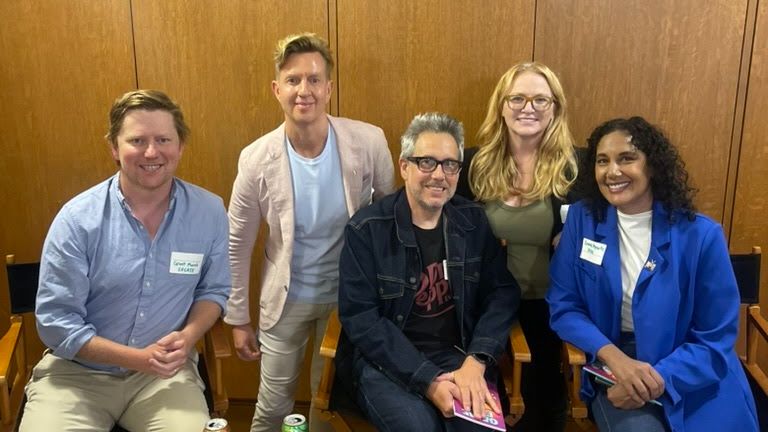
She co-moderated a discussion called The Changing Media Landscape with Warner Johnston. The panel included Simone Aponte, Grant Marek and David Welch, and covered subjects including local journalism, artificial intelligence and pitching. For a former reporter running a PR business, the conversation sits close to the junction of her two professions.
Her agency began virtually, but she later introduced a shared office and hybrid arrangements. The office incentives she described included points toward rewards and, in a particularly domestic detail, work slippers. There are many ways to announce a workplace philosophy. Slippers make a fairly legible statement about the intended atmosphere.
The business has continued adding experience around her. In February 2026, it announced Katina Tinka Bush as vice president and Gabriel Muñoz as account manager, with backgrounds in food, wine, hospitality and lifestyle communications. More capabilities also mean more decisions that can be made by somebody other than the founder.
The work that survives a vacation
Segal has spoken about giving younger employees room to consider different futures. One former colleague went to law school. When a later intern expressed an interest in law, Segal offered an introduction. The founder who began in banking could recognize a career still taking shape. Experience becomes useful to another person when it can be passed along.
Her own changing role has required a comparable generosity with responsibility. She described taking advice that a restaurant’s chef need not also serve every table. The analogy gave her a way to think about leaving daily client management to the team. Knowing the business did not require appearing in every exchange.
So the ten-day trip matters. It gave that idea a practical test, complete with the untidiness of actual client work. Segal returned to an inbox, and to colleagues who had continued doing their jobs. For a founder accustomed to helping other people become visible, there was something useful to learn from being away.
Keep the conversation going
Read Segal’s work, watch a conversation, or explore the agency.
- Segal Communications · Sarah’s writing
- LinkedIn · Twitter / X · Agency Instagram · Agency TikTok
- Watch: Agency Mastery, episode 712
- 21 Hats: ownership and rebuilding · 21 Hats: delegation and a vacation
- The 2021 acquisition announcement · The February 2026 leadership announcement
- The Changing Media Landscape panel · Listen: PR and branding with Sarah Segal