Sanjeev Singh wanted to spend his time growing a technology consulting business. The business, unfortunately, had brought its paperwork. Tax and compliance tasks kept claiming attention that he wanted to give to revenue. There is something exquisitely irritating about owning a company and discovering how much of the day belongs to forms. Singh decided that the irritation deserved a product.
That experience helped inspire Zenwork, the tax compliance and regulatory reporting company he leads today. He began developing the solution in 2011. His wife, Rekha Singh, a former IBM technologist, helped found the business. They chose an area with little appetite for improvisation: helping businesses manage the information they must report and the identities they must check.
A tax form makes an unlikely entrepreneurial muse. It offers neither glamour nor gratitude. Yet Singh had encountered a specific problem as an owner, and that gave the venture a useful beginning. He could describe the interruption because he had lived with it. The ambition was to make a necessary chore consume less of someone else’s working day.
By November 2021, that ambition had attracted a $163 million minority growth investment led by Spectrum Equity. It was Zenwork’s first outside funding. More than a decade of building preceded the announcement. The cheque supplies the dramatic number; the years before it explain why there was a company worth backing.
Eight years before the founder’s desk
Singh’s preparation included eight years at ADP, where his work covered product management and project direction. Before that, he held a senior projects role at Vertte. His background put him close to the practical business of making technology serve an organization: deciding what a product needs to do, coordinating delivery and dealing with the details that persist after the presentation ends.
His education ranges across disciplines. At Nagpur University, he studied mathematics, physics and computer science for a Bachelor of Science, followed by an MBA in marketing and finance. His public professional profile also lists Harvard Business School study in 2017 and 2018. The combination brings technical and commercial subjects into the same biography without requiring either to masquerade as the other.
There are smaller, revealing entries on that professional record: certifications from the American Payroll Association, the Internal Revenue Service and Microsoft. The collection is unusually appropriate for the business he eventually built. Payroll, tax preparation and technology are the ordinary ingredients of an extraordinary amount of administrative work. Singh had spent time among them before asking customers to trust his software.
A customer could change the drawing
In Zenwork’s early days, Singh and his team met prospective customers in person to understand their problems. They built custom prototypes to show how the software could respond to what they had heard. It is a pleasingly concrete picture of product development: somebody describes an awkward task, and the next conversation has a working possibility in it.
The habit also gave customers a role beyond purchasing. They could influence what came next. Singh described solving problems with his team as a favorite part of running the business. That detail helps explain the founder more convincingly than a catalogue of executive virtues. The work he enjoyed was close to the work that had supplied the original idea.
Distribution mattered, too. Zenwork combined direct marketing with partnerships, including Intuit, Bill.com and Xero. A compliance tool becomes easier to adopt when it can work alongside systems a business already uses. For Singh, partnerships offered a route into existing workflows. The product did not have to persuade a customer to reorganize the whole office before it could be helpful.
This attention to connections extended to the software itself. Singh has described building an application programming interface to connect with clients and partners as a point of differentiation. An API is a means for software systems to exchange information. In his business, that connection has an unromantic attraction: fewer repeated entries between one system and another.
- 01Meet the customer
- 02Understand the task
- 03Build a prototype
The courtship lasted three years
Spectrum first met Singh in 2018. The investment followed in 2021. Between introduction and transaction lay three years in which the investor could watch the company develop. That is a useful interval in a story usually compressed into a funding headline. A relationship had time to form while Singh continued to operate the business.
He had already established a demanding standard for it. In 2021, Singh said Zenwork had been profitable from its first year. He spoke admiringly of Zoho’s bootstrapped approach and expressed an interest in experiencing the funded growth associated with Freshworks. Both examples appealed to him. His account leaves room for a founder to value self-financing and still become curious about another way of growing.
That curiosity was explicit: “I was always curious about the way funded start-ups function.” The observation has the appeal of an experienced operator admitting there is still something he wants to learn. After years spent building without outside capital, he was willing to explore the additional possibilities and obligations that came with it.
The transaction brought Spectrum’s Adam Margolin and Cameron Ghorbani onto Zenwork’s board. The capital was intended to support product development and growth. A minority investment also made this a continuing chapter for the founder. Singh remained at the business he had built, now working with an institutional partner and a larger set of expectations.
A bigger business, down to the smallest field
The scale visible at the investment announcement was substantial: more than 100,000 small-business customers nationwide, including 30,000 CPA firms. Zenwork was also serving enterprises. Tax1099 handled electronic filing and delivery, while Compliancely addressed business identity verification and compliance checks. These were related problems, brought together by the need to move reliable information through a business process.
For the person running the company, that range creates a particular kind of responsibility. A small-business owner and a large payments platform may arrive with very different volumes of work. Each still needs the details to survive the journey. A missing field has no respect for the size of the organization that neglected it.
Singh’s expansion plans also crossed borders. In November 2021, he described a team of 60 in Hyderabad and 20 in the United States, with plans to hire more people in India. He named engineering, product management, business analytics, digital marketing and sales operations among the skills sought. Growth, in that telling, had job descriptions attached.
He also discussed entering European, Indian and Asia-Pacific markets. Those were ambitions stated at the time, and they show how he thought about the next stage: add product capability, recruit people and reach customers in more places. There was considerable operational work between the announcement of capital and the delivery of those plans.
The cheque comes with a sequel
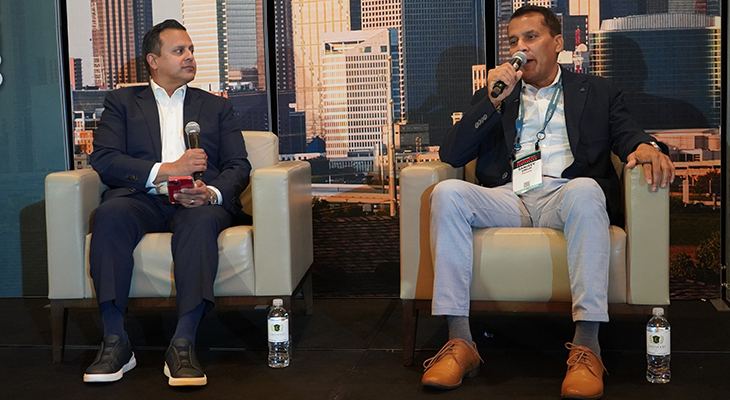
By the 2025 Dallas Smart Business Dealmakers Conference, Singh was talking publicly about what follows an investment. His emphasis was on responsibility. An investor has obligations to the people whose money it manages. A founder accepting that money enters a chain of expectations, with business performance carrying consequences beyond the immediate management team.
His warning about the seriousness of accepting money is a useful counterweight to the festive photograph that generally accompanies a transaction. The celebration occupies an afternoon. The responsibility has a much more accommodating calendar.
At the conference, he urged founders to consider the investor’s position and pay attention to the journey after funding. This is one of the clearest statements of his outlook: capital begins another period of work. It requires the founder to understand a partner’s economics as well as the product’s customers.
There is a quiet continuity here with his earlier career in project delivery. A decision becomes meaningful through what happens after it. A prototype must become useful software; an integration must work inside a customer’s process; an investment must support a business that can carry the expectations placed upon it. Singh’s public account repeatedly returns to execution.
“Money is serious because they’re responsible to someone else, too.”Sanjeev Singh · Dallas, 2025
AI arrives with a reading list
In January 2024, Zenwork introduced AI Tax Assist. Singh emphasized the importance of trustworthy material for an AI tool dealing with tax information. The product drew on IRS publications and the Tax1099 application. It was designed to help customers obtain guidance and complete filing transactions through a conversational interface.
The choice is consistent with the original complaint that led him into the business. An owner has a task to finish and would rather spend less time navigating it. A chat window offers another route through that task. Singh’s stated concern about the reliability of the underlying information matters because convenience loses its charm when the answer needs correcting.
In May 2026, Zenwork appointed Barrett Boston as president. Boston brought experience from Ottimate, TriNet and IBM, and took on commercial strategy and enterprise expansion. Singh continued as founder and CEO. The company said it served more than 1.2 million businesses and CPA firms nationwide, and described a growing suite of AI tools.
The appointment adds another dimension to Singh’s job. A founder who once worked on prototypes with prospective customers now brings in leaders to help extend the company’s reach. His stated ambition remains recognizable: make complicated compliance work easier for businesses of different sizes. The machinery around that ambition has grown considerably.
The pleasing irony of Singh’s career is that an interruption became the main occupation. Work that distracted him from one business supplied the reason to build another. He has spent years paying close attention to tasks other owners would happily stop thinking about. There is a certain commercial elegance in that arrangement. The paperwork gets its attention, and the customer gets some time back.
Continue the conversation
Explore Zenwork, Tax1099 and Compliancely. Follow Singh on LinkedIn or visit his Forbes Business Council profile.