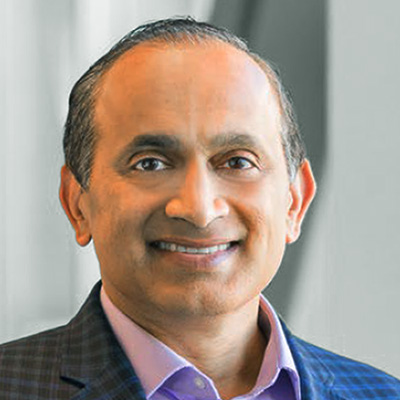
On December 10, 2024, Sanjay Poonen stood up at the close of a deal he had called "once in a lifetime" and announced something quietly enormous. Cohesity, the eleven-year-old data security startup he had taken over in August 2022, had just absorbed the enterprise backup business of Veritas - a competitor with thirty years of NetBackup customers, NASA-grade scale, and the kind of installed base that no growth-stage company simply walks into. The combined entity served more than 12,000 enterprises and protected an estimated $2.4 billion of recurring revenue. Number seven in the market merged with number two. The new company is now, by a wide margin, the largest data protection vendor on earth.
Poonen, fifty-six, took the moment with the calm of someone who had already done this kind of thing twice. At SAP, where he served as President from roughly 2009 to 2013, he helped grow revenues from about $10 billion to $20 billion. At VMware, where he became Chief Operating Officer, he helped double the company from about $6 billion to $12 billion and personally architected the cloud truce with Amazon Web Services that turned VMware from an on-premise vendor into the connective tissue between every hyperscaler. He bought AirWatch for $1.54 billion. He led End-User Computing. He didn't get the CEO job at VMware when Pat Gelsinger left for Intel. He left.
Two years after that detour, he was running Cohesity.
The Cohesity that Poonen inherited was a darling - founded by Mohit Aron, one of the architects of Google File System, funded through Series H, valued at the top of its cohort. But the data protection market was consolidating, ransomware was rewriting the rules of how CFOs think about backup, and the company needed an operator who could stitch enterprise distribution to a clever engineering core. Poonen, who arrived as both CEO and President on August 1, 2022, brought one specific superpower: he had spent two decades convincing Global 2000 CIOs to buy things they were not yet sure they needed. He has, by his own count, two patents. He earned his BA at Dartmouth summa cum laude and Phi Beta Kappa, his MS at Stanford in Management Science and Engineering, and his MBA at Harvard Business School where he was named a Baker Scholar - the top 5 percent of his graduating class. He started his software career in the early 1990s as an engineer at Microsoft, and then Apple.
A pattern shows up in his career arc the way a backbeat shows up in a song. Build the engineering credibility. Switch to product. Move to the field. Master sales. Pivot to running the business. Take the company global. Repeat.
The Fifty-Dollar Boy
Bangalore in the 1980s was not yet the city of glass towers and Uber engineers. It was a city of bookstores and bicycles and a strict, quiet Christian household. Poonen's father, Zac Poonen, is a Bible teacher and writer who planted more than fifty churches across India over a long ministry career; he is still listed as the founder of the Christian Fellowship Church in Bangalore, where Sanjay occasionally preaches when he's in town. The household ran on discipline and books. Sanjay was, by every available account, the kind of student teachers remember. In 1987 he flew to Boston on a Dartmouth scholarship. He has said in interviews that he landed at Logan Airport with about fifty dollars.
He has told that story enough times that it stops sounding rehearsed and starts sounding load-bearing. The fifty dollars is not the point. The point is that the alternative to making it work was not available.
After Microsoft and Apple, Poonen spent the late 1990s and early 2000s at a string of enterprise companies - Informatica, AmberPoint, Symantec - learning the unglamorous craft of how to actually move enterprise software through a Fortune 500 procurement department. By the time he arrived at SAP in 2009, he was running enormous P&Ls. By the time he left for VMware in 2013, he had run mobile, analytics, applications, industries and platform. He came in to VMware as the head of End-User Computing and shipped the AirWatch deal within a year.
The VMware-AWS partnership is the one his peers still talk about. In 2016, VMware and AWS - companies that had spent years being publicly skeptical of each other - announced a joint engineering effort to run VMware Cloud natively on AWS. The deal reset the cloud market. It gave VMware a credible cloud story and gave AWS the Fortune 500 vSphere base it had been failing to migrate for years. Poonen, by then COO, did the choreography.
Backup, Ransomware, and the Quiet Empire
There is a reason the data protection category is suddenly hot, and it is not nostalgia for tape backup. Ransomware made backup a board-level conversation. If your last clean copy of payroll, patient records, ERP, source code, and customer files can be restored quickly and verifiably, you survive. If it can't, you wire bitcoin to strangers and update your incident-response page. Cohesity's pitch is that the same indexed copy of your enterprise data that survives an attack can also feed an AI assistant that helps you find anything, anywhere, in any cloud. Their AI conversational assistant, Gaia, sits on top of the data fabric. Poonen's job is to make that pitch feel inevitable.
After the Veritas merger he set, by his own account, a remarkable target: try to meet, even on video, the top 1,000 Veritas customers. He has framed integration around a single line lifted from American education policy. "No customer left behind." It is in equal parts corny and effective. It also tells you a great deal about how Poonen thinks. He is a sales leader who genuinely believes that retention is product. He runs the company the way a pastor runs a congregation - by name.
The Three Fs
In a 2020 birthday post that has resurfaced on X every July since, Poonen wrote, "Deeply grateful to God for the 3Fs in my life - FAITH, FAMILY, FRIENDS." He has been remarkably consistent about that order. He and his wife host a Thursday-evening Bible study at their home. He has spoken openly about navigating a demanding executive schedule by treating dinners and weekends as inviolable family time. He has flown back to Bangalore to preach. He is on the supervisory board of Philips and the board of Snyk, the developer security company, and somehow still finds the time to write long LinkedIn essays on leadership.
It would be reasonable to assume the discipline is performative. The simpler explanation is that it is just discipline. Poonen is one of those rare executives whose public persona, religious commitment, family routines and operating cadence all describe the same person.
Cohesity, with the Veritas merger digested, is now expected to file for an IPO sometime after the integration smooths out - Poonen has been studiously non-committal on dates, telling Computer Weekly only that the company is "operating with the discipline of a public company." Which is, of course, exactly what a CEO who is months away from an S-1 says.
What the Spreadsheet Won't Tell You
Poonen is, by reputation, a story person. He can rattle off the unit economics of a multi-product enterprise sale and then in the same breath quote Proverbs. He keeps his email open. He answers fast. He sends voice notes. He hires people who once worked for him, then hires their friends. He is also famously hard to surprise. The standard joke among VMware alumni who worked under him is that there are exactly two ways to brief Sanjay: prepared, or in front of him by mistake.
The thing that makes him interesting at this stage of a long career is what he is no longer doing. He is not chasing a CEO title - he has one. He is not trying to prove he can sell - the receipts are public. He is, instead, trying to build the data company that the next ten years of AI is going to need. Most foundation-model conversations are about compute and training. Poonen's bet is that the next conversation is about the indexed, governed, recoverable corpus of enterprise data. He intends Cohesity to own it.
It is a strange specific. A backup company as the spine of enterprise AI. But you can hear, listening to Poonen tell it, that he has been rehearsing the line for a while.