The company waging a quiet war on the fax machine - and winning. It built the prior-authorization platform that gets specialty drugs to patients while there's still a patient to treat.
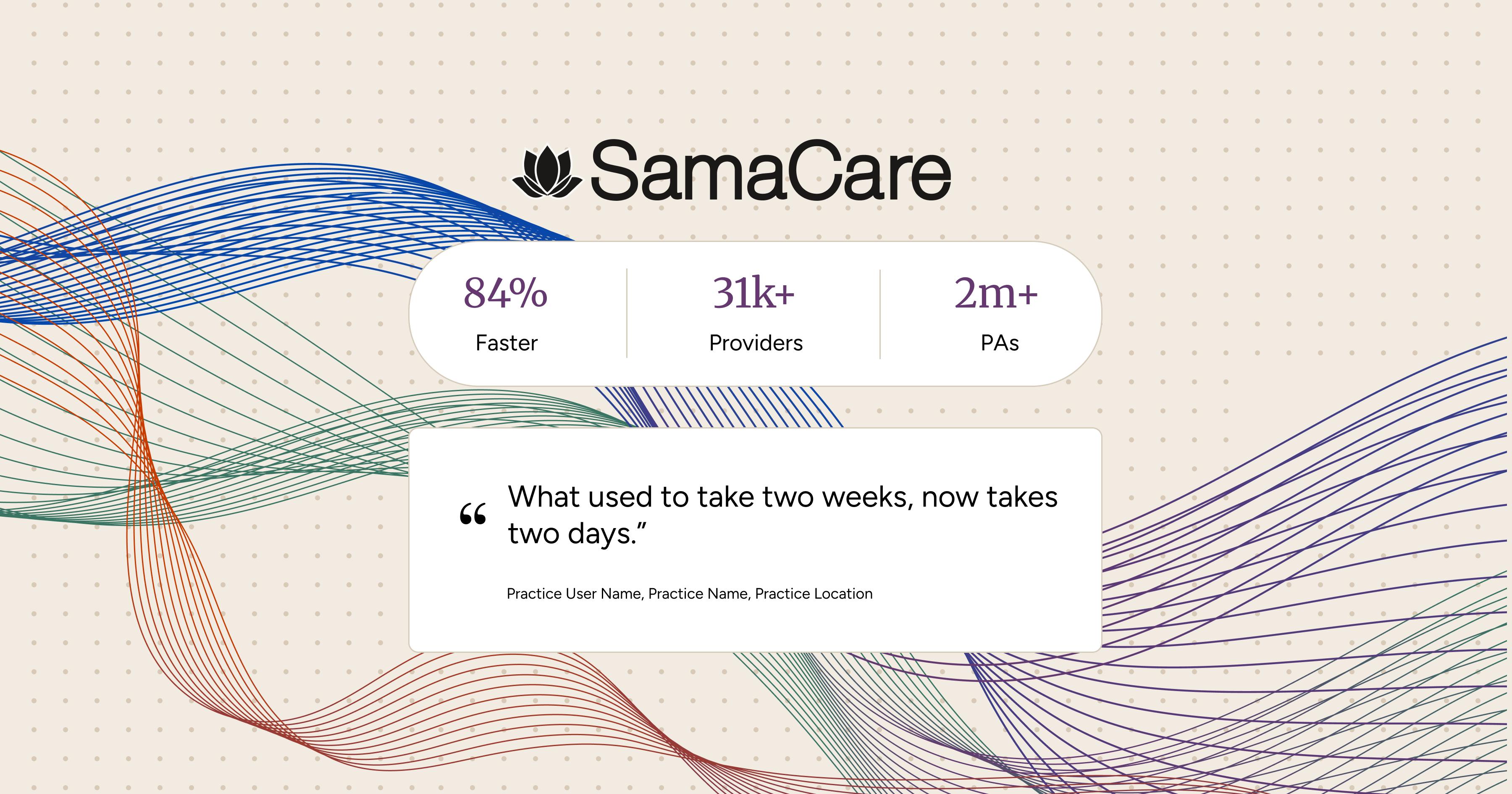
The numbers SamaCare prints on its business card. Most companies brag about growth. This one brags about how much waiting it deleted. - brand card, samacare.com
It is 4 p.m. in a rheumatology clinic. A patient needs a biologic that could give them their hands back. Between the prescription and the pharmacy sits a form, a fax tone, and a payer who will take their time. SamaCare exists to collapse that gap.
Today SamaCare runs what it calls the leading medical-benefit prior authorization platform in the United States. Practices in retina, oncology, neurology, and rheumatology log in, submit, and track approvals across the major payers without touching a fax machine. Behind them, roughly 40% of the country's leading pharmaceutical companies watch the same data to understand why patients do, or do not, get the medicine that was prescribed.
The platform has handled more than two million prior authorizations and processes north of $6 billion in annual medical-benefit drug spend. It is not a flashy consumer app. It is plumbing - the kind nobody notices until the day it stops leaking.
Ensuring medical-benefit prior authorization never stands between patients and their prescribed therapy.
Specialty drugs - biologics for cancer, eye disease, multiple sclerosis, autoimmune conditions - are the most expensive and most regulated medicines in the system. Before a patient can get one, the insurer demands a prior authorization. In theory, a quality check. In practice, a paperwork gauntlet run by fax, phone tree, and the hope that nobody loses the page.
The cost of that gauntlet is not abstract. Approvals that drag on for weeks mean disease that progresses, prescriptions that get abandoned, and staff who spend their afternoons on hold instead of with patients. SamaCare's founders looked at a multi-billion-dollar category of medicine and found it gated by a machine most offices keep around purely out of obligation.
Practices on SamaCare's platform account for more than $20 billion in annual specialty drug spending - and much of it still moved on paper before they showed up.
By digitizing the manual, paper-and-fax-heavy process, our platform reduces administrative burdens that harm patient care.
Syam Palakurthy did not set out to become an expert in insurance forms. He studied engineering modified with economics at Dartmouth, consulted at Bain & Company, and built products at the seams of healthcare - ClearCost Health, and a venture helping primary-care practices coach patients through diabetes and hypertension.
The pattern across that work was the same: the medicine usually existed; the access did not. So in 2018 he made the bet that the bottleneck worth fixing was not the science of the drug but the bureaucracy in front of it. Build software to automate prior authorization for the highest-stakes medications, and you free up the one resource clinics can never buy back - time.
It was an unglamorous bet. Prior authorization is the part of healthcare nobody volunteers to work on. Which, conveniently, is exactly why it was still broken.
The platform can improve the patient experience by streamlining administrative processes that often impact patient care.
SamaCare's platform is deceptively simple from the front desk: submit a prior authorization once, then watch it move. Underneath, it is doing the unglamorous work of speaking every payer's dialect and chasing every approval.
Automated submission and real-time tracking across major US payers - no fax, no re-keying, one screen.
AI surfaces policy guidance and handles post-submission follow-up, with people reviewing the edge cases.
Workflow automation for verifying benefits and managing enrollment for specialty drugs.
Real-time analytics on approval outcomes, used by manufacturers to fix access for their therapies.
Plugs into the electronic medical records practices already live in, instead of asking them to leave.
Built on data from tens of thousands of practices - the part competitors can't simply rebuild.
The phrase "human-in-the-loop AI" usually means a press release. Here it means: the robot drafts, a person catches the weird case, and the patient doesn't pay for either being wrong.
A platform that promises to fix healthcare paperwork is easy to pitch and hard to prove. SamaCare's argument is numerical. Pharmaceutical clients working through it report shorter waits, higher approvals, and fewer patients walking away before therapy ever starts.
Bars are scaled to each reported percentage; figures are company-reported and approximate.
The customer roster reads like a map of specialty care: WeInfuse and the National Infusion Center Association in infusion, NeuroNet GPO in neurology, the American Rheumatology Network, Specialty Networks, and distribution heavyweight Cencora. These are not pilots. They are the people who feel the paperwork most.
What used to take two weeks, now takes two days.
SamaCare's investors frame the company in human terms, not workflow ones. Administrative and financial barriers, they argue, land hardest at exactly the moments patients can least afford them. Fixing the form is fixing the care.
That is the thesis behind $34.8 million in funding from Questa Capital, Vive Collective, South Park Commons, NextView, and Susa Capital. Not a moonshot. A conviction that the most boring part of healthcare is also one of the most fixable - and that whoever fixes it owns a quietly enormous piece of how medicine actually reaches people.
Administrative and financial barriers to care are becoming more painful during patients' most challenging moments.
Specialty drugs are the fastest-growing slice of pharmacy spend, and prior authorization is not getting simpler. Every new biologic adds another rule, another form, another reason to wait. A platform with eight years of approval data and a direct line into 31,000+ providers is positioned to make each new drug move faster than the last - the kind of advantage that compounds.
Return to that rheumatology clinic at 4 p.m. The form is still there; insurers still want their checks. But now it submits once and resolves in days instead of weeks. The patient gets the biologic while it still matters. The staff get their afternoon back. The fax machine, for once, stays quiet.
That is the whole company, in one room: not a cure, but the thing standing between a patient and theirs - removed.
SamaCare didn't invent a drug. It deleted the wait in front of one. In specialty medicine, those can be the same thing.