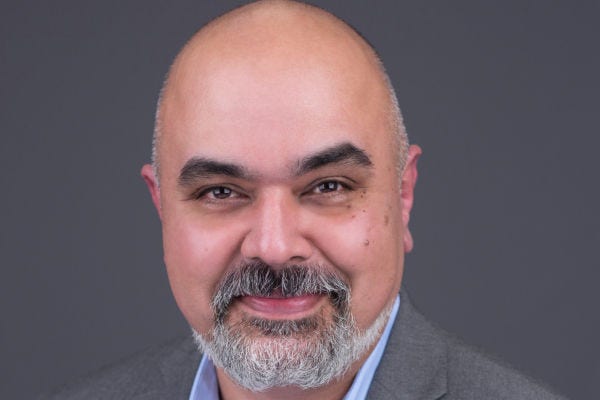
An engineer who keeps showing up in the security chair.
Sam Rehman runs Hitachi Cyber now. The official version is tidy: appointed CEO of Hitachi Systems Trusted Cyber Management Inc. on December 10, 2025, announced from Santa Clara, the press release filed under critical-infrastructure security and AI-accelerated operations. The version that actually explains the appointment is in the patents.
Four categories: software security, cloud computing, storage systems, distributed computing. The point isn't the volume. The point is the spread. Most security executives can defend one corner of a stack. Rehman has built engineering teams that shipped each layer. When he talks about IT and OT converging, he is not describing a slide. He is describing his own resume folded in half.
Hitachi gave him the keys because they want someone who can hold the industrial side and the software side in the same sentence without flinching. He spent close to ten years at Oracle's Server Technology Group as VP of Engineering, shipped Oracle's first in-memory database, then shipped its Sensor/IoT-based platform. Those are not adjacent products. They are bookends. The career between them is the connecting tissue.
After Oracle came a first run at EPAM Systems as Chief Technology Officer and Co-Head of Global Delivery. Then Cognizant, where he ran the Digital Engineering Business. Then Arxan Technologies, where he was appointed CTO in May 2015 to do exactly what Arxan was built to do - keep applications honest after they leave the build server.
And then he went back to EPAM. Not as CTO. As Chief Information Security Officer, with the Senior Vice President title attached, and eventually the whole Head of Cybersecurity Business mandate. Returning to a former employer in a bigger seat is unusual. Doing it after stints at three other companies is rarer still. Rehman did it anyway. He spent the back half of his EPAM tour running both the corporate security program and the customer-facing cybersecurity portfolio - incident response, detection and response, zero-trust, enterprise risk. The blast radius grew. The job widened. Then Hitachi called.
Listen to him on a podcast and the shape of his philosophy comes through fast. He told the OX Security team that security awareness begins with developers understanding the risks. He keeps saying passwords should never be hard-coded into code, the way some executives keep telling you to delete LinkedIn. He treats the CISO role as a collaborative function, not a clipboard. He talks about embedding security champions inside engineering teams so the discipline becomes organic rather than imposed. The vocabulary is unmistakably that of an engineer who became a security leader, not the reverse.
Which matters, because the inverse is far more common. A lot of modern CISOs grew up in audit, compliance, or the SOC. Rehman grew up shipping product. He still publishes - bylines at Dark Reading, Security Magazine, Infosecurity Magazine - and the bylines read like they were written by someone who has rebuilt a build pipeline at three a.m. Because he has.
Hitachi Cyber, the entity, sits inside the broader Hitachi machine and reports up through the parts of the conglomerate that worry about social infrastructure. The customer list is heavy on manufacturing, finance, healthcare, government, and the long tail of organizations who get a phone call from their regulator when something breaks. The market keywords around Rehman's new beat read like a security RFP: SIEM, SOC, EDR, NDR, threat hunting, GRC, GDPR, PCI, MITRE ATT&CK, Splunk, Microsoft Sentinel, Mandiant MDR. He has to translate all of that into something a chief executive sitting outside the technology trade can actually buy.
The early signals from inside Hitachi Cyber suggest he is moving fast on the cultural side. In his first weeks he launched an internal Ask Me Anything series - open, unfiltered, every employee invited. He brought a daily stand-up cadence with him to the top of the org chart. Neither of those is revolutionary inside a software company. Inside an industrial-heritage cybersecurity firm with a global footprint, both are tells. He intends to operate this place like a product team that ships.
In March 2026 he walked the floor at RSAC in San Francisco, alongside CRO Matt Castonguay, the conference circuit doing what the conference circuit always does for a new CEO: putting the face next to the logo. The face is friendly. The logo just got busier.
If there is a single line that explains the appointment, it is this. Hitachi Cyber needs someone who can think like a developer and operate like a board director. Sam Rehman has spent the last two decades alternating between the two. He returned to EPAM. He may end up returning to Hitachi's orbit longer than anyone currently predicts. The pattern is consistent: pick a place, leave a place, come back when the role is bigger. The press release uses words like intelligence-driven and cyber-resilience engineering. The actual job, for now, is much simpler. Make the engineering of trust feel less like a checklist and more like a craft.
He's been arguing for exactly that, in print and on stage, since the title CISO was still a novelty in most org charts.