At McGrath RentCorp, a compensation question came with a small administrative expedition. Match the job. Find the data. Pull information from several places. Check it against the market. Repeat. A lean compensation team was trying to keep pay competitive while preserving internal equity and controlling costs. The obstacle, in Salary.com’s published account, was the time spent assembling an answer.
- The business: compensation data, software, analytics, and consulting for employers, plus salary research for individuals.
- The useful difference: job definitions, market benchmarks, pay planning, and equity analysis can share a workflow.
- The new bet: SalaryTalent brings that compensation context into talent decisions.
McGrath adopted CompAnalyst and its market data, using composites and cost-of-labor information to streamline pricing ahead of budgeting. The company-published case says job-pricing time fell by roughly half, saving several hours a week. It is a modest claim beside the usual software promises. That modesty makes it useful: somebody had fewer places to look.
“Using Salary.com for market pricing, it’s hours and hours of savings in time…”Monica Leroux · Director of Human Resources, McGrath RentCorp
The number arrives last
Most people meet Salary.com through a personal question: what should I earn? The consumer site offers salary research and calculators. The employer business asks a more elaborate question: what should we pay for this work, in this market, within this organization?
A number alone cannot answer that. A role has duties, a level, a location, and a relationship to other roles. The employer has a budget and a pay policy. Salary.com sells the data and machinery for bringing these ingredients together. Its current company materials report more than 10,000 customer organizations worldwide. The customer stories range from Premise Health and Canyon Ranch to Susan G. Komen and the University of Alabama at Birmingham. Compensation is an unusually democratic headache.
Less hunting. More deciding.
The job description is the first price tag
Consider the word “manager.” It can describe someone running a store or someone overseeing a specialist department. A salary comparison becomes less useful when the title matches and the work does not. The interesting part of Salary.com is how much attention it gives to that unglamorous distinction.
JobArchitect centralizes job descriptions, templates, and approvals. Its connection to CompAnalyst lets approved descriptions flow into market pricing. The market-pricing page describes filtering ranges by industry, employer size, and location. This creates a sequence: agree on the job, then compare it with the market. The order matters. A beautifully formatted benchmark for the wrong work is still the wrong benchmark.
JobArchitect Max adds tools for drafting descriptions, surfacing market context, and flagging potential classification issues. Those are product capabilities described by the vendor, rather than independent findings about accuracy. Their practical appeal is straightforward: the description can be reviewed where it is managed, instead of disappearing into another document and another approval chain.
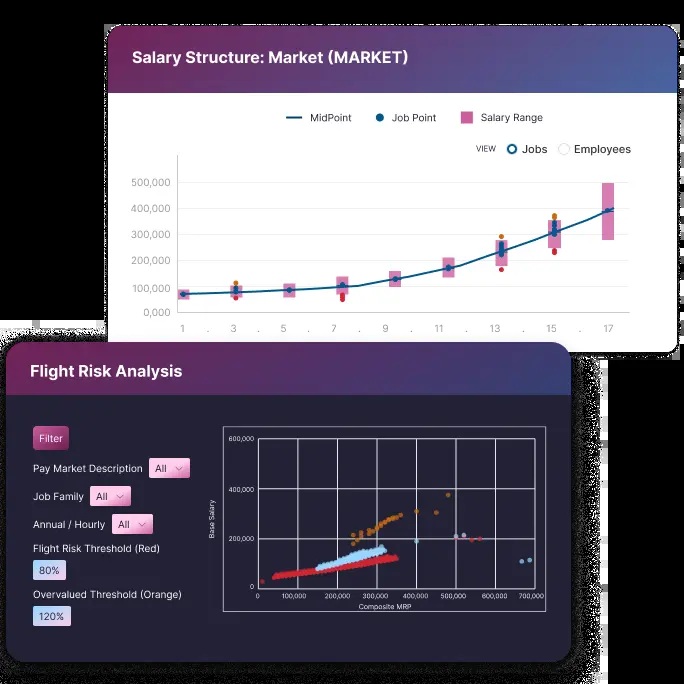
Underneath is a data business. Salary.com combines HR-reported benchmarks, participatory surveys, and job-posting intelligence. Compdata supports industry benchmarking; IPAS addresses international survey needs; SalaryIQ supplies hiring-market signals. These inputs have different jobs. Surveys help establish what employers report paying. Advertisements show what employers are putting into the market now. Treating the two as interchangeable would make a tidy dashboard and an untidy conclusion.
- 01DefineDuties, level, skills
- 02BenchmarkMarket, place, peers
- 03PlanRanges, raises, budget
- 04ReviewEquity, exceptions, record
A spreadsheet with a budget attached
Finding the market rate is only part of an employer’s problem. Someone must turn the analysis into merit increases, bonuses, commissions, or equity awards. In November 2023, Salary.com acquired HCR Software, maker of CompXL, adding compensation planning to its portfolio. CompXL married a familiar spreadsheet format to cloud workflows. There is a certain good sense in meeting a compensation team where its fingers already know the keys.
The current CompXL Max product includes planning workbooks, manager approvals, budget controls, and an audit trail. Its newer market intelligence features include job matching with confidence scoring and pre-planning analysis. Pay Equity Suite handles a related task: finding disparities and modeling adjustments. Consulting and professional services help with structure design, analysis, and implementation. Buying the software is therefore also a choice about how much specialist help the team needs.
The business model follows those needs: software subscriptions, data products and licensing, and services. Developer documentation distinguishes licensed data APIs from APIs used by existing platform customers. Salary.com can supply the compensation workspace, or supply information to another workspace.
Maximum proposed contract cost, including renewal options, in Tennessee’s June 2026 request for continued CompAnalyst access.
Tennessee’s Department of Human Resources provides a concrete glimpse of the economics. Its June 2026 request proposed a 36-month term with two renewal options. The department said it had used CompAnalyst since October 2024 and argued that its integrated methodology and connection to the state’s Edison system would be costly to replace with manual workarounds. The figure above is a proposed ceiling, not actual spending or a price for every customer. The revealing detail is the rationale: once a workflow is established, continuity becomes part of what the buyer is purchasing.
A company bought, rebuilt, and bought again
Salary.com’s own history has had several owners. Founded in 1999, the business went public in 2007. Kenexa announced an approximately $80 million acquisition in 2010. H.I.G. Capital bought Salary.com from IBM Kenexa in December 2015. H.I.G.’s later sale announcement says the company relaunched its entire product suite during that ownership period.
The Compdata merger in 2018 expanded the survey business. In October 2022, Accel-KKR invested as H.I.G. exited; terms were undisclosed. CompXL followed in 2023. Read together, the transactions show a business accumulating more of the steps involved in paying people. That is an interpretation of the product sequence, rather than a claim about what executives privately intended.

In December 2025, co-founder Yong Zhang became chairman and CEO, while Kent Plunkett moved to a board director role. The same announcement reported Salary.com’s sixth appearance on the Inc. 5000. Its careers page describes a hybrid schedule, sponsored compensation certification, and a 401(k) with a 6% match and immediate vesting. These are the company’s stated practices, but the certification support is a telling detail for a business whose expertise is part of its product.

When pay walks into the hiring meeting
March 2026 brought Max, an AI and real-time market intelligence layer across the compensation portfolio. August brought a Workday Design Approved integration connecting Workday HCM with CompAnalyst. Then, on September 28, Salary.com launched SalaryTalent. The chronology points toward a wider ambition: put compensation context where workforce decisions happen.
SalaryTalent launched with recruiting, candidate sourcing, performance management, workforce management, and HR agent orchestration. In the announcement, product leader Christopher Knize said customers wanted job, pay, skills, and market information available during requisitions, candidate conversations, reviews, and retention decisions. That is the documented customer feedback behind this expansion.
Zhang put the idea plainly: “Pay is the foundation of work.” SalaryTalent aims to show a recruiter market pay, salary-band placement, and internal equity considerations before an offer goes out. The launch describes approval gates and audit logs for its agents. It is early evidence of a product direction; a September launch cannot yet demonstrate years of customer outcomes.
What a buyer should try before buying
Salary.com competes with compensation specialists including Payscale and beqom, as well as the tools employers already assemble themselves. Its appeal is the connection between data and execution. The right comparison is specific: which jobs need pricing, which surveys matter, which approval process must survive, and which system holds the employee record?
A buyer can copy the discipline without buying the whole suite. Start with a well-defined role. Choose a defensible benchmark. Record adjustments and exceptions. Test one pay cycle before expanding. Ask for a proposal that makes the data, modules, implementation, and services clear. Bring a difficult real job to the demo; a convenient example reveals remarkably little.
The approach depends on usable employee data, sensible job matches, and people willing to review the result. A hybrid role can challenge a benchmark; a market range cannot select an employer’s philosophy; an equity finding cannot fund its own correction. Salary.com can organize the evidence and the workflow. The employer still has to make a decision it is prepared to explain. That responsibility is the last thing on the screen, and the first thing employees will remember.