Long before Ryne Saxe began working on digital dollars, he watched his father conduct business in a small town. Payment mattered, but so did a person’s reputation. Relationships allowed exchanges to happen without cash arriving at precisely the same moment. His father’s word carried weight. It was an early demonstration that a balance sheet could leave something out.
“We were low in money but high in currency,” Saxe wrote. The distinction stayed with him. Years later, it would appear in a lecture about the future of exchange, delivered by someone whose working life had already taken him through physics, programming, corporate law and a company called Eco. For a person interested in how value travels, he has covered some ground himself.
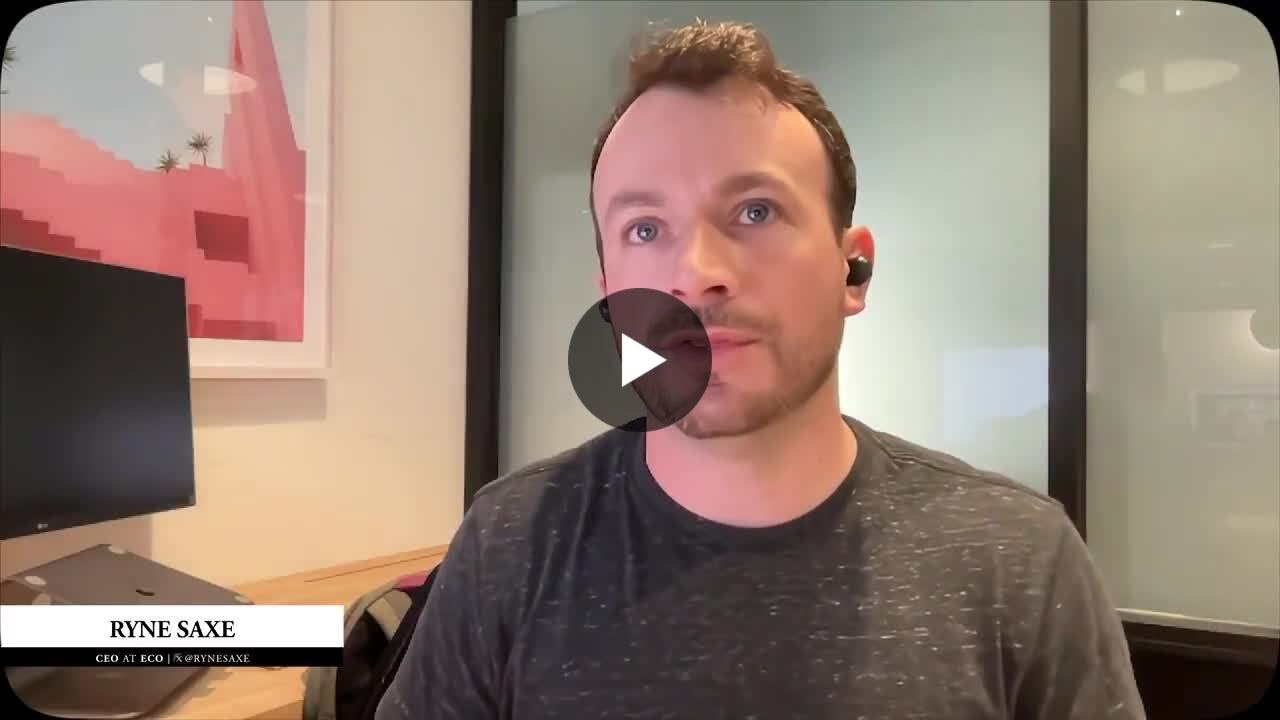
Today, Saxe is Eco’s co-founder and CEO, working on infrastructure that moves stablecoins across blockchains and markets. The vocabulary can become elaborate rather quickly. The human wish underneath it is familiar: people want their money to reach the place where they can use it. Saxe’s story concerns the considerable amount of work hidden inside that reasonable request.
Atoms, contracts, then dollars
At the University of Alabama, Saxe studied physics and mathematics. A surviving report from his 2009 research at the University of Washington gives the technical background a pleasingly solid object: a lithium photoassociation laser. The project concerned a laser system for experiments involving lithium and ytterbium, with diagnostic testing to establish how the apparatus performed.
There were optics to align, components to mount and feedback to control. The assembly lived inside an acrylic enclosure about the size of a shoebox. Before the payment networks and digital assets, there was a physical instrument whose usefulness depended on careful construction. It is an unusually tangible entry in the biography of a software founder. Some careers begin with a pitch deck; this one has a diffraction grating.
Saxe later attended Stanford Law School, from 2011 to 2014. His own education description makes room for the business school and the d.school, where he says he spent considerable time. The interests were already spilling across departmental boundaries. Corporate law then brought him into technology mergers and acquisitions at Weil, Gotshal & Manges, where he worked from 2014 to 2017.
What interested him was the business underneath the transaction. Why did a technology company want another company’s product? How would that acquisition turn into something its customers could use? Legal work offered a view into plans that might take years to appear in public. It also made the machinery of agreements difficult to overlook.
One memory involved a sensitive, typewritten semiconductor agreement that could not simply be uploaded for everyone on an acquisition team to inspect. Even in a business devoted to advanced technology, a physical document could govern who was allowed to know what. The detail is almost comic: tomorrow’s hardware, yesterday’s typewriter, and lawyers keeping the two on speaking terms.
Three chapters in Saxe’s career.
The company that changed its shape
Several products. One continuing question about money.
Crypto gave Saxe a reason to return to building. Its mixture of mathematics, monetary questions and software interested him, and the desire to start a company was already there. Eco came together in 2018. Getting people to understand the company could require an additional preliminary task: explaining why stablecoins were worth thinking about at all.
Being early can sound glamorous from a safe distance. Up close, it can mean waiting for other pieces of the system to become useful. Eco initially expected wallets to bring users into the market. That expectation proved too optimistic for the time. The infrastructure was awkward, and the users were arriving more slowly than the team had hoped.
In 2020, Eco moved toward a consumer app built around USDC. It put the company closer to people trying to save, spend and move money, and it changed Saxe’s job. He became COO as his co-founder Andy Bromberg took over as CEO. Saxe has described Bromberg as well suited to lead that consumer chapter. The handoff matched a change in the work.
The app gained traction, but it depended on banking relationships. After FTX’s collapse, the environment for those relationships became harder. Saxe has described partners withdrawing support and a long defensive period for the company. Eco eventually wound down the app. A product could have users and still rest on arrangements the team could no longer count on.
For Saxe, the experience left an education in dependencies: the outside organizations a company needs in order to deliver its own promise. Building a financial product means being accountable to users while relying on decisions made elsewhere. That tension had become practical, expensive and unavoidable. It helped shape the next version of Eco.
By May 2024, Saxe was CEO again, with Bromberg moving to chairman. The return came with Eco’s renewed emphasis on infrastructure. The company had changed products several times while retaining its interest in making money work better. Saxe’s sequence of titles, CEO to COO to CEO, records some of those changes more economically than a corporate presentation could.
A dollar needs directions
The current problem becomes easier to understand if you imagine money distributed across several systems. Someone may hold one stablecoin on one blockchain while an application needs another asset somewhere else. The holder sees spending power. The infrastructure sees a sequence of transfers, conversions and conditions, each of which has to fit the next.
Eco works on coordinating that journey. Its routing infrastructure is intended to let developers specify what needs to happen without assembling every step themselves. Behind a simple instruction sit questions about available liquidity, prices, destination assets and execution. A successful transfer requires the right outcome at the end of the route, as well as movement along the way.
Saxe’s writing shows an interest in explaining these otherwise invisible operations. In one essay, he separates orchestration, clearing and settlement by following the familiar act of buying coffee. Coordination happens, obligations are calculated, and money ultimately moves. The customer has already walked away with the cup. Convenience has a backstage crew.
His argument carries that observation into crypto. Different blockchains and applications create new coordination problems, even when individual networks can settle transactions quickly. Technical progress in one part of a payment does not automatically make every other part cooperate. The old questions about reliable exchange reappear, wearing new terminology and requesting another integration.
Instructions for money
In April 2026, Saxe put programmability at the center of his explanation of Eco’s work. A transaction should be able to carry rules about how and when it moves, then respond to the conditions it encounters. That could support treasury operations, payment flows or trading. The appeal is the ability to express an intention with enough precision for software to carry it out.
His earlier essay about the velocity of money explored what might happen when digital dollars circulate more continuously through markets. Faster movement, he argued, would require deeper shared liquidity and better coordination. He also raised a question about who benefits from that speed. His desired outcome gives ordinary participants access to capable execution, rather than reserving the advantages for those with privileged infrastructure.
The practical work continued in October 2026. Eco released a unified API on October 14, bringing quoting, funding, routing and transaction status behind a common interface. Partners had asked for services that previously had different shapes to become easier to use together. A request from another builder became a change in the product.
The same day, Eco introduced Programmable Addresses V2, including single-use addresses with live quotes and support for Eco-supported input assets. These are small-sounding details until someone has to reconcile a deposit or explain a transaction’s cost. Saxe’s current chapter consists partly of making those details easier for other companies to manage.
“Building more than tweeting.”
Ryne Saxe · X profile
The pleasure of a difficult team
Saxe’s reasons for founding extend beyond the technology. He has described wanting an environment where capable people challenge one another to do their best work. Starting a company offered a way to try to create that workplace. It also meant accepting that the team would be in a position to push its founder.
His public biography supplies a quieter counterweight: time outside with his children and an interest in analog things. His essays contain their own small joke about the habits of their author. He calls himself an “unapologetic em dash maximalist.” For someone working on the efficient passage of dollars, he is apparently happy to let a sentence take the scenic route.
The childhood memory remains a useful place to leave him. His father’s business showed him exchanges supported by relationships and reputation. His own company works on exchanges supported by software, liquidity and carefully stated conditions. The settings differ enormously. Both require somebody to do the unglamorous work that makes another person comfortable saying yes.
Eco has occupied several forms since 2018, and Saxe has occupied several seats inside it. The thread running through them is a practical curiosity about how value gets from one person’s intention to another person’s hands. It began within the reach of a small-town promise. It now comes with an API.