At three in the morning, Bryan Pellegrino called Ryan Zarick with a disaster. Zarick opened his computer and learned that the disaster was a button. It needed fixing, Bryan said, immediately. Ryan still tells the story with the patience of someone who has spent years working beside a person whose definition of urgent is elastic. The detail is wonderfully small. Their company had real users, real money moving through it and a team so lean that the CTO could be roused to attend to a button. The call did not end the partnership. It became one of its better stories.
Before they were the co-founders of LayerZero Labs, Zarick and Pellegrino were trying to keep a fantasy-sports business alive. They and Caleb Banister had already known one another for years. The three had worked in computer-network research labs at the University of New Hampshire, where questions about connecting machines were a daily occupation. Their friendship traveled with them from one venture to the next. The subject matter changed, but the working arrangement endured: Bryan pushing, Ryan building, Caleb alongside them.
Zarick studied computer science at New Hampshire, earning a bachelor's degree in 2009 and a master's in 2011. His early career took him through Coder Den and Buzzdraft, then through 80Trill and Minimal AI. On paper, the company names look like a succession of stops. In the story he and Pellegrino tell, they sound more like successive drafts written by the same small group of people.
The company they had to sell
The fantasy-sports years left a mark. Zarick recalled a period when three people maintained a site with tens of thousands of users while better-funded competitors could hire entire departments. He described long hours and little income. The early-morning button call is comic partly because the conditions around it were serious. If a customer-facing detail failed, there was no separate team to catch it. If the site needed attention, the founders were the team.
Eventually an acquisition offer arrived. Pellegrino wanted to continue. Zarick said the financial strain had reached its limit. They took the offer. Later, as the industry consolidated, other businesses sold for much more. That hindsight can make any exit look premature, but it cannot pay an old bill. The decision belonged to the moment in which the founders had to make it.
What lasted was an agreement about the next attempt. Pellegrino has recalled Zarick promising that, if they started another company together, he would see it through with him. It was an unusually solemn vow for two men whose shared history included an argument about a button. Perhaps that is why it carried weight. They knew what the work would feel like after the first flush of a new idea wore off.
“That is not a disaster. But it was to him.”Ryan Zarick, recalling the 3 a.m. call
Then Pellegrino called again, this time with something considerably larger than a user-interface fix. Zarick moved to Vancouver. In a later interview he described learning GPU programming by reading documentation during early-morning walks through Pellegrino's house with his infant daughter. It is an image of startup life that requires no mythology: a tired parent, a technical manual and the suspicion that a new skill might become useful soon.
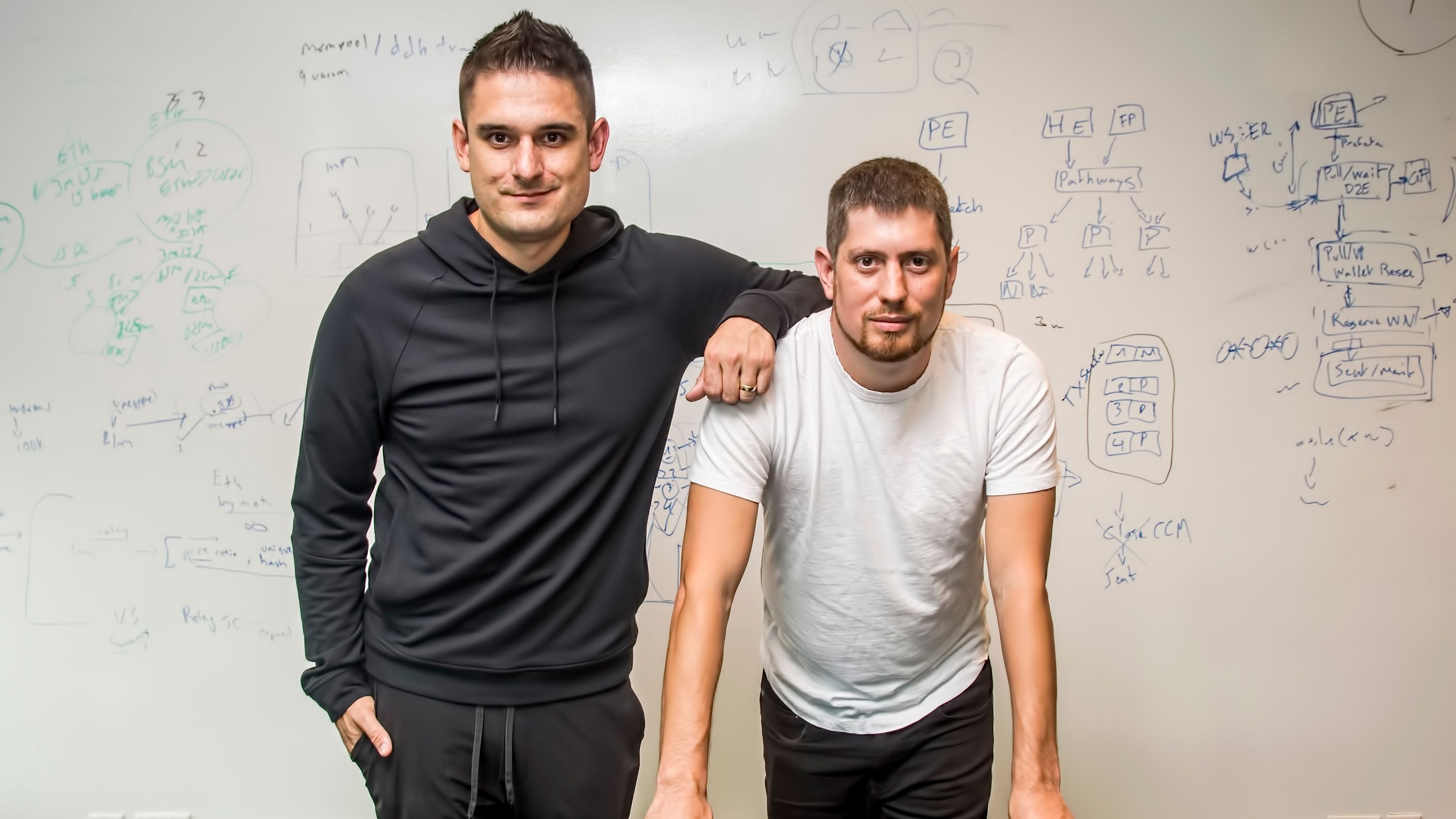
A message needs a way across
By 2021, the problem in front of them had changed. Blockchains were multiplying, each with its own rules and applications. A developer could build on one chain and discover that the people or assets they needed were on another. Moving information across that divide required a bridge, and bridges carried costs and risks of their own. Zarick, Pellegrino and Banister began work on what they described as a messaging layer: a way for one chain to tell another that something had happened.
Their first LayerZero paper, published in October 2021, called the fragmentation a consequence of choice. Developers had many platforms, but the resulting islands could not easily exchange state or liquidity. The paper proposed a low-level communication primitive on which applications could build. The engineering aim was narrower and more useful than a slogan about a united digital world: deliver a message, verify it, let a separate application decide what to do next.
records an event
passes a message
acts on it
Zarick wrote publicly during the first years of the project. His posts explained the bridging problem, introduced Stargate, announced LayerZero's beta launch and discussed security measures including Pre-Crime. Those pieces show a CTO doing more than signing off on code. He was trying to make an unfamiliar architecture legible to developers and users while the architecture itself was still evolving.
In 2023 he was among the authors of a second LayerZero paper. It set out a design with configurable verification infrastructure and argued that an application should control its own security choices and costs. That shift matters because a universal route between chains can only be useful if the traveler knows what sort of trust the route demands. For a game item, a stablecoin transfer or a governance message, the acceptable terms may differ. The protocol had to make those terms visible to the application building on it.
The company drew major funding and attention. An early round announced in 2022 involved Sequoia Capital and Andreessen Horowitz. It also brought a test that every infrastructure project eventually faces: people began to use the thing. The original three-author paper became a larger development effort, and the public repository credits Zarick among the core developers of the first LayerZero endpoints. A whiteboard sketch had acquired users, code reviews and the ordinary burden of staying up.
The bottleneck moves
Interoperability did not exhaust Zarick's interest in blockchain systems. By 2025, his name appeared on papers about the machinery inside a chain. QMDB, the Quick Merkle Database, joined ordinary key-value storage with a structure that can prove what is in the database. That proof matters because a blockchain participant should be able to check the system's account of its own state. Storage speed alone is not enough if the record cannot be verified.
The QMDB authors reported benchmark gains over other database approaches. As with any systems benchmark, the hardware, workload and comparison method define the result; the headline number is not a speed guarantee for every deployment. The interesting engineering move was to treat verifiability as part of the storage design, rather than a costly task to attach afterward. Zarick joined colleagues Isaac Zhang and Thomas Kim in a technical podcast to discuss the design, its proof structure and the questions it leaves for builders.
The next paper dealt with a different bottleneck. FAFO, short for Fast Ahead-of-Formation Optimization, is a transaction scheduler. Many transactions could run at the same time in principle, but a system must know whether they touch the same data. If it guesses badly, parallel work turns into a queue. The FAFO authors tested a method for detecting conflicts and ordering transactions before a block is formed. Their paper reported more than 1.1 million native ETH transfers per second on one node under the tested conditions. The number is striking. The circumstances around it are part of the number.
A December 2025 paper added Zarick to the author list for ZeroOS, a modular library operating system for applications that run in zero-knowledge virtual machines. To readers outside software infrastructure, the sequence can sound like a tour of difficult acronyms. It has a plain logic. First, chains needed a way to communicate. Then the team asked how a chain stores its state, schedules its work and proves its computations. Each solved problem pointed at the next constriction in the pipe.
A faster chain is useful only if enough people can still check its work.The design tension Zarick describes
What speed costs
In a 2026 interview, Zarick described a physical tradeoff in blockchain performance. Make every participant process ever more work, and the required machine gets larger. As the machine grows more expensive, fewer people can operate one. A network can become fast on paper while becoming less open in practice. His question was therefore about access as much as throughput: who can afford to verify the result?
LayerZero's 2026 Zero announcement assembled the company's work on databases, scheduling, proofs and networking into a proposed new blockchain architecture. The company published ambitious performance claims. Some derive from paper benchmarks; broader performance in real-world use will depend on the deployed network and its workload. Zarick's own account of the project emphasizes that speed should preserve the design principles that drew him to decentralized systems. He has spoken about wanting impact more than another quick commercial win.
This is where the old startup story becomes more than a charming origin anecdote. During the fantasy-sports years, Zarick had learned what it meant to carry a service with a tiny team, to argue over what needed fixing at 3 a.m. and to make a hard financial choice. At LayerZero, the stakes and the vocabulary grew. The recurring questions stayed familiar: what actually breaks, what must be checked and what is worth keeping alive when the simplest path would be to ship sooner?
Pellegrino has said plainly that he could not have built the company without Raz. Zarick has described their partnership in almost fated terms, recalling the first time they met and the years that followed. His public GitHub biography is less ceremonial: “coding in the jungle.” Both versions fit a person whose work has been carried out in long collaboration, amid messy systems that refuse to become tidy just because somebody has written a clean diagram.
There is a neat ending available to this sort of story, in which the promise is fulfilled, the machines all agree and nobody calls about a button again. Engineering rarely grants one. Each new layer exposes another problem, and a protocol that connects distant systems creates new obligations for the people maintaining the connection. For Ryan Zarick, that appears to be the attraction. The next difficult question is already waiting on the other side.