Ryan Faridian’s account of his family’s financial history begins with a house being sold. His grandfather, Enayat Faridian, had built a trust company in Iran. When defaults followed the Iranian Revolution, he sold his assets, including his home, to repay investors. Faridian tells the story as a lesson in keeping an obligation when keeping it becomes expensive.
It is an unusual starting point for a wealth-management profile. The opening transaction reduces the family fortune. The lasting asset is a promise fulfilled. Before there is a discussion of portfolios, there is a question about what someone owes the people who trusted him.
Today, Faridian is CEO of Global Solutions Family Office in Vancouver. The business deals with investments, tax planning, succession and the arrangements that carry family wealth across borders and generations. His grandfather’s story supplies a personal frame for that work. A fortune has owners, certainly. It also has dependants, expectations and commitments attached.
A family practice, with a different arrangement
Faridian’s father, Foad, immigrated to Canada and entered financial services. Ryan joined the family business in 2013. In his telling, the irritation that followed was organizational: professionals handled their specialties separately, leaving the family without a unified strategy. A client then asked him to build a family office. He brought tax, investment, financial-planning, estate and legal specialists into a coordinated team.
That request offers a useful hinge in his career. Joining a family practice means inheriting relationships and a way of working. Changing its arrangement means deciding which habits serve those relationships and which need revision. Faridian’s description places the change in the connections between advisors. The client’s life crosses the boundaries between specialties; the advice has to make the crossing too.
“Our work is grounded in purpose, integrity, and collaboration.”
Ryan Faridian
There is a small comedy in the idea of a wealthy family acting as its own messenger service. One advisor has a question for another. A third needs a document. Someone must remember which conversation happened first. The family office’s proposition is to take responsibility for that coordination. The promise becomes meaningful in the details: a decision, an owner, a sequence, a follow-up.
Seven divisions, and the space between them
Global Solutions describes seven divisions: family office, investments, accounting, wealth planning, legal planning, capital advisory and real estate. The list moves from the running of family affairs to the funding of businesses and the management of property. Faridian’s job as CEO sits over an organization designed to hold those subjects in the same conversation.
The distinction matters because a family’s decisions rarely arrive wearing departmental labels. Selling a business raises questions about capital, tax, investment and succession. Property can be an investment and a source of financing. A trust can involve legal arrangements and family expectations. A family member’s move abroad introduces another set of connections.
Read that structure as an operating proposition: someone should be able to see how one decision affects the others. It places a demanding task on coordination. Bringing disciplines together creates an opportunity for shared planning; the work still has to happen between people. An organizational chart can introduce colleagues. It cannot conduct their next conversation for them.
The family before the spreadsheet
One of Faridian’s public client accounts concerns a $40 million planning problem. He describes three siblings, an operating business and parents whose succession intentions had remained verbal. There were also cross-border exposures and a property portfolio assembled without a common investment thesis. This is his account of the engagement, with the family unnamed.
The point he draws from it is about order. Before coordinating the technical work, the family had to agree on its goals and on what fairness meant. Tax, geography and property strategy were connected. Treating each separately would leave the larger problem standing.
“We didn’t start with spreadsheets. We started with alignment, then built backwards.”
Ryan Faridian, describing a client engagement
That sequencing gives the story its interest. A spreadsheet can model an agreed objective. It has less to say when three people mean different things by the objective itself. The word fair can sound like an agreement until someone asks it to carry a specific decision. Then the family needs language precise enough for everyone to recognize what is being proposed.
Equal is easy to divide
Faridian was exploring that difficulty in June 2021, when he published an article about fairness and equality in wealth transfer. He considered circumstances in which equal-looking allocations could produce different outcomes, including assets carrying different tax consequences. He also examined a business in which children had different levels of involvement.
The underlying tension is familiar. Equal division is a mathematical instruction. Fair treatment requires deciding what should count: work, need, responsibility, prior support or some combination. Those choices belong to a family’s circumstances. A tidy fraction cannot explain them on its own.
His article emphasizes explaining the reasoning behind decisions and documenting it when direct communication is difficult. That adds another task to the preparation of an inheritance: making the intentions understandable. The person receiving a decision may judge it differently from the person making it.
It is easy to see why this subject belongs in a profile of someone who joined a family business. Faridian’s own career sits within a continuing enterprise. His writing asks readers to consider what continuity demands from people whose roles and interests may differ.
An evening beyond the balance sheet
A photograph from a June 2023 account of a YVR Entrepreneurs Club gathering puts Faridian in a different setting: La Terrazza restaurant in Vancouver. He stands beside Kambiz Ahmadi, Omar Sharif and the club’s founder, Brittany Michalchuk. The evening included dinner, introductions and networking among business owners.
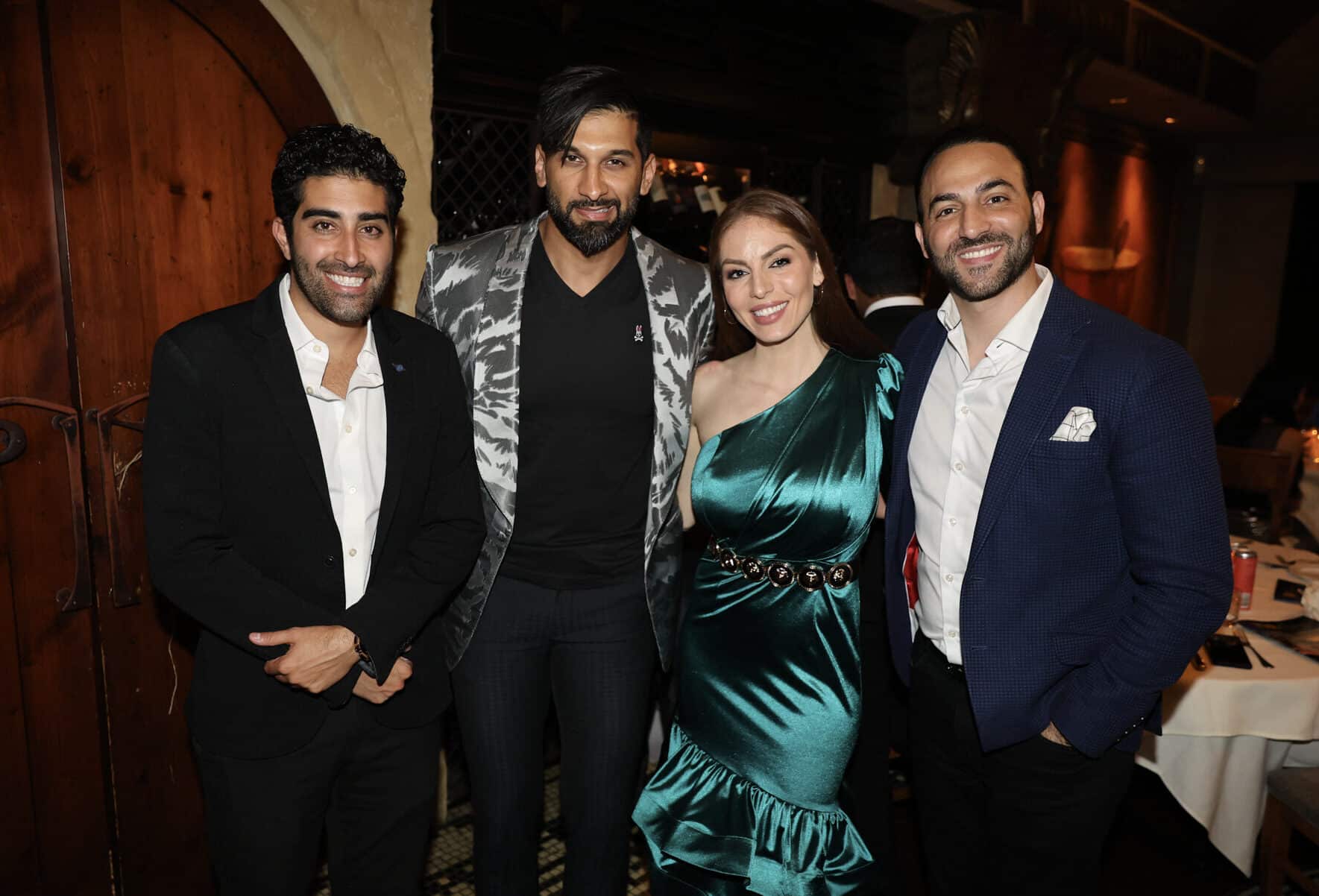
The photograph is a modest reminder that business relationships have places as well as profiles. Here the place is a restaurant, the occasion an entrepreneurship gathering, and the participants people introducing themselves to one another. It records his participation in Vancouver’s business community without requiring a grand theory of the evening.
Another glimpse comes from a holiday-season post in which he welcomed the office’s festive preparations. Even a firm concerned with long-term planning has a calendar with decorations on it. These public moments add an ordinary scale to a career otherwise described in the vocabulary of wealth and succession.
The appealing answer from Instagram
Faridian has also described a prospective client who thought incorporation in a zero-tax jurisdiction would make business revenues tax-free. The explanation had arrived through Instagram, reinforced by friends. He uses the episode to warn against confusing the place a company is incorporated with the questions that determine its tax position.
The anecdote has the efficiency of a good cautionary tale: a complicated decision acquires an easy answer, and the easy answer acquires witnesses. Friends have tried it. A post explains it. By the time it reaches an advisor, the claim has begun to feel like a plan.
His role in that account is to question the premise before organizing a solution around it. It fits the broader coordination theme. A structure described in isolation can sound persuasive while leaving the person’s circumstances outside the frame. The attractive part of the answer may be precisely the detail it has omitted.
There is humour in how far a confident sentence can travel. The slower work begins when somebody asks what it means for this particular person, with this business and these obligations. That work is less suited to a caption, but rather better suited to a consequential decision.
A career that keeps returning to the connections
Faridian’s public career record includes study at Capilano University from 2010 to 2012, an Advocis speaking engagement in 2016 and a volunteer co-chair role with the association. He lists industry recognition from Sun Life, HUB Financial and the Million Dollar Round Table, including Top of the Table in 2024. These entries describe professional participation alongside his role leading Global Solutions.
His more recent writing continues to separate questions that people can be tempted to combine. In July 2026, he published an article asking readers to consider a move abroad and the location of their wealth as two decisions. The title alone extends the pattern: look closely at the connection before assuming the answers must match.
The family-office business gives Faridian a setting in which to pursue that question repeatedly. A family grows, a business changes hands, an investment needs attention, somebody moves. Each event asks for expertise. Together they ask for a person or a team to understand the sequence.
Return, finally, to the house in his grandfather’s story. Its significance is the obligation it helped fulfil. Faridian’s account places that decision near the beginning of his own professional explanation. The inheritance running through this career is a standard of responsibility, carried into the less dramatic, continuing work of getting people and their plans to agree.
Continue the conversation
- Global Solutions Family Office
- Ryan Faridian on LinkedIn
- Faridian’s essay on fair and equal inheritances
- His account of a three-sibling planning problem
- His account of the foreign-incorporation misconception
- The Vancouver entrepreneurs evening
- Ryan Faridian on Clubhouse
- The firm on Instagram · Facebook · LinkedIn