Rumble began with a complaint that was almost quaint by current internet standards. In 2013, founder Chris Pavlovski believed the large video sites were favoring established creators and leaving smaller ones without reliable distribution. His answer was a platform that would license viral clips, find audiences for them and share the proceeds. Thirteen years later, the grievance has grown into a corporate architecture. Rumble now sells video hosting, livestream production, ads, subscriptions and direct crypto payments. Its parent company owns an AI-infrastructure business with roughly 22,000 high-end Nvidia GPUs. The little play button has acquired a power bill.
The expansion explains why calling Rumble merely a YouTube alternative now misses half the story. The familiar part remains: viewers open the app for politics, podcasts, gaming, sports, culture and livestreams, while creators upload videos and earn through ads, subscriptions, licensing, tips and paid programming. The less visible part is a bid to control the machinery beneath that exchange. Rumble has built its own ad marketplace, launched a cloud service, added a wallet and, in June 2026, folded Northern Data into a new public parent called RUM Group. Rumble is the media brand. Quake AI is the infrastructure unit. Independence is the connective tissue.
01 / The originA home for the overlooked
Rumble’s original customer was not necessarily ideological. It was the small creator staring at an algorithm that seemed to prefer someone bigger. The company offered distribution and video-management licenses, including help placing clips across third-party networks and protecting content through YouTube’s Content ID system. That early service model gave Rumble expertise in the unglamorous parts of online video: transcoding, storage, rights management, ad sales and syndication.
Politics later supplied much of the audience growth and the public identity. Commentators who distrusted the moderation or recommendation systems of YouTube and Facebook found an accommodating home. Rumble describes itself as “freedom-first,” with policies centered on lawful expression and a promise not to manipulate reach for ideological reasons. Admirers see a needed check on concentrated platform power. Critics see a service whose lighter moderation can reward polarizing content. Both reactions matter commercially because Rumble sells not only viewing time but also a particular relationship with platform authority.
Rumble was founded based on the premise of providing small creators with the tools and distribution that they needed to succeed.Rumble 2025 annual filing
That identity creates a strong acquisition hook and a stubborn growth problem. News and political commentary surge around elections, then cool. Average monthly users fell through much of 2025 before recovering to 52 million in the fourth quarter and 56 million in the first quarter of 2026. The company’s response has been to broaden the feed with gaming, sports, culture and short-form video while signing recognizable programming. The aim is straightforward: give people a reason to open Rumble when no ballot is in sight.
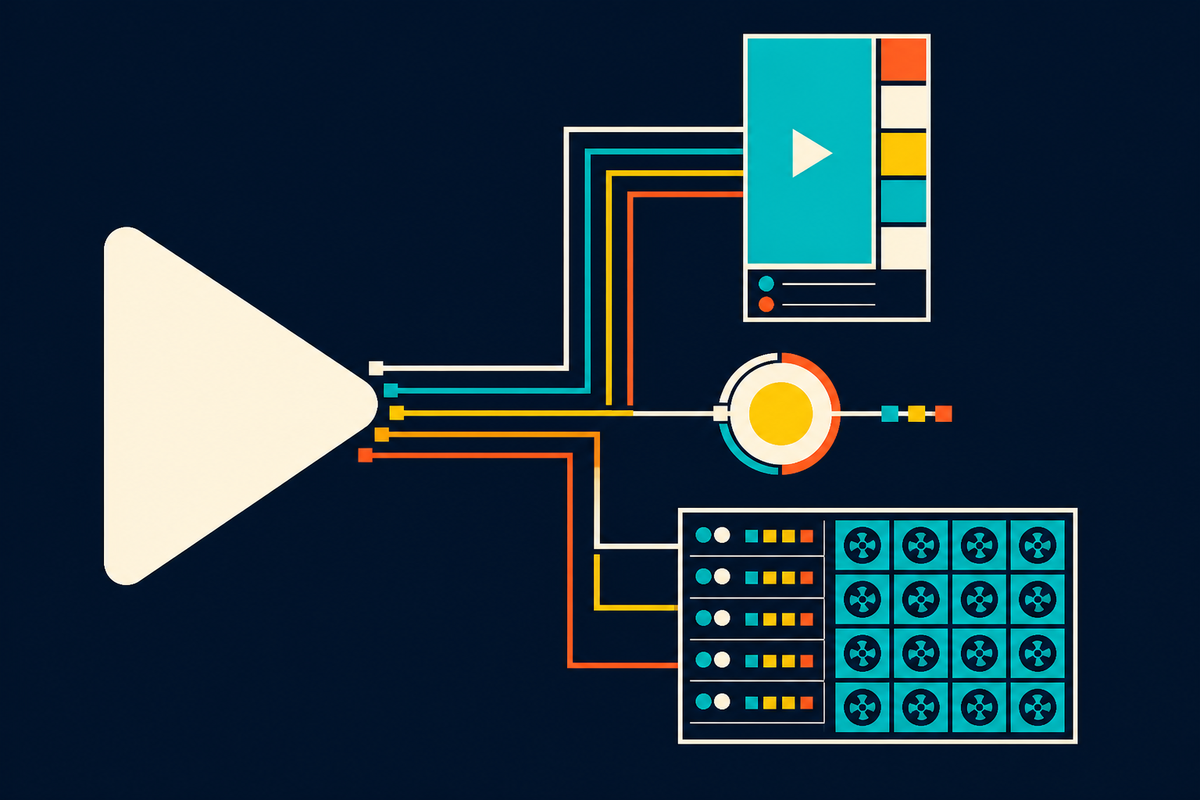
02 / The product stackOne creator, several machines
For a creator, the practical front door is still Rumble Video. It handles uploads, channels, live chat, video-on-demand and monetization across web, mobile and connected televisions. Rumble Shorts, released across web, Android and iPhone in February 2026, adds the vertical swipe familiar from TikTok, Reels and YouTube Shorts. Management said Shorts reached roughly two million unique video views in a single day in May. The format is less a revolution than overdue plumbing: discovery increasingly begins with a clip, not a channel page.
Rumble Studio is the more revealing product. Built on technology acquired with the podcasting platform Callin, Studio lets a host bring in guests, combine chats and broadcast to Rumble, YouTube, Twitch, X, Facebook and other destinations. That sounds oddly generous for a platform competitor, but it matches the customer’s reality. Creators do not want another dependency. They want leverage. Rumble can become the production desk even when some of the resulting attention lands elsewhere.
Money moves through several rails. The Rumble Advertising Center lets advertisers buy inventory and gives publishers more control over what appears beside their content. Rumble Premium sells ad-free viewing and exclusive programming. Creators can receive tips, license videos and participate in programs that reward watch time, signups and subscriptions. In January 2026, Rumble and Tether added a non-custodial wallet supporting bitcoin, stablecoins and tokenized gold. The wallet’s most useful feature is not crypto theater; it is the ability to pay a creator directly across borders without asking the platform to hold the funds.
03 / The businessAudience first, infrastructure underneath
Rumble reports two broad revenue families. Audience monetization includes advertising, subscriptions, licensing and tipping fees. “Other initiatives” include advertising inventory sold for outside publishers and cloud services. In the first quarter of 2026, revenue rose 7 percent from a year earlier to $25.5 million, helped by higher subscription and advertising revenue. Full-year 2025 revenue reached $100.6 million, the company’s first crossing of the $100 million line.
The chart is steady, not explosive, and the company remains unprofitable. Rumble posted a $30.3 million net loss in the first quarter of 2026 and ended March with $219 million in cash plus 210.82 bitcoin then valued at $14.4 million. It also has content commitments, infrastructure costs and the integration work of a large acquisition. The bet is that a broader product set can improve monetization while the acquired compute business brings a different revenue profile.
Tether made that bet possible. Its $775 million strategic investment closed in February 2025, with $525 million used for a self-tender and roughly $250 million directed toward growth after expenses. The relationship has since expanded into wallet technology, advertising commitments, blockchain projects and support for the Northern Data deal. Rumble gains a mission-aligned capital partner and a large potential customer. It also gains concentration risk: when one relationship touches financing, products, advertising and infrastructure, strategic alignment becomes strategic dependence.
04 / The customersTwo markets sharing one argument
On the consumer side, Rumble serves viewers who want independent commentary and creators who want an additional audience, a looser editorial perimeter or bargaining power with larger platforms. The service is especially visible in politics, but the customer map includes podcasters, gamers, sports personalities, financial commentators, comedians and lifestyle channels. Advertisers arrive for that engaged audience, while publishers use the marketplace to sell inventory beyond Rumble itself.
On the enterprise side, the customer is a developer or institution that wants compute, storage and networking without a conventional hyperscaler relationship. Rumble Cloud sells monthly resource tiers with OpenStack interfaces, dedicated or shared CPUs, NVMe storage, object storage, load balancers, automation and Kubernetes. Its pricing pitch is predictable bills and no data-transfer fees. Publicly named customers and partners have included the Tampa Bay Buccaneers, Miami Dolphins, Cleveland Browns, the government of El Salvador, MoonPay, TRON and Tether-linked projects.
05 / The differenceVertical integration with a point of view
YouTube has far greater reach, a deeper creator economy and mature recommendation technology. Twitch owns strong livestream habits. TikTok dominates short-form discovery. AWS, Azure and Google Cloud offer vast catalogs and global capacity. Rumble does not beat those rivals by matching each feature. It bundles a smaller set around a single promise: more control for the person publishing, advertising, paying or deploying software.
That promise appears in details competitors might avoid. Studio distributes to rival platforms. The ad center lets brands and publishers make clearer placement choices. The wallet is non-custodial. Cloud pricing is packaged rather than metered across dozens of line items. Rumble also operates more of its own video delivery infrastructure than a typical media startup. The Northern Data acquisition pushes that logic further by adding GPU capacity, data centers and more than 200 megawatts of unmonetized energy capacity.
It also changes the comparison. Rumble is no longer only fighting for viewing hours against YouTube, Kick and Twitch. Quake AI now meets CoreWeave and the hyperscalers in a capital-hungry market where utilization, energy contracts and hardware cycles decide the margins. Northern Data expected its roughly 22,000 H100 and H200 GPUs to reach about 85 percent utilization in March 2026, and a multi-year agreement with Together AI provides an anchor workload. More capacity can create upside. Idle capacity can become an expensive collection of very warm rectangles.
We respect independent thought, and care about impact more than titles.Rumble careers page
06 / Where it fitsThe alternative is becoming an ecosystem
Rumble occupies a peculiar but legible place in the market. It is a mid-sized consumer platform with a culturally distinct audience, a creator tool that welcomes multihoming, an independent ad network, a subscription media service and an emerging infrastructure operator. Few competitors combine all five. Fewer still organize them around an explicit political philosophy of the internet.
The culture mirrors the product. Rumble describes its team as focused, fast and fearless, with autonomy for builders and impact valued over titles. At the end of 2025, before the Northern Data deal, it employed 156 people across the United States and Canada. That was a compact group for the range of products on offer. The combined organization is larger, but a current consolidated headcount has not been publicly detailed.
What can someone steal from Rumble’s playbook? Start with a user who feels ignored. Turn that grievance into a concrete tool. Then inspect every dependency that can weaken the promise. Rumble moved from distribution to monetization, from monetization to ads and payments, and from media hosting to cloud and compute. The lesson is not that every startup should buy data centers. It is that differentiation becomes more durable when the operating choices reinforce the marketing claim.
The question is whether the stack will work as one system rather than a row of expensive nouns. Rumble must keep creators producing, improve discovery, persuade brands to spend, turn Premium viewers into recurring revenue and keep costly processors busy. Its audience remains tied to news cycles, its losses are material and its larger competitors can bundle aggressively. Yet the company has moved beyond protest as a product. It has built tools, acquired physical capacity and made its philosophy measurable. For Rumble, the second act begins when independence stops being the headline and starts appearing in the invoice.