A company can come back online in a morning. Coming back as a business takes longer. Roshan Dharia arrived at Paxful in May 2023, after the peer-to-peer cryptocurrency marketplace had suspended trading and then reopened. He inherited a name people knew, a product people used and a company whose future required more than a working login screen. The assignment was day-to-day leadership, stronger operations and a search for strategic alternatives. It was a job description with very little room for ceremony.
Dharia had already worked on distressed private companies through PTHL Affiliates, the investment platform he founded. At TrustToken, later called Archblock, he had led institutional lending in decentralized finance. His path into crypto ran through borrowers, balance sheets and the awkward business of getting money back. That background matters to his present role as founder and chief executive of Echo Base, a privately funded firm operating across digital asset acquisitions, financing, restructuring and recovery.
The temptation with a turnaround executive is to write the rescue first and examine the wreckage later. Dharia’s career resists that neat arrangement. Paxful restarted, announced growth and subsequently wound down. Echo Base bought crypto products, then developed an increasingly explicit business around distress. The second act has its own bills. A promising opening scene does not guarantee a happy ending.
A lender brings a different set of questions
Before Paxful, there was PTHL Affiliates, which acquired and turned around distressed private businesses across industries. Then came TrustToken’s institutional lending operation. In announcing his Paxful appointment, the company credited Dharia with deploying more than $1.5 billion in stablecoin loans and described his aggregate transaction experience across financing, restructuring and mergers and acquisitions as exceeding $30 billion. These are career transaction figures, not personal wealth, and the distinction is rather consequential.
In October 2022, when TrueFi faced troubled loans, Dharia described defaults as part of the lending business and emphasized examining counterparties, the composition of their assets and their liquidity. That is a recognizable credit investor’s vocabulary. A borrower’s reputation is useful information; a borrower’s ability to repay is the actual subject. Blockchain changes the machinery around a loan. The due date retains an admirable resistance to fashion.
He returned to that argument in a March 2024 TrueFi forum discussion. Signing as the former head of credit, he defended the 2021-2022 crypto-native lending portfolios, putting their volume at approximately $1.7 billion across 150 loans and their credit losses below 0.50%. Those were his reported figures. He argued that conservative controls had worked and that reduced borrower demand had ultimately been the problem. He also supported Cicada Partners’ proposed return to crypto-native lending. His answer was specific enough to be challenged: a portfolio, a period, a loss rate.
Figures stated in his March 2024 TrueFi forum reply. Historical portfolio figures, not current performance.
The marketplace already had a history
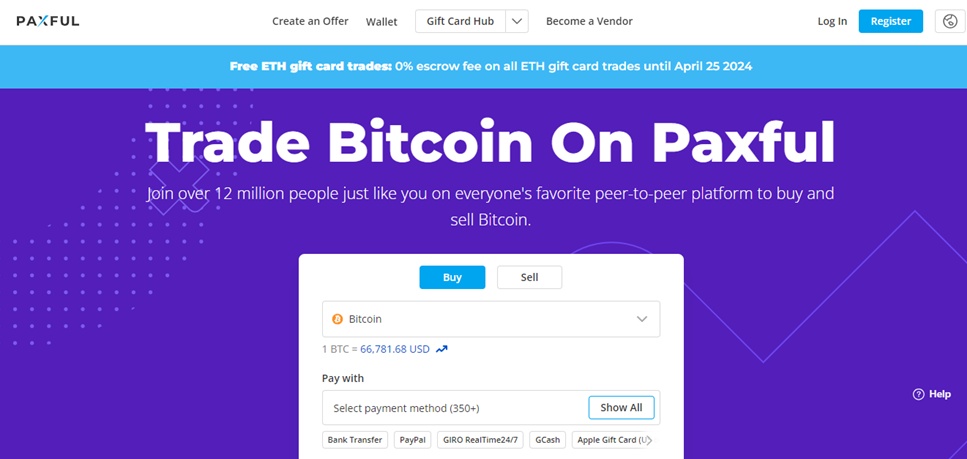
Paxful had been founded in 2015. By Dharia’s arrival, its appointment announcement counted more than 12 million users. Its attraction was practical: buyers and sellers could exchange cryptocurrency using a wide range of payment methods. For people working across uneven banking systems, that flexibility made the marketplace relevant to everyday transactions. Dharia joined an existing institution with an existing constituency. He was neither its founder nor the author of its earliest decisions.
The May 2023 appointment followed a spring interruption. The marketplace had shut temporarily in April and returned in May. Custodian Srinivas Raju welcomed Dharia into the role responsible for daily management. A custodian’s involvement gives the scene a different atmosphere from the usual founder interview. The company needed a functioning decision-making process as well as an available trading service.
By November, Paxful was announcing an agreement separating its governance from the legacy founding team. It also reported eightfold revenue growth over four months and adoption across more than 130 countries. The claims belonged to the company’s announcement, rather than an independently audited verdict on the turnaround. Still, they show what the new management wanted to establish: renewed operational independence, renewed trading activity and a reason for customers to keep coming back.
The user was more interesting than the token
In an April 2024 interview, Dharia described a payments marketplace serving people across Africa, Asia and Latin America, including users with limited access to banks. He spoke about identity checks, escrow, customer support and the human work surrounding each trade. The product, in that account, was a combination of payment routes, traders, custody arrangements and people who could resolve a disagreement. Even an entirely digital marketplace eventually requires someone to answer an entirely human complaint.
Asked for advice to prospective entrepreneurs, he directed attention toward users, including Moneybees’ Jay Villarante in the Philippines and a TradeX operator in South Asia. It was a revealing choice of reference point. He was discussing a business whose customers could be students paying tuition or institutions transferring substantial sums. The use case was the thing to investigate; the industry’s preferred slogan could wait its turn.
His other market commentary that month was similarly interested in local behavior. He described differing preferences for stablecoins, Bitcoin and Ethereum across regions and said Paxful had added Ethereum in response to customer demand. His reported demand figures were observations from that moment, not a permanent description of the market. The larger point was an operating one: a global product still has to notice what happens in particular places.
A restart has limits
The next part of the Paxful story prevents the revival from becoming a trophy. In 2025, the company announced that it would wind down operations by November 1. It attributed the decision to the continuing impact of earlier misconduct and the cost of extensive compliance remediation. Paxful described the closure as a decision about long-term sustainability and said it remained financially stable. Those were the company’s explanations, and they should be read as such.
The corporate legal history also continued. In February 2026, Paxful Holdings was sentenced to a $4 million criminal penalty following its guilty plea to federal offenses. FinCEN’s consent order distinguished the relevant conduct, ending in April 2023, from the ownership and management that subsequently took control. That chronology is essential when reading Dharia’s tenure. The corporate judgment concerned Paxful; it was not a personal conviction of Dharia.
Paxful’s remaining service is now focused on access to accounts and withdrawals, rather than buying and selling. This gives the story a sober ending: improving operations and finding a sustainable future are separate tests. A company can spend money fixing inherited problems and still decide that continued trading no longer makes sense. For a restructuring professional, closure and the administration of obligations belong inside the work. They cannot be edited out to improve the ending.
- April 2023Marketplace temporarily suspended
- May 2023Reopens; Dharia appointed interim CEO
- November 2023Company announces governance agreement and revenue growth
- October 2025Company announces a wind-down
Buying the parts that can work together
Echo Base’s 2025 transactions illustrate another side of Dharia’s work. In February, affiliate Trader Acquisition Corp. announced its acquisition of TabTrader’s assets, operations and staff. The mobile trading product brought together charting, portfolio management and execution across exchanges. Kirill Suslov and the TabTrader team were to join the wider group. Dharia’s stated rationale was to combine the technology and people with the portfolio’s existing offerings.
In March, another affiliate, Omni Acquisition Corp., announced a purchase of Omni Wallet’s assets, operations and key staff. Omni supplied a self-custodial, multichain wallet and portfolio management system. Taken together, the announcements described an attempt to assemble complementary capabilities: tools for reading markets, tools for acting on them and tools for holding assets. The transactions were purchases of operating pieces, not simply purchases of tokens.
Echo Base now describes separate strategies for control investments, rescue financing, restructuring advice and asset administration. That range gives Dharia several possible roles in the same troubled sector. He can be a buyer, a source of capital or an adviser. It also makes the judgment more demanding: a useful product, an overburdened company and a viable rescue are three different propositions, each requiring its own examination.
The balance on the screen and the claim behind it
Dharia’s 2026 essays bring the reasoning into view. In May, he examined failures of decentralized autonomous organizations, asking what rights tokenholders can enforce when governance arrangements come under strain. A vote, an economic exposure and a legal claim may have very different consequences. His attention went to identifiable entities, control points and the institutions capable of administering a recovery. These are questions about what happens after the attractive interface has stopped being reassuring.
In July, he turned to cross-border crypto insolvencies. His concern was the path from an apparent asset to an actual recovery: which entity holds it, who controls the wallet, how a customer’s interest is treated and which proceeding can reach it. The essay makes his investment focus legible. Token valuation occupies one part of the exercise. Ownership, records and distribution occupy others. A balance displayed in an account is the beginning of the investigation.
The distinction has a distinctly unglamorous charm. A spreadsheet can be immaculate while its assumptions about ownership are a mess. Dharia’s work sits in that uncomfortable space between arithmetic and permission. His July essay ends with a compact judgment: “It remains unforgiving for tourists.” The line suits the argument because the attractive discount is only useful if the route to the asset actually exists.
“It remains unforgiving for tourists.”Roshan Dharia · July 2026
A proposal is only the beginning
In September 2026, Echo Base announced a BitMart claimholder group after proposing up to $10 million for a pre-negotiated bankruptcy process. The firm said its August 6 proposal had received no response and that the group had retained legal counsel. These were Echo Base’s account and position in an unresolved situation. The proposed commitment was money offered for a process, not evidence of a completed rescue or of money already returned to customers.
Later that month, Echo Base introduced EBRx, its restructuring and crisis advisory line. The announcement concentrated on decisions made before a formal advisory team is assembled: financing gaps, disputed control, suspended withdrawals and relationships that have broken down. Dharia’s description of a founder facing an urgent decision with incomplete information ended simply: “We take that call.” The promise is small enough to understand and substantial enough to test.
There is a consistent ambition across these chapters: make a difficult financial situation workable, whether through credit discipline, operating changes, new capital or an orderly exit. The results are mixed, and the latest proposals remain proposals. That makes Dharia a more interesting subject than a sequence of acquisition announcements would suggest. He works where a company’s future must be negotiated with its past. The second act starts when those two finally have to share a table.
Continue reading
- Echo Base website
- Roshan Dharia on LinkedIn
- The April 2024 conversation about Paxful
- Dharia’s TrueFi forum reply
- When Jurisdiction Becomes the Trade
- DAO Failures and the Reality of Claim Enforcement in Crypto
- Echo Base’s EBRx announcement
- Paxful’s wind-down announcement
- Paxful’s February 2026 corporate sentencing