The exam room is an odd place for a camera. It is also an odd place for a physician to spend a patient visit looking at a keyboard. Robin Healthcare was built around that uncomfortable choice. The Berkeley company wanted the conversation to become the record, so the doctor’s eyes could go where the patient thought they already were.
The short version
- Robin Assistant captured visits and produced clinical notes and billing codes.
- AI handled the first pass; scribes, coders and auditors checked the work.
- A dedicated device made recording visible through a lens cover and colored lights.
- Robin charged practices a flat fee per visit, according to its CEO in 2022.
The founder who had almost become a doctor knew the bargain. Emilio Galán was five months from finishing medical school when conversations with practicing physicians soured his plans. Doctors told him about the paperwork, the insurance rules, the evenings spent inside the electronic health record. He joined Noah Auerhahn, a serial entrepreneur he had met at a healthcare conference, to build the sort of assistant those doctors might welcome.
Auerhahn gave the product its governing metaphor: a sidekick. The clinician was to remain the protagonist. Robin would listen, organize and deliver the administrative aftermath. That distinction mattered. A tool that asks a doctor to speak in commands while examining a patient merely trades one interruption for another.
An object with manners
The first experiments were prosaic: a webcam on the physician’s computer, then a tablet propped on a counter. Robin eventually arrived at a rounded, tabletop device with microphones and a camera. It looked rather like an egg that had gone to medical school.
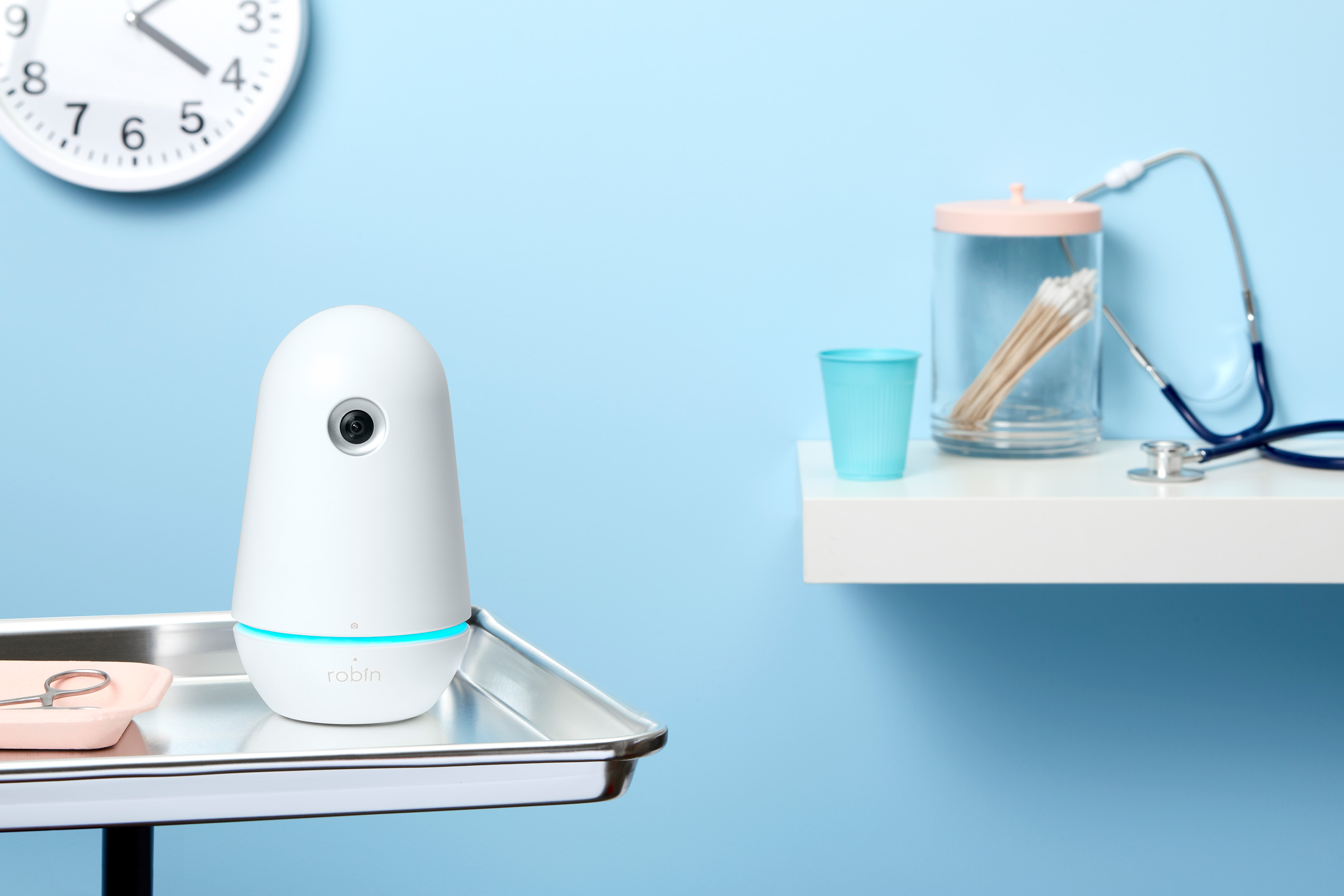
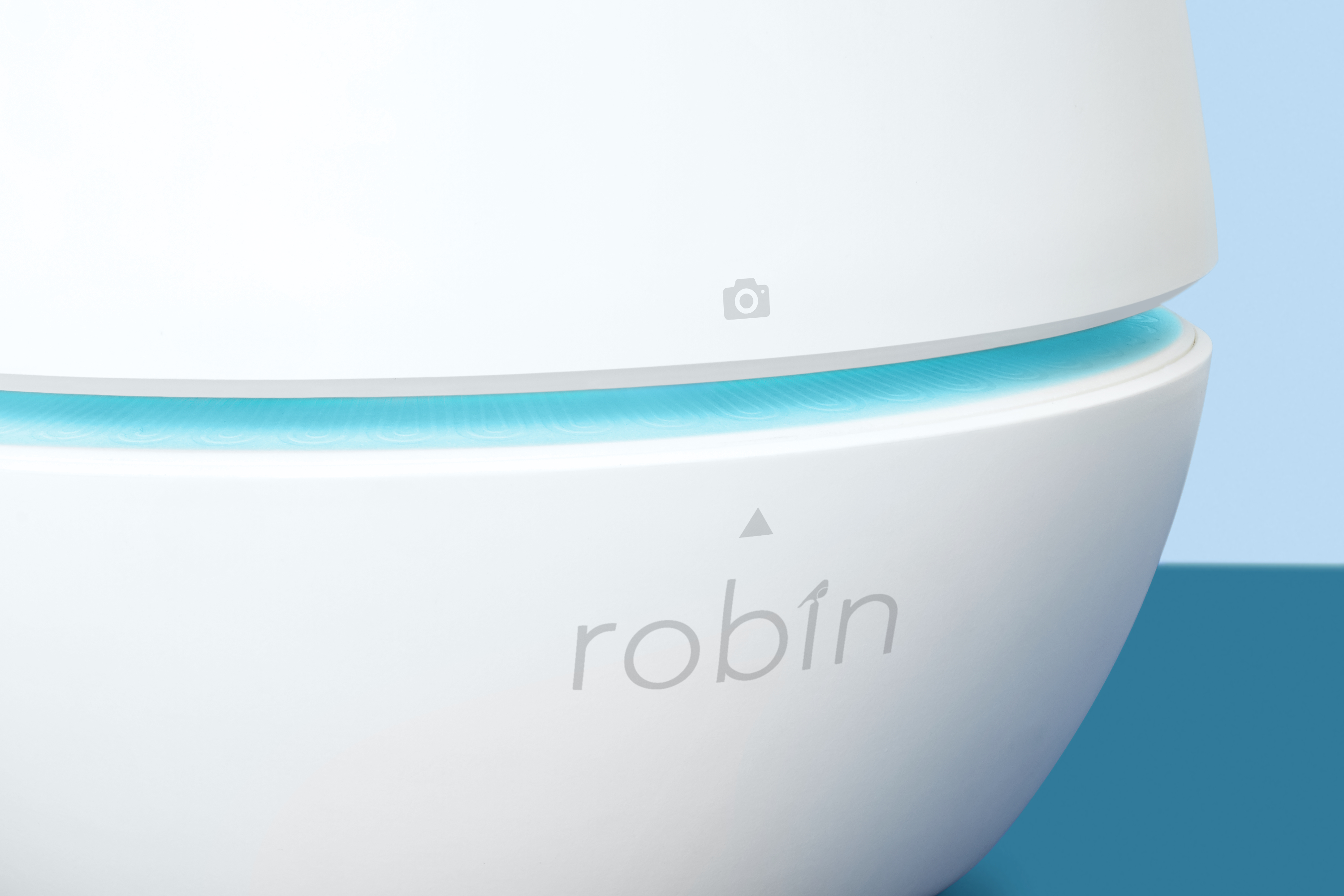
Robin’s industrial design partner, Hatch Duo, spent time in clinics before settling the object’s behavior. Medical staff wanted a physical lens cover patients could see. They wanted a clear signal for when the device was recording or muted. And they wanted it on a tabletop, not hovering from a wall. The final rotating sheath covered the camera without requiring fingers to touch the lens. A light band showed blue or red depending on recording state.
Those are small choices with large consequences. A patient deciding whether to allow a consultation to be captured should not have to trust a settings menu somewhere else in the building. Robin’s chief medical officer said in 2021 that 98% of patients agreed to audio and video capture. That was a company figure, but the design suggests Robin knew consent had to be understood at a glance.
The invisible staff behind the bird
Robin Assistant did more than transcribe speech. It took an encounter, assembled a clinical note, identified information relevant to billing and sent the result into the practice’s electronic record. The service began in orthopedics, where a single visit can leave a wake of charting and coding, before moving into other surgical specialties and primary care.
The phrase “AI scribe” can make the process sound instantaneous. Robin’s was a production line. Speech and video models processed the encounter; human scribes, coders and auditors reviewed the output. Galán said in an interview that work could be checked up to three times. That labor was part of the product, because a fluent but inaccurate note is not a harmless typo. A billing code affects reimbursement; an invented exam finding can affect the next clinician who reads the chart.
The last step proved stubborn. In a 2022 interview, Galán called EHR interoperability a “giant stinking mess.” Robin used everything from full integrations to CSV files, robotic automation and manual pushes. This is the part that rarely appears in a demo: a polished note is useful only if it lands in the right field of the right system before the physician needs to sign it.
“Part of why Robin exists is to avoid technology interrupting care.”Noah Auerhahn, co-founder
The price of a quiet room
Robin sold to medical practices and health systems, with physicians as daily users. Early named deployments included Campbell Clinic in Tennessee, Duke’s Private Diagnostic Clinic, UCSF Medical Center and Webster Orthopedics in Northern California. By late 2021, Galán said more than a thousand Robin Assistants were in use. The company reported that doctors saved roughly 90 minutes a day on manual capture. Both figures came from Robin and describe its service at that time.
The financial pitch had two sides. Less charting gave physicians time back; more complete coding could help practices receive payment for care they had provided. Robin’s medical leadership argued that physicians sometimes under-coded to avoid audit risk. Robin also said it would stand behind its work in an audit. There was no public menu price. Galán described a flat fee per visit, adopted during COVID when appointment volumes swung unpredictably. A variable charge followed the patient through the door; a fixed monthly bill would have followed the practice even when the room sat empty.
Investors saw room for scale. Norwest Venture Partners led an $11.5 million Series A in 2019. Scale Venture Partners led a $50 million Series B in December 2021, joined by Khosla Ventures and returning backers. A 2022 filing later disclosed $7 million in debt funding from Horizon Technology Finance. Capital could put devices in more rooms; it could not, by itself, make every EHR behave or remove the human cost of review.
What the sidekick taught
Robin sat in a crowded field with remote scribes, dictation tools and other ambient documentation companies such as Augmedix, Suki and DeepScribe. Its distinctive bet was the whole package: a physical device designed for the room, machine processing, human quality control and coding tied to the economics of a visit. It asked practices to change the workflow, not simply buy a transcription app.
That package also made the hard parts impossible to hide. A camera needed consent. A note needed verification. A code needed evidence. An EHR needed an integration, even if that meant an inelegant workaround. Each step was essential to the promise that the doctor could stay with the patient.
Later industry reporting describes Robin as having closed in 2023. The exact date and cause are not firmly documented. What remains useful is its practical lesson: start with the physician’s ordinary day, test the device in the actual room, make recording state obvious, price around the practice’s volume and budget for the people who check the machine’s work. That approach will struggle where patients decline recording, where integration is costly, or where review labor erases the time and money saved.
The little bird did not abolish medicine’s bureaucracy. For a while, it made the paperwork wait outside the conversation. That is a modest ambition only until you remember how many people have visited a doctor who seemed unable to look up.